Article History Submitted 17 June 2025. Accepted 16 Keywords fundamental rights law, judicial engagement, case complexity, constitutional law, Supreme Court of Norway |
Abstract Given that fundamental rights are protected by both constitutional and international human rights law, how do judges handle the resulting complexity? Despite scholarly debate about the multilayered, overlapping codification of fundamental rights, few studies have examined empirically how domestic judges engage with different sources of fundamental rights law when writing judicial opinions. We propose that when litigants invoke fundamental rights in national courts, judges engage differentially with fundamental rights laws to avoid unnecessary workload and to convince key audiences about the legal quality of their rulings. To test our arguments, we analyse how the Norwegian Supreme Court engages with litigants’ fundamental rights claims based on the Norwegian Constitution, the European Convention on Human Rights (ECHR) and United Nations (UN) human rights treaties from 2008 to 2023, before and after a 2014 constitutional amendment. Using a novel dataset of 221 fundamental rights decisions that measures levels of engagement with litigants’ claims, we find that judges engage more extensively with the ECHR than with UN conventions and the Constitution. This pattern is consistent across multiple types of rights and decisional settings and highlights the challenge of revitalizing constitutional jurisprudence in settings where an authoritative international court exercises supranational constitutional review. |
|---|
When applicants can claim fundamental rights based on constitutional, European and international human rights law, how do judges handle the resulting complexity? In the “age of rights” (Henkin 1990), claimants can use multiple laws to petition courts for redress of violations of their fundamental rights (FR), including several international human rights law (IHRL) treaties which partly overlap with constitutionally protected rights (Cope et al. 2019; Schaffer 2015). Since these multilayered sources of fundamental rights law lack an overarching ordering principle, they present national courts and judges with questions about legal hierarchy and the status of international law in the domestic context (Lustig and Weiler 2018; Versteeg 2019).
While the multilayered nature of the legal instruments protecting fundamental rights has long been recognized, there is little systematic empirical knowledge about how domestic judges use constitutional and international fundamental rights law. Legal scholarship suggests that the multilayering of rights protection grants judges greater discretion, compared to traditional doctrines (Wiklund 2008; Stone-Sweet 2012). While some hope that domestic courts will use the expanding normative toolkit to promote the global rule of law (Schwartz 2014), sceptics argue that courts reference transnational sources selectively or in ways skewed by institutional constraints, capacities or attitudes (cf. Müller and Kjos 2017; Krommendijk 2022). Using international law can help national judges shield their decisions from reactions by other institutions (Mayoral 2019), but their use of IHRL may also be moderated by concerns about political backlash (Lupu et al. 2019) or international critique (cf. Müller and Kjos 2017; Benvenisti 2008).
In this paper, we examine how justices on the Supreme Court of Norway (SCON) handle multilayered, overlapping sources of fundamental rights law. We argue that judges engage differentially with FR laws depending on the legal stock associated with each source and the risk of being overruled by international courts. The SCON provides a crucial case: After incorporating several IHRL treaties into national law (1999, 2003, 2009), parliament marked the Constitution’s 2014 bicentennial by granting key human rights constitutional rank “to strengthen the status of human rights in national law” (Menneskerettighetsutvalget 2011). To test our argument, we construct a novel dataset of SCON judgments involving FR law from 2008 to 2023 that measures how much attention judges devote to different FR sources when writing decisions. Our results demonstrate that when faced with legal arguments based on multiple FR sources, judges devote more attention to the European Convention on Human Rights (ECHR) than to either the Constitution or other IHRL treaties, which suggests that they find the ECHR more applicable and authoritative. Judges’ greater attention to the ECHR compared to the Constitution becomes more pronounced after the 2014 constitutional amendment, indicating that the reform made the ECHR even more central to SCON’s decision-making.
The paper makes both empirical and theoretical contributions to existing literature. First, by examining how SCON judges assess the relative importance of and interaction between constitutional and international fundamental rights law, we provide novel empirical knowledge about how domestic judges apply different fundamental rights laws. Where previous scholarship has tended to focus on judicial citations of IHRL treaties or binding decisions (Krommendijk 2022), we analyse judicial engagement with fundamental rights claims based on both IHRL and the Constitution. Second, whereas a growing literature examines how internationalization of law increases case complexity (Bentsen et al. 2021; Arnesen, Bentsen, and Grendstad 2018), our study adds insight into how judges handle case complexity through differential engagement. Third, few studies have examined how domestic judges, facing cross-pressures from domestic and international audiences, engage with legal sources when writing judicial opinions. By demonstrating that judicial attention to fundamental rights depends on the properties of the legal instruments upon which the claims are based (cf. Hartlapp and Hofmann 2021), we open new opportunities for theorizing how and why judges attend to fundamental rights arguments based on the arguments themselves.
The paper is structured as follows: In section 2, we introduce the phenomenon of complex layering of fundamental rights and theorize how domestic judges engage with fundamental rights arguments when crafting judicial opinions. In section 3, we present the multilayered protection of FR in Norway and describe the SCON’s decision-making process. In section 4, we present the data and the method. In section 5, we present our empirical results, before we conclude by discussing broader implications and issues for future research.
Judges today must handle more cases dealing with fundamental rights arguments and face legal arguments based on a diverse set of fundamental rights laws.3 National constitutions and international human rights treaties increasingly overlap in protecting an expanding set of fundamental rights. For example, the right to freedom of speech is protected in 90 per cent of all constitutions in the world (Cope et al. 2019), as well as the ICCPR and the ECHR. Additionally, certain fundamental rights protected by constitutional bills of rights and IHRL treaties, such as rights to non-discrimination and equal treatment, are also protected by EU law. Consequently, “[i]ndividuals have a choice of which source to plead, and judges have a choice of which right to enforce. These choices have consequences, as when national judges prefer to apply European rights, rather than their own constitutional law, as a means of raising standards of protection” (Stone-Sweet 2012).
This unordered layering of fundamental rights law presents judges with questions about legal hierarchy and authority (Pérez 2018). Certainly, both constitutional and international rights may reflect states’ legal commitments to rights and a “symbiotic relationship” whereby “treaty ratification can spur the adoption of new constitutional rights and vice versa” (Cope et al. 2019, 156). Moreover, international human rights instruments have had a coordinating effect on the contents of national constitutions (Elkins et al. 2013). However, national legal systems have become more likely to grant international law hierarchical superiority over domestic law (Verdier and Versteeg 2015), giving domestic judges the ability to review domestic law and administrative decisions based on international norms as a higher law (Lustig and Weiler 2018). At the same time, most legal systems grant constitutional law primacy over international law (Versteeg 2019), allowing domestic judges to voice opposition towards international law using the vocabulary of constitutional and national identity (Lustig and Weiler 2018; Kunz 2019). Thus, in contemporary constitutional democracies, fundamental rights law is characterised by de facto constitutional pluralism, where a variety of overlapping legal orders lack a coherent overarching ordering principle.
Adding to the complexity facing national judges, IHRL provides partly overlapping accountability mechanisms with varying authority. All state parties to the ECHR today accept the individual petition mechanism, while several IHRL treaties have optional protocols establishing complaints procedures that individuals can use to file complaints if a state party fails to meet its treaty obligations. However, these oversight mechanisms differ in terms of their judicial authority: A UN committee decision on a complaint is not legally enforceable on the state party. By contrast, ECtHR judgments are not only binding inter partes, i.e., the state addressed is obliged to comply, but also have res interpretata: authoritatively interpreting the Convention, Strasbourg judgments are generalisable beyond the case at hand (Krommendijk 2022). Additionally, whereas the ECtHR is an international court with legally competent judges appointed by state parties and issues comprehensively reasoned judgments, UN treaty body committees do not operate as courts, are composed of diplomats or other non-lawyer state delegates, lack oral hearings, and issue short, declaratory decisions (Krommendijk 2022, 178). As a result, the accountability apparatus may vary considerably across different fundamental rights within the same state.
Furthermore, even as international human rights law and constitutional bills of rights may be considered components of a multilayered fundamental rights law system, they also differ in terms of their methods of enforcement, legal sources and constitutional status. Certainly, the two are similar enough in terms of origin, content, and structure to be considered “two systems for protecting the same thing: namely, the fundamental rights of individuals” (Gardbaum 2008). Yet whereas constitutional law typically occupies a supreme and entrenched position in the hierarchy of laws, any analogously constitutional status of IHRL is debatable. The ECHR, whose member states have incorporated the Convention into national legislation and recognise the compulsory jurisdiction of the ECtHR, has arguably advanced significantly along the path of developing federal supremacy, whereas the UN human rights system is less developed in this regard (Gardbaum 2008). However, there is also great variation among states in how judges are empowered to apply the rights protected by the multilayered fundamental rights system.
So how do judges handle the complex, multilayered, and partly overlapping protection of fundamental rights when they craft their opinions? When given the opportunity, which fundamental rights law sources do they use? Combining insights from the literature on case complexity and judicial rhetoric, we propose that when litigants claim fundamental rights in national courts, judges will engage differentially with different FR laws to avoid unnecessary workload and to convince key audiences of the legal quality of their rulings, within the institutional constraints set by the decision-making context of the court. For our purposes, “judicial engagement” concerns how judges pay attention to domestic and transnational FR legal sources (regardless of their expressed attitude to those sources) (cf. Saunders 2014, 80).
When judges decide cases, they rely on shared interpretative standards of judicial reasoning, often referred to as ‘the legal method’. In short, the legal method identifies what the authoritative sources of law are and how to use them to decide legal conflicts (e.g., Lindholm et al. 2025). Yet, the complexity of legal cases both enables and compels judges to decide which aspects are central and which are not. Legal cases always concern multiple issues and laws (Rice 2019; Schroeder and Lindholm 2023; Lindholm et al. 2025), and judges therefore have some opportunity to emphasise, tone down, or avoid certain issues and laws, and thereby to “signal important information about the kind of legal argument and the framing a court is advancing in a decision” (Arnold et al. 2023, 29; Rice 2017). Moreover, judges may also have different preferences over judicial reasoning as expressed in their choice of authoritative legal sources along two dimensions: extra-national versus national and extra-legislative versus legislative sources (Lindholm et al. 2025). In cases dealing with FR laws, judges signal information that is interpreted and acted upon by a wide range of political and legal audiences with different preferences regarding the interpretation of these laws.
While judges have some discretion to frame the essence of a case, using FR laws is time-consuming per se. For one thing, European legal integration means judges must “give legal meaning to a voluminous corpus of European case law” (Wiklund 2008, 179). The volume of cases heard in Strasbourg causes a “real challenge both for the European Court of Human Rights and for those applying the ECHR at the domestic level” (Bårdsen 2014, 1295). For instance, when SCON decides on issues related to the ECHR, the time it spends on oral arguments increases by ca. 45 minutes compared to other cases (Bentsen et al. 2021) and case-processing times increase by more than one day (Arnesen et al. 2018). Adding more fundamental rights laws to the picture, for instance through constitutional amendments, should further increase case complexity, both by adding more information that the court needs to process and by requiring judges to clarify difficult questions about the relationship between different FR laws (Aall 2018, 46-50). Therefore, citing FR laws and case law adds to judges’ workload, although the magnitude of this cost may depend on the case and legal context.
To handle the case complexity caused by the expanding number of FR laws and the differing resonance of these laws among various audiences, we expect judges to engage differentially with FR laws, particularly when they are confronted with multilayered and overlapping FR arguments. Differential engagement may be influenced by factors at various levels of analysis: case-specific factors such as the quality of litigants’ legal arguments; area of law-specific factors, including which type of right is being claimed; and factors that systematically vary across FR laws, such as how judges perceive the legitimacy of the legal source, its formal status within the hierarchy of laws, specific legal characteristics (e.g., the wording of rights; the amount and quality of case law), accountability mechanisms, and legislative signals through constitutional amendments. Our main argument centres on the institutional level of FR law, though we also consider factors from the other levels when we examine differential engagement within different types of overlapping rights in Section 5.
One factor possibly shaping how judges attend to FR law is their beliefs about the legitimacy and status of the legal sources upon which FR arguments rest. Discussing Scandinavian supreme courts’ reluctance towards international law, Wind (2016, 289) argues that citing case law from international courts is not only about constructing a persuasive and legitimate argument but also about “lending legitimacy to the cited court”. References, Wind suggests, “may thus mirror the reputation of the specific court cited and its judges.” Her analysis shows that Scandinavian supreme courts cite case law from the ECtHR and the ECJ but rarely other treaty bodies, such as UN committees. While judges may indeed view the legitimacy of various IHRL bodies differently, we contend that these differences may also reflect how judges perceive the authority of the respective treaty bodies—i.e., their enforcement mechanisms and case law.
As guardians of the domestic constitutional order, SC judges likely value having final authority and seek to avoid having their decisions reviewed by international tribunals. Yet, international tribunals vary in their authority to review domestic judicial decisions and their propensity to exercise it. From 1990 to 2024, the ECtHR decided 70 cases against Norway, finding violations of the ECHR in 47 cases. By contrast, in the same period the UN Human Rights Committee decided only 18 cases against Norway, finding violations of the ICCPR in only three of these.4 Because the ECHR has stronger accountability mechanisms and a larger body of relevant case law than UN conventions, we expect domestic judges to be more concerned about convincing the supervisory body (ECtHR) that they have carefully considered the international legal sources than they are when confronted with UN FR arguments. We therefore propose the following hypothesis:
Differential engagement (H1): When writing judicial opinions, judges engage more extensively with ECHR arguments than with ICCPR and CRC arguments.
A similar logic of selectivity may apply when judges engage with arguments based on FRs defined in the national Constitution. The Constitution crowns the national hierarchy of laws. Following interpretative legal doctrines such as lex superior, judges may give greater attention to fundamental rights embedded in constitutional law than to those defined by an IHRL treaty. Nadim (2017) finds that judges on SCON cite the Constitution more frequently than they cite the ECHR and UN IHRL treaties in expropriation and civil law cases decided in enlarged panels. We therefore expect judges to engage more deeply with constitutional arguments, compared to arguments based on UN conventions, whose legitimacy and accountability mechanisms are weaker. However, in comparison to ECHR arguments, the possibility of being overruled by the ECtHR may weigh more heavily than the lex superior status of the Constitution.
Previous qualitative legal scholarship suggests that the SCON often emphasises the ECHR more than the Constitution in cases where parties reference both. A qualitative analysis of freedom of expression cases decided by SCON from 2004 to 2011 found that the constitutional right defined in § 100 (amended in 2004) only plays a minor role compared to SCON’s engagement with the balancing of interests derived from ECtHR case law (Kierulf 2012; also see Aall 2018; Pedersen 2016).5 Similarly, an analysis of the SCON’s doctrinal method after the 2014 amendment noted that in a handful of cases, the SCON has only assessed whether there is a violation of the ECHR without mentioning parallel rights in the Constitution; more commonly, it has based its reasoning on the ECHR and the ECtHR’s method and case law, drawn its conclusions based on provisions of both the ECHR and the Constitution, yet abstained from discussing the Constitution independently or its relationship to the ECHR (Reiertsen 2019).
Thus, against this backdrop, we can expect that when litigants present ECHR arguments and leverage the ECtHR’s comparatively extensive and varied case law, they may prompt judges to engage more with ECHR arguments than with constitutional ones. We propose the following two hypotheses:
Differential engagement (H2): When writing judicial opinions, judges engage more with ECHR arguments than with arguments based on the Constitution.
Differential engagement (H3): When writing judicial opinions, judges engage more with constitutional arguments than with ICCPR and CRC arguments.
The Supreme Court of Norway (SCON) presents an excellent opportunity to explore how supreme court judges engage with litigants’ multilayered and overlapping fundamental rights arguments. The Norwegian Constitution of 1814 established the protection of several key civil rights. Norway ratified the ECHR in 1952 and accepted the jurisdiction of the ECtHR in 1964, which provided an additional layer of international human rights protection, as did the ratification of core UN human rights treaties in the 1970s and 1980s. In 1998, parliament adopted the Human Rights Act (entering into effect in 1999), which incorporated the ECHR as well as key UN human rights conventions into national law (Schaffer 2024), granting these IHRL instruments priority over other national laws (§3).6
Preparing for the bicentennial of the Constitution, Parliament in 2009 appointed an inquiry commission mandated to propose how “to strengthen the status of human rights in national law by giving key human rights constitutional rank” (Menneskerettighetsutvalget 2011). The resulting constitutional amendment, adopted by Parliament in 2014, included a new Chapter E entitled ‘Human Rights’ that codified a catalogue of fundamental rights corresponding to many of the rights protected by the ECHR and ICCPR, and also CRC (Table 1).7 In 2015, parliament also codified judicial review as it had evolved in jurisprudential practice.
While the 2014 amendment was hailed as a milestone that secured human rights at the highest level as part of the written constitution (Aall 2017), it left several questions about the legal status of fundamental rights unresolved. Traditionally, the rights granted by constitutional and statutory law in Norway were considered political declarations of intent backed by a broad cross-partisan majority, rather than as justiciable individual rights (Menneskerettighetsutvalget 2011, 42). The amendment strengthened judicial review, but provided little guidance on how courts were supposed to interpret the constitutional human rights provisions, for instance in situations where IHRL treaty bodies “have gone too far” or have not yet established a certain and unambiguous jurisprudence (Menneskerettighetsutvalget 2011, 90; Reiertsen 2019). Parliament also failed to enact a proposed constitutional provision regulating lawful interference into the rights enumerated in the new human rights chapter (Kierulf 2018, 245; Tverberg 2024).
Moreover, the amendment included an obligation for state authorities to secure human rights as codified in the Constitution and IHRL treaties binding on Norway (§92), but no regulation of the state’s liability for compensation or redress for human rights violations. The commission found that the requirement for an “effective remedy” provided by the ECHR (Article 13) and ICCPR (Article 2:3) sufficed; however, this choice rendered some constitutional rights—such as the rights of children, which lack overlapping protection in the ECHR or ICCPR—less justiciable than those corresponding to an ECHR or ICCPR right (Hagland 2019; Kjeljebakken 2022). In sum, the 2014 amendment left the SCON considerable discretion to bring order among the multiple sources of fundamental rights law.
| Table 1. Multilayered and partly overlapping protection of fundamental rights in Norway | |||||
|---|---|---|---|---|---|
| Protection | CCP category |
Const. 2014 | ECHR | CRC | ICCPR |
| Prohibition of capital punishment, Prohibition of torture, Prohibition of cruel treatment, Right to life, Prohibition of slavery | Physical integrity | §93* | Art. 2 Art. 3 |
Art. 6.1 | |
| Protection from unjustified restraint, Protection from false imprisonment | Legal procedural | §94* drawing on §99 pre 2014 | Art. 5 | Art. 9.1 | |
| Judicial independence, Right to public trial, Right to fair trial, Right to speedy trial | Legal procedural | §95* | Art. 6 | Art 14.1 | |
| Principle of no punishment without law, Presumption of innocence in trials | Legal procedural | §96** | Art .7 | Art. 9.1 | |
| Protection from ex post facto laws | Legal procedural | §97 | Art. 15 | ||
| General guarantee of equality | Equality, gender & minority | §98* | Art. 14 | Art. 26 | |
| Freedom of expression, Freedom of opinion/thought/conscience, Freedom of press, Right to public trial, Right to information | Civil and political | §100 | Art. 10 | Art. 19.2 | |
| Right to form political parties, Right to join trade unions, Freedom of assembly, Restriction on the armed forces | Civil and political | §101* | Art. 11 | Art. 22.1 | |
| Right to privacy, Regulation of evidence collection | Civil and political | §102* | Art. 8 | Art. 17.1 | |
| Rights of children, State support for children | Civil and political | §104* | CRC | ||
| Protection from expropriation | Economic | §105 | P1-1 | ||
| Freedom of movement, Restrictions on entry or exit | Civil and political | §106* | P4-1 | Art. 12.1 | |
| Protection of language use, Right to culture | Equality, gender & minority | §108** | Art. 27 | ||
| Rights of children, Access to higher education | Social | §109* | P1-2 | ||
| Right to work | Social | §110* | |||
| Protection of environment | Social | §112* | |||
| The authorities of State require a provision in law to encroach on the individual | Legal procedural | §113* | |||
| Note: Columns 1 and 2 categorize the FRs based on the Comparative Constitutions Project (CCP, https://comparativeconstitutionsproject.org/). Single and double asterisks respectively mark § added (*) or changed (**) by the 2014 constitutional amendment. The right to freedom of religion, as protected by ECHR Art. 9, is not included in Chapter E, but protected by § 16 of the Constitution. | |||||
The effects—anticipated and actual—of the 2014 amendment have been debated both before and after the reform. The reform was said to “bring rights back home”: The Constitution’s rights protection would now take pride of place, rather than being overshadowed by the ECHR (Tobiassen 2024). Yet some feared that constitutionalising human rights would weaken overall human rights protection in Norway, if it would place IHRL conventions in the background (Menneskerettighetsutvalget 2011, 86). Some have suggested that the reform led to the desired strengthening of constitutional rights protection, as evidenced by the SCON’s more frequent references to the Constitution after the reform (Kierulf 2018, 247). Others observe that while the SCON frequently cites both the Constitution and the ECHR (and other IHRL instruments), it tends to resolve cases primarily on the basis of ECtHR case law and is reluctant to use its discretion to develop constitutional rights protection beyond that of the ECHR (Reiertsen 2019; Tobiassen 2024; Tverberg 2024).
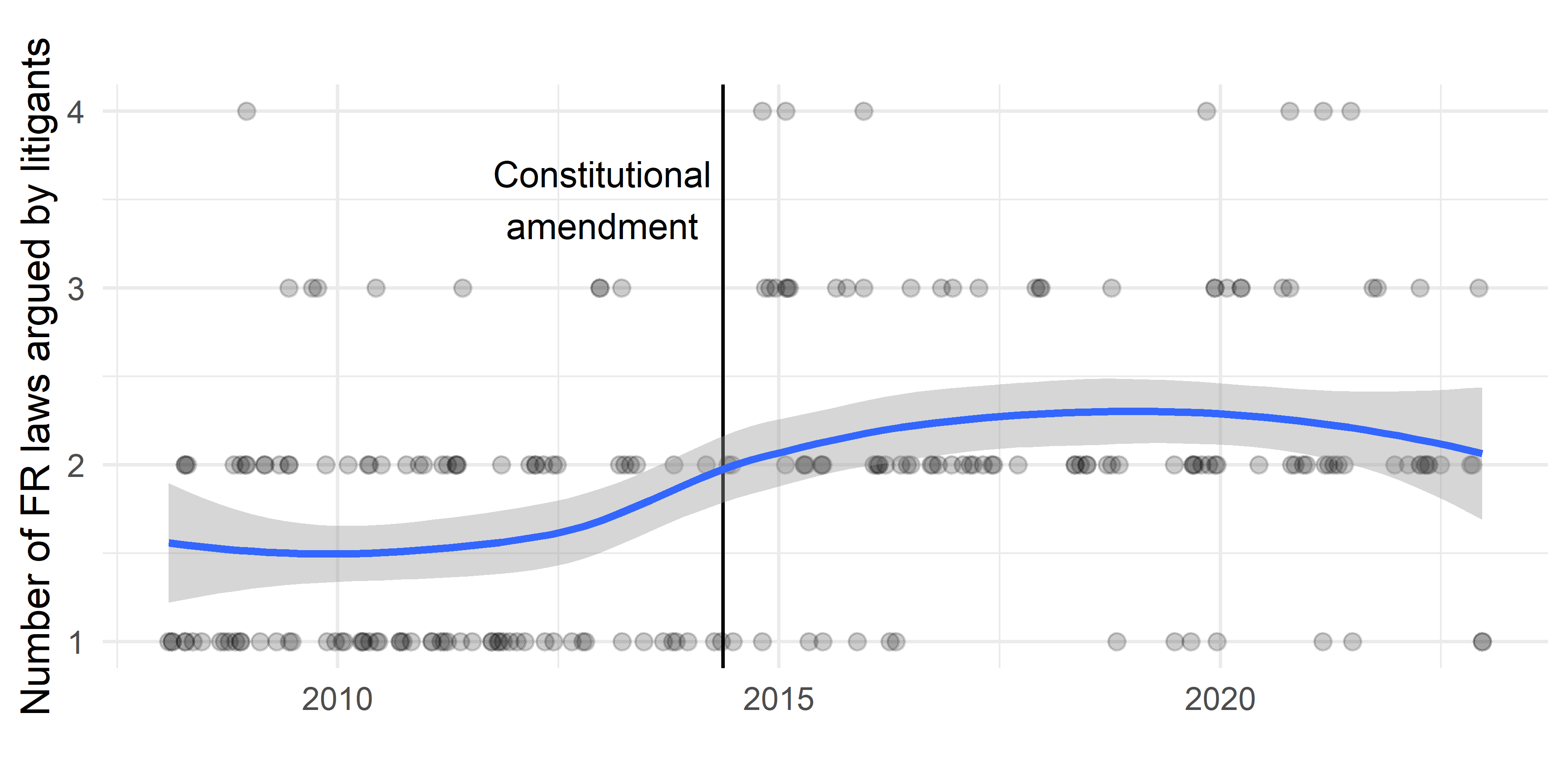
Figure 1 plots the number of distinct FR laws (ECHR, the Constitution, CRC, ICCPR) cited or mentioned in cases before the SCON. The trendline shows the smoothed average number of FR laws and the confidence intervals. It shows that litigants increasingly make multilayered and overlapping FR law arguments in the period we study, and particularly after the constitutional amendment in 2014.
Figure 1. Number of unique FR laws argued by litigants on SCON 2008–2023. N = 221.
While the multilayered codification of fundamental rights provides opportunities for litigants and some discretion for judges, the legal and institutional context of the court also structures how judges engage with the claims litigants bring. Established by the 1814 Constitution, the SCON sits atop a three-level court hierarchy and has competence in all civil, criminal, administrative, and constitutional issues (Sunde 2017). The SCON was originally a reactive court of appeal which also produced precedents, but successive partial docket reforms have refined its proactive, precedential function, and the SCON gained full and formal discretionary docket control in 2008 (Ghavanini et al. 2023)—the starting year of our period of study. Case selection takes place in the Appeals Selection Committee (ASC). SCON judges might differentially engage with FR laws at the case selection stage, for instance if they are more likely to grant leave to appeal in cases that concern ECHR issues compared to cases concerning UN conventions. Thus, it is possible that we fail to observe differential engagement at the merits stage because it already took place at the case selection stage.
Although SCON judges’ engagement with the laws is driven by the parties’ claims, the formal rules and legal principles guiding their opinion writing grant them bounded discretion to engage with litigants’ FR arguments (Qvigstad and Schei 2018; Falkanger 2015; see also Noer 2023; Andenæs and Meyer 2024).8 Judges should aim to discuss all elements that influence the outcome of the case; they should dismiss marginal and peripheral elements, but must sometimes explain why (Qvigstad and Schei 2018).
Confined by these rules and principles, the roles judges take in writing judicial opinions may allow their individual characteristics to shape engagement with FR claims. When the Court constructs the written opinion, the key roles are the (assigned) majority-opinion writer, the presiding justice, and any dissenting-opinion writers. Both the majority-opinion writer and the presiding justice roles are determined by panel composition. The Chief Justice or, in their absence, the most senior justice, serves as presiding justice. The presiding justice presents their views on the facts of the case and the relevant statutes and therefore informs both the content and decision of the Court (Grendstad et al. 2020). Consequently, the writing of the opinion is largely a teamwork between the presiding justice and the majority-opinion writer (Bårdsen 2018). Still, the majority-opinion writer’s personal writing style and preferences for different legal materials may influence how much emphasis they place on FR law arguments. The majority opinion is written by the justice on the panel (excluding the presiding justice) who least recently wrote an opinion—unless they find themselves in the minority, in which case the next justice in the queue writes the majority opinion (Grendstad et al. 2015).
Furthermore, the decision to assign a case to an enlarged panel may incentivize judges to engage more with FR laws. While the SCON decides the vast majority of cases in five-judge panels (‘avdeling’), it decides appeals that are of “special importance” or concern an “extraordinary case” in enlarged panels.9 The Chief Justice assigns cases to enlarged panels when they expect the outcome to deviate from precedent and/or address a conflict between, on the one hand, statutes, provisional ordinances or parliamentary decisions and, on the other hand, the Constitution or international treaties to which Norway is a party. In practice, cases where the Court reviews the constitutionality of laws are decided in plenary (Sunde 2015, 217). In effect, assigning a case to an enlarged panel is an instruction to judges to engage particularly with FR laws.
Finally, judges may have the opportunity to engage with FR laws in different types of cases. The SCON classifies any case it decides as a decision (‘dom’) or an order (‘kjennelse’ or ‘orskurd’), or both. A decision concerns the merits of the case and an order concerns the form of procedure (Grendstad et al. 2020, 66). Since the ECHR has historically been a central legal source in (chiefly criminal) procedural law in Norway (Wiklund 2008, 208), judges may be likely to engage with it in procedural orders and not only in decisions on the merits.10
To examine how judges on SCON engage with FR law arguments when writing judicial opinions, we created a novel dataset consisting of written decisions and metadata that keep track of legal references in SCON decisions. We gathered textual, meta and citation data by downloading all FR law cases decided by SCON from 2008 to 2023 from the legal database Lovdata. Focusing on this period allows us to analyse how judges engage with FR law before and after the 2014 constitutional amendment that expanded litigants’ opportunities to make FR law arguments based on multiple FR laws. Based on Lovdata’s issue area classification,11 we selected all 233 cases from the ‘Human Rights law’ and ‘The Constitution’ categories decided by SCON in five-judge panels and enlarged panels (grand chamber and en banc). We dropped twelve cases from the dataset.12 In the main analysis, we are left with 221 cases.
Using metadata associated with each case, we coded the type of decision (Decision or Order), type of panel (Five-judge panel, Grand chamber or Plenary), type of law (Civil or Criminal law) and whether the case was decided unanimously or with dissenting opinions (Consensus, Dissents). Of the 221 cases, 194 were decided in five-judge panels, 15 were decided in grand chamber and 12 were decided in plenary; 51 cases were orders, 170 were decisions,13 109 were criminal law cases, 112 were civil law cases, 173 cases were decided unanimously, and 48 cases were decided with dissenting opinions.
The 221 cases include citations to FR laws, but how central FR laws are in the case varies. One way to assess the importance of FR laws in the case is to examine whether judges cite or mention them in the first paragraph of the case, which states the main legal question (Bårdsen 2018). There are 70 cases in the material that cite or mention FR laws when presenting the main question of the case. Out of these 70 cases, 63 cite or mention the ECHR, 22 the Constitution, four the CRC and 12 the ICCPR. Several cases cite or mention more than one FR law, with ECHR and the Constitution being the most common combination (16 cases). While we expect that FR laws are particularly relevant in these 70 cases, this measure is endogenous to the case itself and the crafting of the main question is subject to judges’ discretion (Bårdsen 2018).
To assess how judges engage with FR law arguments—i.e., how much attention judges devote to FR laws when writing their decisions—we created a variable that measures the percentage of paragraphs in the decision that cite or mention different FR laws. This measure does not identify whether FR laws are decisive for the outcome in the case. We created the measure in three steps:
We classified each paragraph of text as belonging to mutually exclusive parts of the decision: introduction (main question, case history and the parties’ claims), judicial opinion (majority opinion and dissenting opinions) and judgment, based on text patterns and manual coding.
We classified each paragraph of text as either belonging to a FR law (ECHR, Constitution, ICCPR, CRC) or not. We coded paragraphs according to a multi-membership principle: when a paragraph cites multiple FR laws (e.g., the ECHR and the Constitution), the paragraph belongs to each FR law. We classified paragraphs based on law citations embedded in the decision as hypertext and a word dictionary that captures citations or mentions that are not embedded as hypertext.
We counted the number of paragraphs in judicial opinions (excluding the introductory parts of the decision and the paragraph that arrives at the judgement) that cite or mention FR laws and divided by the total number of paragraphs in judicial opinions (again, excluding the introductory parts of the decision and the paragraph that arrives at the judgement) and then multiplied this by 100, to arrive at a standardised measure of engagement across cases that vary in length.
Citations to FR laws offer an attractive proxy for judicial engagement with FR laws because SCON regularly and formally cites legal sources throughout its decisions and because citations are embedded in the decision as hypertext. Therefore, the number of citations to a legal source in judicial opinions is a valuable indication of judges’ level of engagement and is also straightforward to measure. However, legal citations do not capture instances where a judge engages with FR laws without formally citing them, e.g. when judges discuss the EHCR/ECtHR or the CRC/UN Committee on the Rights of the Child without explicitly referencing a law or case law, or explicit citations that are not embedded as hypertext. Therefore, our main approach is to use citation data in combination with a word dictionary that picks up citations that are not embedded in hypertext to count the number of paragraphs of text in a decision that cite or mention different FR laws. However, it remains possible that our approach fails to capture some paragraphs of text that discuss FR laws in more subtle terms.
Paragraphs of text are a useful unit of measurement because they are formal textual units that are focused on a question relevant to the case at hand. The importance of paragraphs as textual units in the SCON’s decisions is highlighted by the fact that they are enumerated, cited in other decisions, and communicated in the SCON’s own press releases indicating the most important paragraphs (‘Nøkkelasvnitt’).14 Counting the number of paragraphs in a decision that cite or mention an FR law reduces the risk that our measure of engagement captures FR laws that are cited repeatedly in one paragraph but that are of little relevance in the decision otherwise. It is possible that we inflate engagement levels for overlapping FR laws, for instance, if judges every time they mention ECHR Article 8 also mention the Constitution § 102, but only really engage with the ECHR.
The unit of observation in our analysis is at the law-decision level, i.e., 403 FR law observations across the 221 cases. Decisions include both majority and minority opinions. In the main analysis we group majority and minority opinions together. However, it is possible that dissent cases distort our results, for instance if judges are more likely to dissent in cases concerning ECHR than other FR laws, which we could expect if judges see the institutional apparatus associated with ECHR as chance to signal to the ECtHR that the majority’s decision is incorrect. We account for dissenting cases by examining engagement in FR laws in both unanimous and non-unanimous cases in Figure A1 in the appendix. To test our hypotheses, we generate a set of descriptive estimates that show how judges engage with FR laws under different scenarios as described below. Because our data consist of few cases that are also heterogeneous in their characteristics, we test our hypotheses in the total sample yet also within subgroups of cases, i.e., area of law and different types of rights. To highlight the case variation, we plot the underlying data (i.e., each observation) along with boxplots that show the distribution of judicial engagement for each type of FR law.
We test H1–H3 about differential engagement across all cases and under multiple conditions that are theoretically relevant to how judges engage with FR laws. We first examine how central different FR laws are to judges’ reasoning under two different scenarios: 1) in cases where parties make claims based on multilayered FR laws and 2) in cases where parties make claims based on one FR law. This is an important distinction: it indicates whether judges’ differential engagement with FR laws is conditioned by having the choice between different FR laws in the same case or not. Our outcome variable in this analysis measures the percentage of paragraphs that cites or mentions the Constitution, the ECHR, the CRC or the ICCPR (Type of FR law). This variable counts both laws and case law for the ECHR and UN conventions but excludes constitutional caselaw since we cannot separate between constitutional caselaw and case law that deals with other issues.
Next, we examine differential engagement with the ECHR and the Norwegian Constitution before and after the constitutional amendment in 2014 to examine the extent to which this amendment generated a boost in engagement with the Constitution relative to the ECHR.
For a more focused test of H1, we then zoom in on those cases where the parties invoke partly overlapping FR laws. Based on the categorization of rights in Table 2 we identified those cases where parties invoked partly overlapping rights (e.g., the right to freedom of expression protected in ECHR Article 10 and the Constitution § 100). We created 12 variables that identify partly overlapping rights and named nine of them according to the ECHR label and three of them according to the Constitution/UN conventions.15 We then examine the proportion of paragraphs that cite or mention the different FR laws, within each category. This analysis therefore tests our hypotheses within a set of cases that share similar characteristics (similar types of rights and similar areas of laws). Finally, we explore how judges engage with the Constitution and the ECHR in the 16 cases where both are mentioned in the main question of the case. We also present additional analysis to complement the main results in the appendix.
We begin our empirical analysis by presenting how judges engage with different FR laws to examine H1–H3. In Figure 2, the upper part shows descriptive statistics for judges’ levels of engagement with the Constitution (CON), CRC, ICCPR and ECHR in cases where only one type of FR law is litigated (left panel) and in cases where multiple FR laws are litigated (right panel). The lower border of the box shows the 25th percentile, the black line inside the box shows the median (the 50th percentile), the upper border of the box shows the 75th percentile, the lines above and below show the 5th and 95th percentiles of the variable, and the outermost bullet points refer to values that are considered extreme values. The lower part of Figure 2 shows the average difference in levels of engagement between the different FR laws across all cases as estimated by a linear probability model. See Table A2 for the full results for the regression models, including a model where we control the difference in level of engagement for different FR laws for case complexity, type of decision, type of law, type of panel and dissent case. The results are nearly identical to the ones reported in Figure 2.
The results in Figure 2 show that judges engage more extensively with FR law arguments based on the ECHR than with FR law arguments based on the Constitution, CRC and ICCPR, yet also that they engage differently in cases where multiple FR laws are litigated compared to cases where only one type of FR is litigated. In cases where litigants invoke the ECHR together with other FR laws, the median level of engagement with the ECHR is 18 percent. In these cases, paragraphs that engage exclusively with ECtHR case law constitute a fair share of judges’ engagement with the ECHR. When we only count paragraphs that engage with specific ECHR articles or the Convention, the median level of engagement is 14 percent. When litigants invoke the Constitution, CRC and ICCPR together with other FR laws, the median percentage of paragraphs is 6, 5, and 4 per cent, respectively.
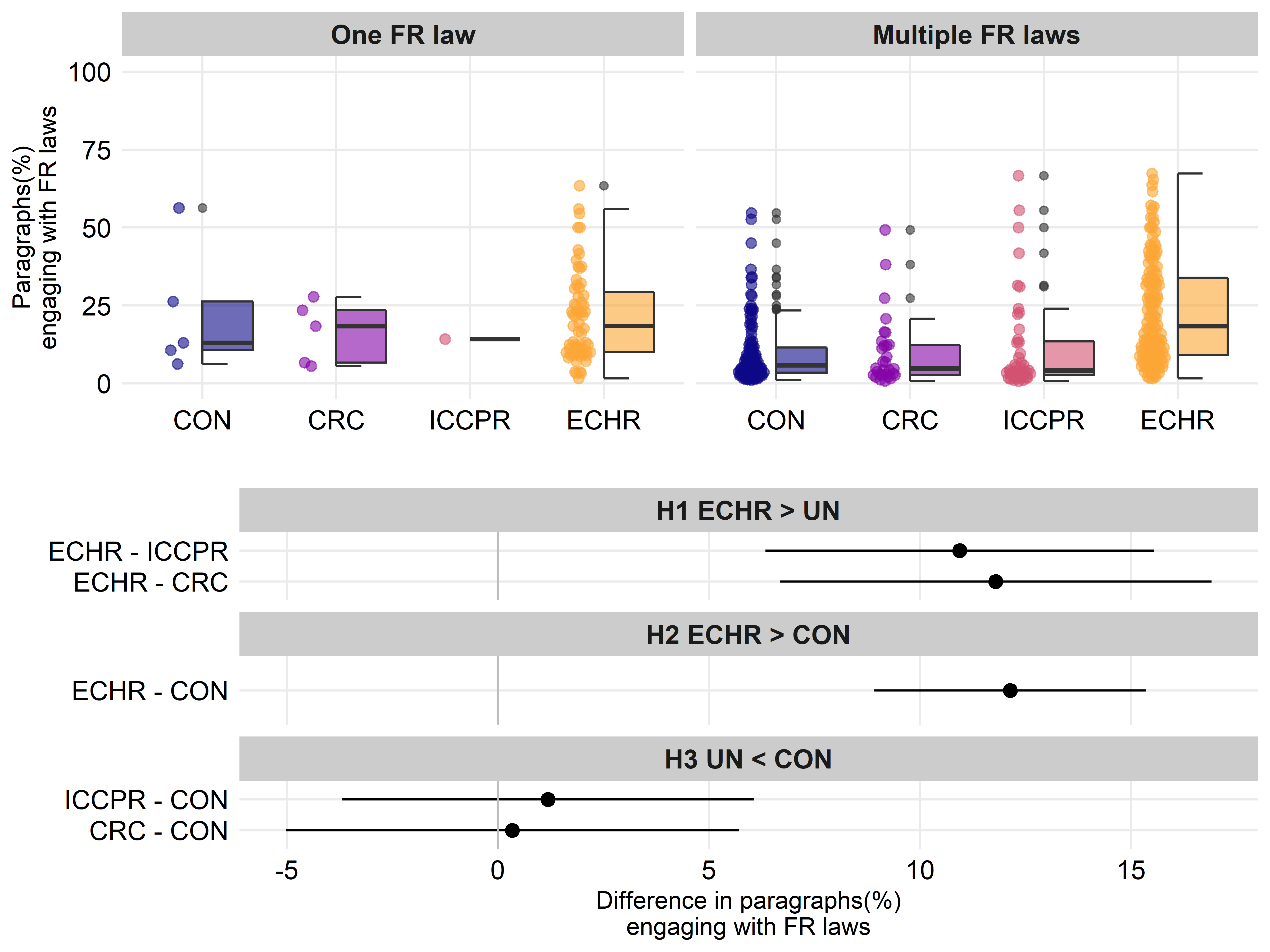
Figure 2. Differential engagement with multilayered FR laws in SCON. Abbreviations: CON = The Norwegian Constitution, CRC = Convention on the Rights of the Child, ICCPR = International Covenant on Civil and Political Rights, ECHR = European Convention on Human Rights.
The pairwise comparisons in the bottom part show that the overall average difference in levels of engagement is 11.8 percentage points between ECHR and CRC, 10.9 percentage points between ECHR and ICCPR, 12.1 percentage points between ECHR and the Constitution, and close to zero between the Constitution and UN conventions. Thus, these results are consistent with H1 and H2, and inconsistent with H3, and suggest that the legal stock and the accountability mechanisms associated with the ECHR do matter for how judges engage with FR law arguments.
The results in Figure 2 demonstrate that judges’ differential engagement with ECHR is driven by cases where litigants invoke multiple FR laws and judges have a choice between different FR laws. When litigants base their FR arguments on either the Constitution, the ECHR, or a UN convention, judges engage with the various FR laws at more equal levels. Yet as is also evident from the underlying data in Figure 2, litigants only rarely base their FR arguments on the Constitution, CRC or ICCPR alone. While the results highlight the Court’s engagement with the ECHR compared to UN conventions and the Constitution, the underlying data points show that there are several cases where judges engage extensively also with the Constitution and with UN conventions, and that there are cases where judges engage little with the ECHR.
Furthermore, the 2014 constitutional amendment seems not to have boosted the SCON’s engagement with the Constitution relative to IHRL. In Figure 3 we examine SCON’s level of engagement with the Constitution and the ECHR before and after the constitutional amendment in 2014. The trendline shows the smoothed average level of engagement and the confidence intervals. The results in Figure 3 demonstrate the opposite of a relative constitutional boost. While the lines indicating the average level of engagement with the Constitution and ECHR are close to each other before the amendment in 2014, they drift apart in favour of ECHR after the amendment. The higher concentration of blue dots with relatively low levels of engagement after the amendment indicates that the Court engages with the Constitution in more cases, but less extensively than it engages with the ECHR. Taken together with the results concerning cases with multiple FR laws in Figure 2, the results tell a clear story of how the constitutional amendment shaped judges’ engagement with different FR laws: After the constitutional amendment, FR law claims are more often based on both the Constitution and ECHR, and in these cases, the Court usually engages more with ECHR claims.
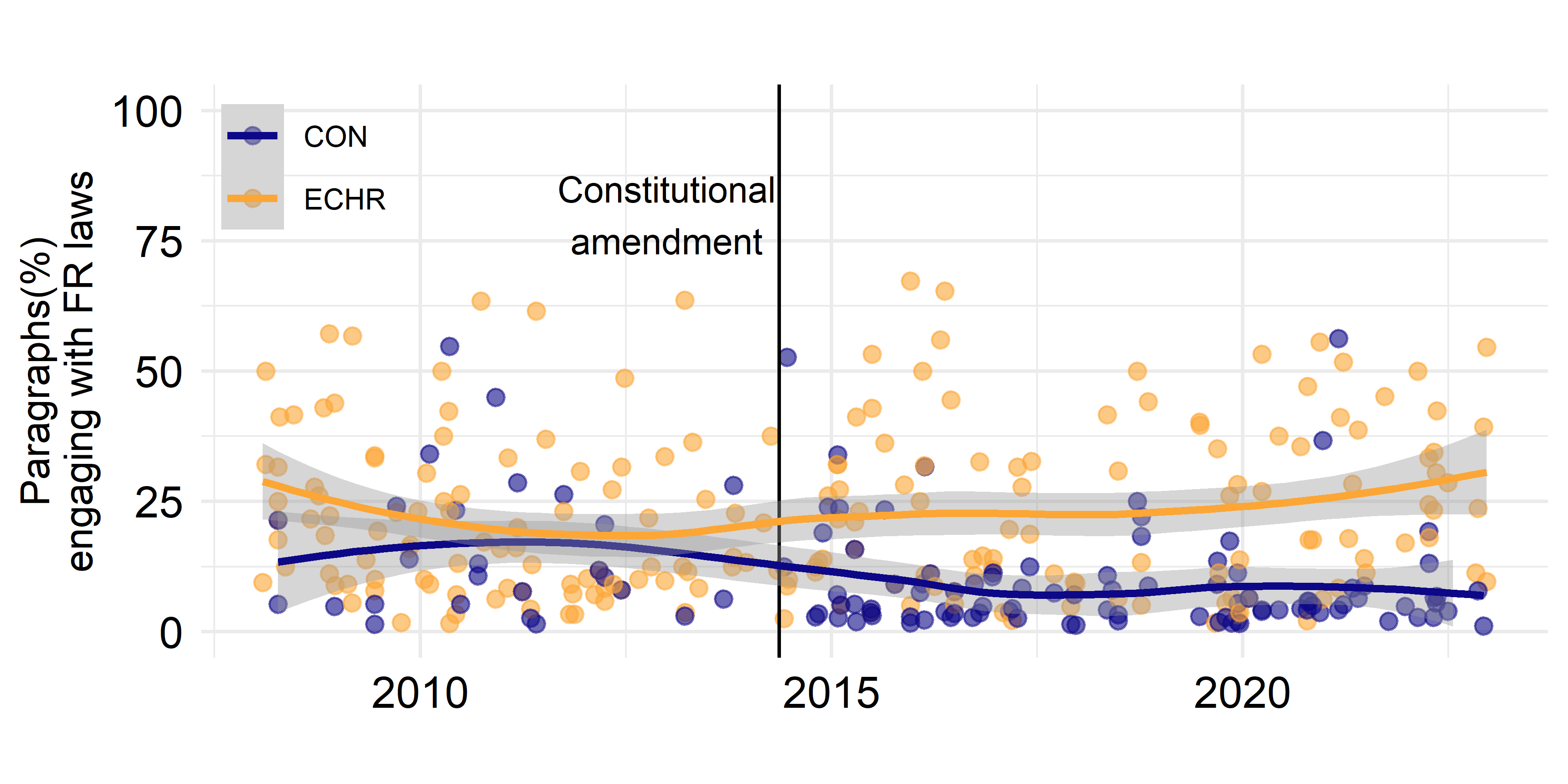
Figure 3. Engagement with the Norwegian Constitution and the ECHR before and after the constitutional amendment in 2014. Abbreviations: CON = The Norwegian Constitution, Covenant on Civil and Political Rights, ECHR = European Convention of Human Rights.
So far, our analysis groups together a wide variety of rights and areas of law, potentially masking important differences in engagement. In Figure A2 in the appendix we show descriptive statistics for judges’ engagement with FR laws in different types of panels, types of law and types of decisions. These results largely confirm the dominance of ECHR vis-à-vis the Constitution and UN conventions. However, we also find that in the twelve cases where the Court convenes in plenary to decide on the most significant legal questions, the median level of engagement is highest for the Constitution. In cases decided in grand chamber, the median level of engagement is highest for ECHR and ICCPR claims.
In Figure 4, we compare judges’ differential engagement in cases where litigants invoke partly overlapping FR laws. Each panel shows descriptive statistics for the respective rights (e.g., Freedom of Expression, Right to Privacy). Litigants can invoke multiple overlapping rights in the same case. We examine cases citing both private property and the Constitutional ban on ex post facto laws together, as they have a common conceptual core and their field of action cannot be separated (Grendstad et al. 2015, 166–67, with references to Knoph, 1939 and Andenæs and Fliflet, 2006).
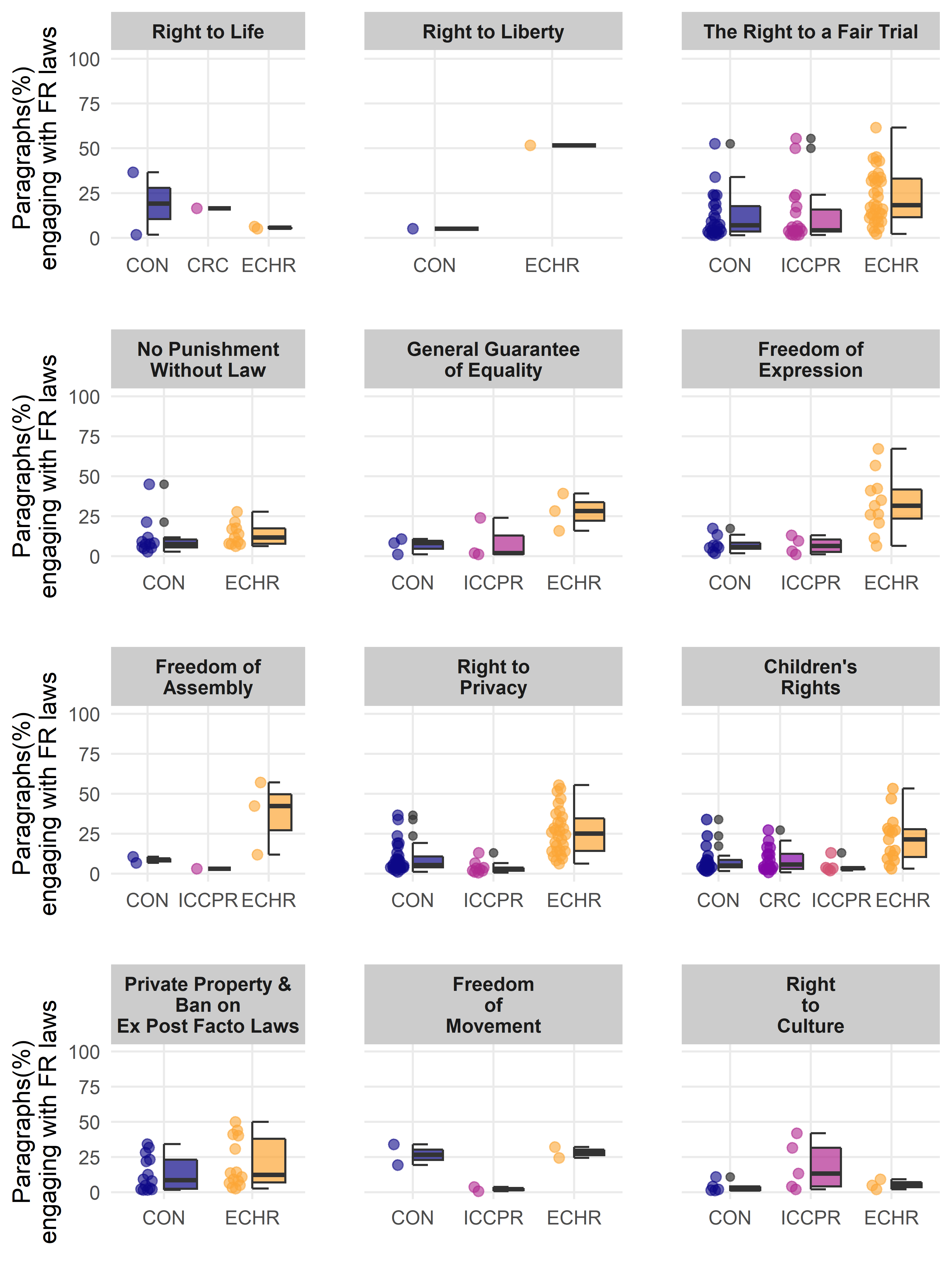
Figure 4. Differential engagement with overlapping FR laws in SCON. Abbreviations: CON = The Norwegian Constitution, CRC = Convention on the Rights of the Child, ICCPR = International Covenant on Civil and Political Rights, ECHR = European Convention of Human Rights.
The results in Figure 4 largely confirm the differential engagement in favour of the ECHR, with some interesting departures. Results for the Right to Freedom of Expression (protected by the Constitution §100, ECHR Article 10 and ICCPR Article 19) and the Right to Private Property and Ban on Ex Post Facto Laws (protected by the Constitution §105 and ECHR Protocol 1 Article 1; Constitution §97) show that judges engage more with ECHR even when the parallel constitutional rights have been established long before the ECHR.16 The Constitutional protection of Freedom of Expression was amended in 2004, yet in all cases where this section of the Constitution is ligated together with the ECHR, judges engage more with the latter. We find similar differential engagement for the Right to a Fair Trail, No Punishment Without Law, General Guarantee of Equality, Freedom of Assembly, Right to Privacy, and Children’s rights. Notably, judges’ differential engagement with the ECHR relative to the Constitution is pronounced in cases concerning the right to privacy, the right to a fair trial, and freedom of expression—i.e., those rights that have most frequently been the subject when the ECtHR has found against Norway.
One departure from the pattern is the right to culture, where SCON judges engage more with the ICCPR than with either the Constitution or the ECHR (Figure 4, bottom right). The ECHR has no provisions on minorities’ right to culture and only references minorities in Article 14 on rights against discrimination. However, the ICCPR Article 27 protects the rights of members of an ethnic, religious, or linguistic minority to enjoy their own culture and the UN Human Rights Committee promulgates standard-setting interpretations. Thus, in cases on minorities’ rights to culture, both litigants and the SCON seem to find the ICCPR—as interpreted through the HRC’s statements—both legitimate and authoritative, and engage with it accordingly.17
Cases that emphasize both the Constitution and the ECHR further highlight how the 2014 constitutional amendment has shaped judges’ differential engagement in favour of the ECHR. Figure 5 shows the level of engagement in the 16 cases that mention both the Constitution and ECHR in the main legal question of the case, five of which were decided before the amendment in 2014 and eleven after. In the five pre-amendment cases, SCON’s level of engagement with the Constitution was higher or equal to the ECHR. Three of these cases were decided in enlarged panels. The biggest difference in engagement in favour of the Constitution is the Ship Owner Taxation case (Rt-2010-143), decided in plenary, in which a majority of six justices voted for the ship owners’ claim that the ex post facto taxes violated § 97 of the Constitution. In the Voldstad case (Rt-2013-1345), a majority of nine judges found that an amendment to a regulation that introduced a time limit to fishing quotas did not violate § 97 on ex post facto laws. In this case, too, the SCON used the Constitution more extensively than the ECHR.
In the eleven post-amendment cases that mention both the Constitution and the ECHR in the main question, all were decided in five-judge panels. The court engages more with the ECHR than the Constitution in seven of these cases, which concern the right to a fair trial, presumption of innocence, the right to privacy and children’s rights, the right to privacy, freedom of expression, and freedom of assembly. In three cases, the Court engages more extensively with the Constitution. Two concern the ban on ex post facto laws and property rights and one concern the right to a fair trial. One case engages equally with the Constitution and ECHR. In sum, these cases underscore the importance of the constitutional amendment in shaping judges’ differential engagement in favour of the ECHR. These cases also highlight the prevalence of the Constitution vis-à-vis the ECHR in cases where judges consider the ban on ex post facto laws and/or the protection of private property, when these constitute the main question of the case.
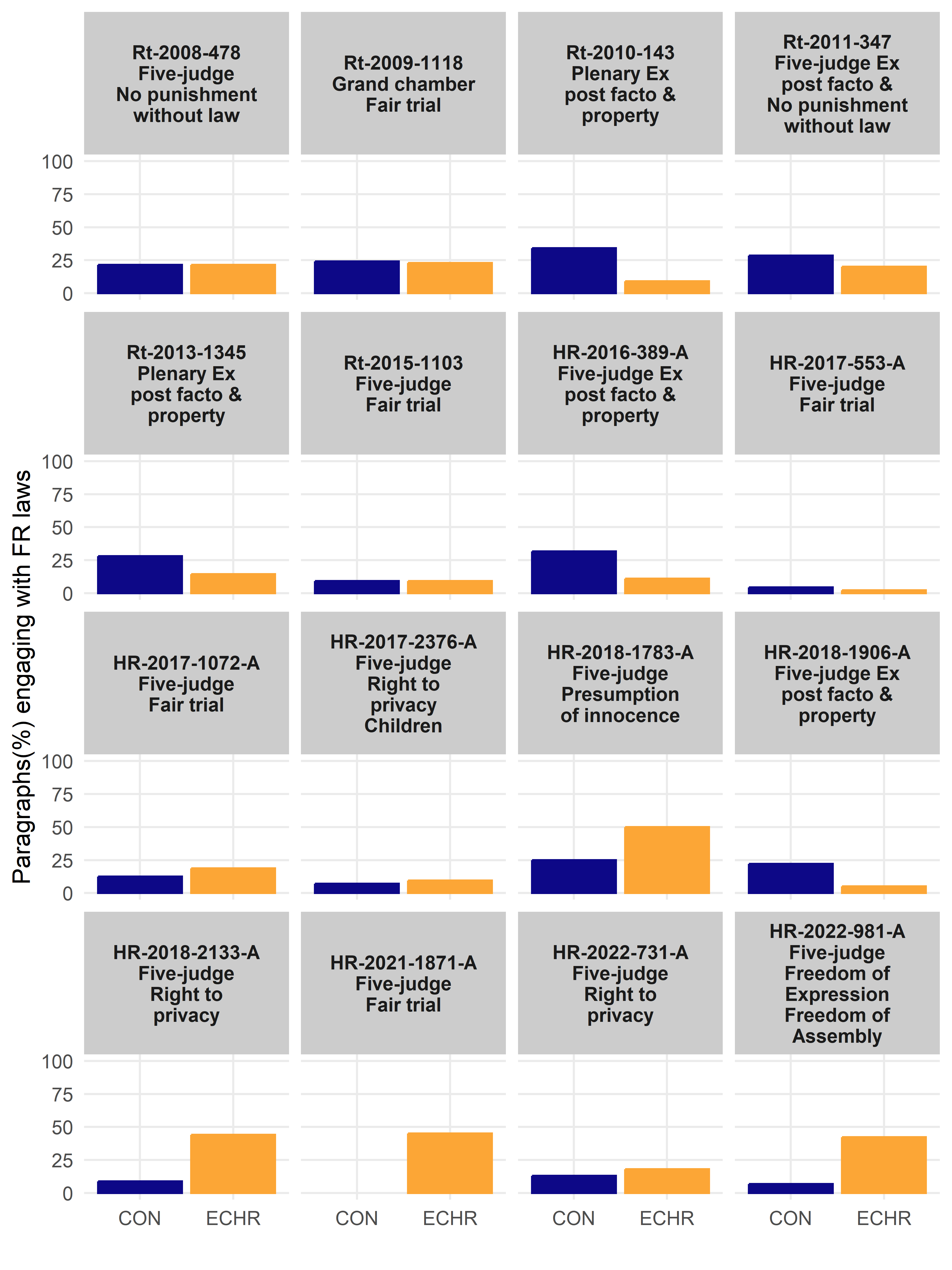
Figure 5. Engagement with the Constitution and ECHR in cases where both are mentioned in the main question of the case.
Given that constitutional law and international human rights law today provide partly overlapping codification of fundamental rights, how do supreme court judges engage with the fundamental rights claims litigants bring? In this paper, drawing on theories on how judges handle case complexity and how judicial rhetoric serves to persuade relevant audiences, we hypothesized that how judges engage with FR law claims depends on the status of the FR law on which such claims are based. To test this argument, we analysed how much the Supreme Court of Norway (SCON) engages with fundamental rights entrenched in the Norwegian Constitution and in IHRL treaties that Norway has incorporated into national legislation. Employing a new dataset of 221 SCON decisions in from 2008 to 2023 allowed us to assess how a 2014 constitutional amendment—intended to “bring rights back home” by codifying a new human rights chapter modelled chiefly on the ECHR—has altered judicial engagement with fundamental rights.
Our theoretical argument builds on the observation that, compared to other IHRL treaties that Norway has incorporated into national law, the ECHR enjoys greater legitimacy and has more authority. Consequently, SCON judges would likely be more concerned about persuading the ECtHR (and audiences that similarly place higher trust in the ECtHR) that they have carefully considered its articles and case law, compared to other IHRL treaty bodies (H1). Moreover, since the SCON’s constitutional interpretation does not entail similar risks of supranational override, we expected judges to engage more with FR arguments based on the ECHR than with arguments based on the Constitution (H2), and to engage more with FR arguments based on the Constitution than with arguments based on UN IHRL treaties (H3).
Overall, our results suggest that the legal stock and authority of the ECtHR do matter for how judges attend to claimants’ FR arguments. When litigants invoke the ECHR, ca. 18 per cent of the paragraphs engage with the ECHR, compared to 4–6 per cent for UN conventions and the Constitution. Thus, whereas we find support for H1 and H2, we do not find support for H3. This pattern of differential engagement in favour of using the ECHR more than the Norwegian Constitution increases after the 2014 amendment. While the number of cases citing the Norwegian Constitution increased after the amendment, judges engaged even more with the ECHR than the Constitution than before the amendment. We also find that differential engagement in favour of ECHR is fairly consistent across multiple types of rights and decisional settings. Our results therefore suggest that when litigants invoke multiple sources for their FR claims, judges prioritize FR laws that are associated with more relevant case law and more authoritative accountability mechanisms.
Our findings have important implications for understanding how judges engage with multilayered and overlapping fundamental rights laws in contemporary Europe and beyond. Contrary to claims that judicial review has entered a third wave, in which courts are “re-asserting the primacy of the constitution over international law” and judicial discourse “emphasizes national identity” (Versteeg 2019, 10; Lustig and Weiler 2018), our findings from Norway demonstrate the inverse pattern: The constitutional amendment, which was framed as a reform to “bring rights back home”, rather underscored how the national protection of fundamental rights takes place in an institutional setting where an authoritative European court exercises a form of supranational constitutional review. Our results corroborate observations by legal commentators that the Supreme Court of Norway has not yet used the amendment to strengthen constitutional rights protection vis-à-vis IHRL (Tverberg 2024). Some commentators even suggest the SCON has made choices that increase the probability that the Constitution will be less relevant in the future, for instance by its reluctance to close the remedies gap (Jøsendal 2025; Nordhus 2019; Tobiassen 2024).
One reason why judges on the SCON engage more with the ECHR than other FR laws could be related to workload and case complexity. We find that judges’ differential engagement is more pronounced in cases referencing multiple FR laws rather than just one FR law. While there are very few cases with only one FR law, this finding is consistent with the notion that differential engagement is a way to handle case complexity. Another possible reason the SCON engages more extensively with the ECHR than the Constitution is that the former provides more legal resources that both enable and necessitate greater engagement. The 2014 amendment did not incorporate IHRL into the Constitution but created a new catalogue of rights modelled chiefly on the ECHR. The ECtHR has developed a rich case law on how to interpret and apply fundamental rights in jurisdictions similar to Norway. The easiest way to establish what the overlapping rights require, in a way likely to hold up in Strasbourg, is for SCON judges to engage with the ECHR and its caselaw. Also, the principle of subsidiarity and the ECtHR’s massive caseload imply that domestic courts should write FR opinions in ways that minimise the risk of unnecessary supranational appeals (e.g., Aall 2018, 104). Our descriptive research, however, is only suggestive of these possible explanations for differential engagement.
The limitations of our analysis suggest several issues for future research on how national courts handle the complex, multilayered nature of contemporary fundamental rights law. First, our quantitative measure of engagement shows how much judges at the SCON use different FR laws and thereby how central these laws are to their written opinions. However, our analysis does not say anything about how different levels of engagement are associated with important outcomes, such as case outcomes, workload, compliance, development of legal doctrine, and consequences for the principle of subsidiarity. While we have demonstrated how judicial engagement varies across FR laws, future research could use the as-if-random case assignment to assess how panel composition influences the level of engagement with FR laws (Bentsen et al. 2025).
Second, our analysis raises questions about whether judges engage differently with FR laws and case law depending on the case outcome. We found that differential engagement in favour of the ECHR is pronounced in cases that involve rights that have most frequently been the subject when the ECtHR has found against Norway. Future research should investigate whether judges follow a supportive or competitive justification logic (e.g., Arnold et al. 2023)—i.e. whether they engage more with FR laws when they find in favour of a rights claimant, compared to when they find against the rights claimant. In cases where judges dismiss rights claims and run the risk of international override, they want to ensure their decisions are robust against potential international review by showing that the SCON has considered and (correctly) understood relevant international rules and has made the assessments and balancing tests that the rules require (Bårdsen 2018, 98).
Third, our analysis only compares how judges engage with IHRL relative to the Constitution. However, in concrete cases, FR laws always engage with nationally produced legal material, such as statutory law and travaux préparatoires, and judges may convincingly argue that the case should be decided by more specific and concrete lower-level national law rather than by abstract and vague FR law (Noer 2023). Future analyses should investigate how FR laws relate to ordinary national laws, and the extent to which judges base their decisions in favour of the rights claimant in ordinary national laws or the FR laws.
Fourth, our results prompt questions about how private litigants exploit changes in the protection of fundamental rights. Entrenching human rights in the Constitution sends a powerful message that national policymakers are committed to human rights norms but does not in itself make the rights justiciable. To the extent that rights grounded in the ECHR and ICCPR—compared to constitutional rights—provide better legal remedies (access to court and rights to compensation or redress in case of violations), litigants are likely to find them more useful. Future research may look at how litigants selectively mobilise FR claims supported by relevant IHRL and comparative case law to achieve their aims.
Obviously, given the unique characteristics of Norway’s Constitution and Supreme Court, our findings do not necessarily generalise to other European high courts that similarly need to handle the complexity arising from the multilayered system of fundamental rights law. At a time when the ECtHR faces political resistance in many European countries (Madsen 2020), the ECHR system’s legitimacy and functioning require domestic courts to apply the Convention faithfully. Future research should explore differential engagement with FR laws in countries where the domestic status of IHRL is more contested. For instance, the UK and Denmark are countries where ECtHR has met stronger pushback and where we might expect judges to prioritise differently among overlapping FR law sources.
This research was supported by the Swedish Research Council, grants no. 2017-02877 and 2019-03111.
For comments on earlier drafts, we thank Silje Synnøve Lyder Hermansen, Henrik Litleré Bentsen, Olof Larsson, Gunnar Grendstad, Anna Wallerman Ghavanini, as well as participants at the Nordic Political Science Congress in Bergen in 2024. We also thank two anonymous referees for critical comments.
Data and code to replicate the results in this paper is available at: https://osf.io/ng82t/overview?view_only=3bd02c5576764cdba81aab6cd262a856
Aall, Jørgen. 2017. “EMKs betydning etter Grunnlovsrevisjonen.” Tidsskrift for Rettsvitenskap 130 (5): 407–32. https://doi.org/10.18261/issn.1504-3096-2017-05-01.
Aall, Jørgen. 2018. Rettsstat og menneskerettigheter. 4th ed. Fagbokforlaget.
Andenæs, Mads, and Johannes Hygen Meyer. 2024. “Hvorfor ikke bruke alle rettskildene?” Lov og Rett 63 (2): 142–45. https://doi.org/10.18261/lor.63.2.6.
Arnesen, Petter Kristiansen, Henrik Litleré Bentsen, and Gunnar Grendstad. 2018. “Internasjonalisering, sakskompleksitet og arbeidsmengde i Norges Høyesterett.” Lov og Rett 57 (7): 391–411. https://doi.org/10.18261/issn.1504-3061-2018-07-02.
Arnold, Christian, Benjamin G. Engst, and Thomas Gschwend. 2023. “Scaling Court Decisions with Citation Networks.” Journal of Law and Courts 11 (1): 25–44. https://doi.org/10.1086/717420.
Bårdsen, Arnfinn. 2014. “The Norwegian Supreme Court and Strasbourg: The Case of Lillo-Stenberg and Sæther v. Norway.” German Law Journal 15 (7): 1293–305. https://doi.org/10.1017/S2071832200019374.
Bårdsen, Arnfinn. 2018. “Å forstå og bli forstått.” In Festskrift till Stefan Lindskog. Jure Förlag.
Bentsen, Henrik L., Gunnar Grendstad, William R. Shaffer, and Eric N. Waltenburg. 2021. “A High Court Plays the Accordion: Validating Ex Ante Case Complexity on Oral Arguments.” Justice System Journal 42 (2): 130–49.
Bentsen, Henrik Litleré, Jon Kåre Skiple, Mark Jonathan McKenzie, and Gunnar Grendstad. 2025. “The Impact of Judicial Leadership on Consensus Formation: Evidence From the Supreme Court of Norway.” Journal of Empirical Legal Studies n/a (n/a). https://doi.org/10.1111/jels.12408.
Benvenisti, Eyal. 2008. “Reclaiming Democracy: The Strategic Uses of Foreign and International Law by National Courts.” American Journal of International Law 102: 241–74.
Boe, Erik Magnus. 2024. “avsnitt – jus.” In Store norske leksikon. November 3. https://snl.no/avsnitt_-_jus.
Cope, Kevin L., Cosette D. Creamer, and Mila Versteeg. 2019. “Empirical Studies of Human Rights Law.” Annual Review of Law and Social Science 15 (1): 155–82. https://doi.org/10.1146/annurev-lawsocsci-101317-031123.
Elkins, Zachary, Tom Ginsburg, and Beth A. Simmons. 2013. “Getting to Rights: Treaty Ratification, Constitutional Convergence, and Human Rights Practice.” Harvard International Law Journal 54 (1): 61–95.
Falkanger, Aage Thor. 2015. “Høyesteretts vota.” In Lov, sannhet, rett. Norges Høyesterett 200 år., edited by Tore Schei, Jens Edvin A. Skoghøy, and Toril M. Øie. Universitetsforlaget.
Gardbaum, Stephen. 2008. “Human Rights as International Constitutional Rights.” European Journal of International Law 19 (4): 749–68. https://doi.org/10.1093/ejil/chn042.
Ghavanini, Anna Wallerman, Gunnar Grendstad, and Johan Karlsson Schaffer. 2023. “Institutions That Define the Policymaking Role of Courts: A Comparative Analysis of the Supreme Courts of Scandinavia.” International Journal of Constitutional Law 21 (3): 770–97. https://doi.org/10.1093/icon/moad068.
Grendstad, Gunnar, William R. Shaffer, Jørn Øyrehagen Sunde, and Eric N. N. Waltenburg. 2020. Proactive and Powerful: Law Clerks and the Institutionalization of the Norwegian Supreme Court. Eleven International Publishing.
Grendstad, Gunnar, William R. Shaffer, and Eric N. Waltenburg. 2015. Policy Making in an Independent Judiciary: The Norwegian Supreme Court. ECPR Press.
Hagland, Birgitte. 2019. “Statens oppreisningsansvar ved menneskerettsbrudd.” Tidsskrift for erstatningsrett, forsikringsrett og trygderett 16 (2): 67–99. https://doi.org/10.18261/issn.2464-3378-2019-02-02.
Hartlapp, Miriam, and Andreas Hofmann. 2021. “The Use of EU Soft Law by National Courts and Bureaucrats: How Relation to Hard Law and Policy Maturity Matter.” West European Politics 44 (1): 134–54. https://doi.org/10.1080/01402382.2020.1738095.
Henkin, L. 1990. The Age of Rights. Columbia University Press.
Johansson, Peter, Johan Karlsson Schaffer, Sara Johansson Lopez, Sofie Palm, Camille Parguel, and Ina Sandin. 2023. "Cultural Expertise in Sami Land Rights Litigation: Epistemic Strategies in the Girjas and Fosen Cases." Jindal Global Law Review 14 (2): 217–40. https://doi.org/10.1007/s41020-023-00211-1.
Jøsendal, Peder. 2025. “Fastsettelsesdom for Grunnlovsbrudd – Kommentar til HR-2024-826-A.” Jussens Venner 60 (1): 21–47. https://doi.org/10.18261/jv.60.1.2.
Justis- og politidepartementet. 2000. Om endring av grunnloven § 100. St.meld. nr. 42 (1999-2000).
Kierulf, Anine. 2012. “Hvilken rolle spiller Grunnloven § 100 i Høyesteretts ytringsfrihetspraksis?” Lov og Rett 51 (03): 131–50. https://doi.org/10.18261/ISSN1504-3061-2012-03-02.
Kierulf, Anine. 2018. Judicial Review in Norway. Cambridge University Press.
Kjeljebakken, Karoline Rebekka. 2022. “Barnets konstitusjonelle vern mot vold i hjemmet – i lys av menneskerettighetene.” Tidsskrift for familierett, arverett og barnevernrettslige spørsmål 20 (3): 214–31. https://doi.org/10.18261/fab.20.3.4.
Krommendijk, Jasper. 2022. “Domestic Gatekeepers or International Enforcers? National Courts Engagement with Decisions of International Human Rights Courts and Treaty Bodies.” In Research Handbook on Implementation of Human Rights in Practice, edited by Rachel Murray and Debra Long. Edward Elgar Publishing. https://www.elgaronline.com/view/book/9781800372283/book-part-9781800372283-18.xml.
Kunz, Raffaela. 2019. “Judging International Judgments Anew? The Human Rights Courts before Domestic Courts.” European Journal of International Law 30 (4): 1129–63. https://doi.org/10.1093/ejil/chz063.
Lindholm, Johan, Mattias Derlén, and Daniel Naurin. 2025. “A Source-Based Theory of Variation in Judicial Reasoning: Evidence from Sweden.” Journal of Law & Empirical Analysis, April 18, 2755323X251335396. https://doi.org/10.1177/2755323X251335396.
Lupu, Yonatan, Pierre-Hugues Verdier, and Mila Versteeg. 2019. “The Strength of Weak Review: National Courts, Interpretive Canons, and Human Rights Treaties.” International Studies Quarterly 63 (3): 507–20. https://doi.org/10.1093/isq/sqz026.
Lustig, Doreen, and J. H. H. Weiler. 2018. “Judicial Review in the Contemporary World—Retrospective and Prospective.” International Journal of Constitutional Law 16 (2): 315–72. https://doi.org/10.1093/icon/moy057.
Madsen, Mikael Rask. 2020. “Two-Level Politics and the Backlash against International Courts: Evidence from the Politicisation of the European Court of Human Rights.” The British Journal of Politics and International Relations 22 (4): 728–38. https://doi.org/10.1177/1369148120948180.
Mayoral, Juan A. 2019. “Judicial Empowerment Expanded: Political Determinants of National Courts’ Cooperation with the CJEU.” European Law Journal 25 (4): 374–93. https://doi.org/10.1111/eulj.12334.
Menneskerettighetsutvalget. 2011. Dokument 16 (2011-2012). Rapport til Stortingets presidentskap fra Menneskerettighetsutvalget om menneskerettigheter i Grunnloven. Stortinget. https://www.stortinget.no/globalassets/pdf/dokumentserien/2011-2012/dok16-201112.pdf.
Müller, Amrei, and Hege Elisabeth Kjos. 2017. “Introduction.” In Judicial Dialogue and Human Rights, edited by Amrei Müller. Studies on International Courts and Tribunals. Cambridge University Press. https://doi.org/10.1017/9781316780237.001.
Nadim, Morten. 2023. Precedents in the 21st Century. Karnov group.
Noer, Ragnhild. 2023. “Hvorfor ikke bare bruke vanlig norsk rett?” Lov og Rett 62: 483–84. https://doi.org/10.18261/lor.62.8.2.
Nordhus, Ole G. 2019. “Oppreisningskrav etter EMK artikkel 13 – En sammenligning av norsk og svensk rett.” Tidsskrift for erstatningsrett, forsikringsrett og trygderett 16 (1): 33–60. https://doi.org/10.18261/issn.2464-3378-2019-01-03.
Norges institusjon for menneskerettigheter. 2024. Menneskerettighetene i Norge 2023. NIMs årsmelding Dokument 6. https://www.nhri.no/wp-content/uploads/2024/03/NIM_Arsmelding_2023_UUweb.pdf.
Pedersen, Jussi Erik. 2016. “Noen utviklingstrekk i pressens kildevern i Tore Scheis tid i Høyesterett.” In Rettsavklaring og rettsutvikling. Festskrift til Tore Schei., edited by Magnus Matningsdal, Jens Edvin A. Skoghøy, and Toril M. Øie. Universitetsforlaget.
Pérez, Aida Torres. 2018. “Judicial Dialogue and Fundamental Rights in the European Union: A Quest for Legitimacy.” Comparative Constitutional Theory. Comparative Constitutional Theory, February 23. https://www-elgaronline-com.ezproxy.uio.no/view/edcoll/9781784719128/9781784719128.00011.xml.
Qvigstad, Jan F, and Tore Schei. 2018. Kriterier for «gode» begrunnelser. 117.
Reiertsen, Michael. 2019. “Prinsipielt (u)prinsipiell – Når Høyesterett er prinsipiell uten å ville være det.” Lov og Rett 58 (7): 416–35. https://doi.org/10.18261/issn.1504-3061-2019-07-03.
Rice, Douglas. 2017. “Issue Divisions and US Supreme Court Decision Making.” The Journal of Politics 79 (1): 210–22. https://doi.org/10.1086/687540.
Rice, Douglas. 2019. “Measuring the Issue Content of Supreme Court Opinions.” Journal of Law and Courts 7 (1): 107–27. https://doi.org/10.1086/701130.
Saunders, Cheryl. 2014. “Judicial Engagement.” In Comparative Constitutional Law in Asia, edited by Rosalind Dixon and Tom Ginsburg. Edward Elgar Publishing.
Schaffer, Johan Karlsson. 2015. “The Co-Originality of Human Rights and Democracy in an International Order.” International Theory 7 (1). https://doi.org/10.1017/S17 52971914000426
Schaffer, Johan Karlsson. 2024. "Why Incorporate the ECHR? The Domestic Incentives of Human Rights Commitment." International Studies Quarterly 68 (2). https://doi.org/10.1093/isq/sqae039.
Schroeder, Philipp, and Johan Lindholm. 2023. “From One to Many: Identifying Issues in CJEU Jurisprudence.” Journal of Law and Courts 11 (1): 163–86. https://doi.org/10.1086/717421.
Schwartz, Osnat Grady. 2014. “International Law and National Courts: Between Mutual Empowerment and Mutual Weakening.” Cardozo Journal of International and Comparative Law 23 (3): 587–626.
Stone-Sweet, Alec. 2012. “A Cosmopolitan Legal Order: Constitutional Pluralism and Rights Adjudication in Europe.” Global Constitutionalism 1 (1): 53–90.
Sunde, Jørn Øyrehagen. 2015. Høgsteretts historie 1965-2015: At dømme i sidste instans. Fagbokforlaget.
Sunde, Jørn Øyrehagen. 2017. “From Courts of Appeal to Courts of Precedent: Access to the Highest Courts in the Nordic Countries.” In Supreme Courts in Transition in China and the West: Adjudication at the Service of Public Goals, edited by Cornelis Hendrik (Remco) van Rhee and Yulin Fu. Ius Gentium: Comparative Perspectives on Law and Justice 59. Springer.
Tobiassen, Tomas Midttun. 2024. “Grunnloven tilbake i skyggen av EMK?” Lov Og Rett 63 (10): 654–56. https://doi.org/10.18261/lor.63.10.1.
Tverberg, Arnulf. 2024. “Menneskerettsreformen ti år etter – og veien videre.” Lov og Rett 63 (6): 364–66. https://doi.org/10.18261/lor.63.6.1.
Verdier, Pierre-Hugues, and Mila Versteeg. 2015. “International Law in National Legal Systems: An Empirical Investigation.” American Journal of International Law 109 (3): 514–33. https://doi.org/10.5305/amerjintelaw.109.3.0514.
Versteeg, Mila. 2019. “Understanding the Third Wave of Judicial Review: Afterword to the Foreword by Doreen Lustig and J. H. H. Weiler.” International Journal of Constitutional Law 17 (1): 10–16. https://doi.org/10.1093/icon/moz026.
Wiklund, Ola. 2008. “The Reception Process in Sweden and Norway.” In A Europe of Rights: The Impact of the ECHR on National Legal Systems, edited by Helen Keller and Alec Stone Sweet. Oxford University Press.
Wind, Marlene. 2016. “Do Scandinavians Care about International Law? A Study of Scandinavian Judges’ Citation Practice to International Law and Courts.” Nordic Journal of International Law 85 (4): 281–302. https://doi.org/10.1163/15718107-08504010.
NORCE Research, Bergen, Norway, josk@norceresearch.no, https://orcid.org/ 0000-0002-4810-5042.↩︎
School of Global Studies, University of Gothenburg, Gothenburg, Sweden, j.k.schaffer@gu.se, https://orcid.org/0000-0002-0568-7353.↩︎
For the purpose of this paper, we use the term ‘fundamental rights’ as a descriptive category encompassing both basic rights and liberties in domestic constitutions and human rights defined by international human rights law treaties, which “perform the same basic function of stating limits on what governments may do to people within their jurisdictions” (Gardbaum 2008). In some jurisdictions, jurisprudential doctrines vest the term ‘fundamental rights’ with specific meanings that differ from our usage. In the Norwegian case, both types of fundamental rights laws have the status of domestic law, since Norway has incorporated the IHLR instruments we include in our empirical analyses into national legislation.↩︎
The majority of ECtHR decisions against Norway concern the right to private and family life (Article 8), most of which are related to child protection. The ECtHR has also found against Norway in several cases concerning the right to a fair trial (Article 6) and freedom of expression (Article 10). The ECtHR has also found against Norway once concerning the right to liberty and security, the prohibition of torture, and the right to property (Norges institusjon for menneskerettigheter 2024).↩︎
Presenting draft legislation for the 2004 amendment of § 100, the Ministry of Justice argued that “if one wishes for the Constitution to be to a greater or lesser extent autonomous in relation to Article 10 of the [ECHR], an identical formulation [to ECHR Article 10] can be a disadvantage and appear misleading” (Justis- og politidepartementet 2000, 55 our translation). Unlike many of the rights included in the 2014 amendment, press freedom is among the original civil rights set out in the Norwegian Constitution of 1814. Thus, the SCON could draw on considerable amounts of domestic legal sources, yet chose to base its freedom of expression jurisprudence on the ECtHR.↩︎
Already in 1994, however, Parliament amended the Constitution to include a new § 110 c, obliging public authorities “to respect and secure human rights”. The HRA in 1999 originally incorporated the International Covenant on Civil and Political Rights (ICCPR) and the International Covenant on Economic, Social and Cultural Rights (ICESCR). Parliament later amended the HRA to incorporate two further IHRL conventions: the Convention on the Rights of the Child (CRC) in 2003 and the Convention on the Elimination of All Forms of Discrimination against Women (CEDAW) in 2009.↩︎
There is also overlap between constitutional rights and some ICESCR rights (see Aall 2018, 32), yet there is only one case in our data that cites the ICESCR.↩︎
See the Dispute Act §19-6 and the Criminal Procedure Act §39 & §32. The parties’ statements are always explicitly stated in civil cases, but not always in criminal cases.↩︎
Enlarged panels are either grand chamber (‘Storkammer’), which includes the chief justice and 10 randomly drawn judges, or en banc (‘Plenum’) when all eligible justices (with a maximum odd-number) participate. See the Court Act, Section 5.↩︎
Already in the 1960s, Parliament had inserted incorporation clauses into several laws (the Criminal Procedure Act, the Civil Procedure Act, the Enforcement Act, the Criminal Act, and the Immigration Act). Since early in the 1990s, the ECHR was understood to be incorporated into Norwegian law in criminal procedural law (Sunde 2015, 429)↩︎
Lovdata assigns non-mutually exclusive issue areas to cases on the basis of the laws cited in decisions. ‘Human Rights law’ (all laws incorporated by the HRA) is one issue area category that can further be split up into sub-categories for ECHR, ICESCR, ICCPR, CRC, and CEDAW. ‘The Constitution’ is a separate issue area under the broader category of ‘Public, Constitutional, Citizenship law’.↩︎
Two cases are one-judge decisions on postponement of processing of appeals (HR-2009-656-F and HR-2009-746-F). One case is SCON’s response to a specific legal inquiry by the Norwegian parliament (HR-2021-655-P). We dropped another five cases because they did not have any references to FRs in the decision text. All five cases were decided in pairs with other cases that discuss FR laws. They are HR-2020-2020-A, HR-2009-2136-S - Rt-2009-1423, HR-2011-2395-A - Rt-2011-1778, HR-2008-2176-S, HR-2008-2177-S. Four cases were decisions on the impartiality of judges participating in plenary cases: HR-2009-2378-P - Rt-2009-1617, HR-2020-2079-P, HR-2009-760-P - Rt-2009-459, and HR-2010-1767-P - Rt-2010-1228.↩︎
Three cases are classified as both decision and order. We coded these as decisions. They are Rt-2015-93, HR-2021-1345-A and HR-2016-681-A.↩︎
Further indicating the legal significance of the paragraph in SCON judgments, it is given its own entry in Norway’s national encyclopedia: “In recent Supreme Court decisions, the paragraphs are divided by using numbers to show when the court moves from discussing one issue to other issues that the case also raises.” (Boe 2024)↩︎
The variables are: Right to Life (N = 2), Right to Liberty (N=1), Right to a Fair Trial (N = 35), No Punishment Without Law (N=11), General Guarantee of Equality (N=4), Freedom of Expression (N=11), Freedom of Assembly (N=3), Right to Privacy (N=30), Children’s Rights (N=18), Private Property & Ban on Ex Post Facto Laws (N=14), Freedom of Movement (N=2), and Right to Culture (N=5). See Table A1 for more details on how we coded these variables.↩︎
ICCPR Article 15 protects the ban on retrospective law within criminal law and is not relevant in the context of property rights. ICCPR Article 15 is not cited at all in our data.↩︎
For example, in the 2021 landmark Fosen judgment (HR-2021-1975-S), the SCON, sitting as a grand chamber, unanimously declared a wind power concession license invalid for failing to consider how the 150 wind turbines on the Fosen peninsula would impact reindeer herding, thus violating the right to culture of the Sami reindeer herders under ICCPR Article 27 (Johansson et al 2023). Acknowledging the overlap between Article 27 ICCPR and § 108 of the Constitution (on the state’s duties toward the Sami as an Indigenous people), the SCON engaged extensively with the jurisprudence of the Human Rights Committee on how to establish whether a violation has occurred. Initially, the Sami plaintiffs had claimed the expropriation appraisal violated property rights in Article 1 of Protocol 1 ECHR and Article 5 (d) (v) of ICERD. The Court of Appeal dismissed the ECHR claim and once the SCON had established a violation of the ICCPR, it found the ICERD claim irrelevant.↩︎