Article History Submitted 10 July 2025. Accepted 17 June 2026. Keywords Informational uncertainty, procedural justice, small claims, self-representation |
Abstract This study examines how self-represented litigants perceive procedural justice and trust in Dutch small claims procedures. Using qualitative interviews conducted after real-life court hearings, we examined what respondents mentioned and considered relevant when talking about perceived procedural justice and trust in judges and the Dutch judiciary. Furthermore, because self-represented litigants have limited knowledge of the law and civil procedure, we were interested in whether they would mention issues of informational uncertainty spontaneously during their interviews. Findings show that components of perceived procedural justice are well interrelated and that respondents shared detailed accounts of voice and due consideration particularly. Respondents referred to procedural justice by their opponents often in terms of issues of respect, due consideration and neutrality. Notably, respondents shared accounts of informational uncertainty spontaneously during the interviews, particularly when asked about the accuracy of the judge and trust in the Dutch judiciary. This suggests that self-represented litigants may still have limited information to form procedural justice and trust perceptions, even after court hearings in small claims procedures. These findings highlight the importance of studying procedural justice and trust by means of qualitative studies, letting litigants speak for themselves. |
|---|
Over the years, various procedural justice studies across the globe have established the importance of perceived procedural justice in court hearings. Being treated fairly by judges is associated with people’s trust in judges and the legitimacy of social institutions, including the legal system (Creutzfeldt and Bradford 2016; Lind and Tyler 1988; Thibaut and Walker 1975; Tyler 1990). Considering growing levels of distrust in social authorities, it is important to keep studying perceived procedural justice as fair and just procedures may contribute to proper legitimacy of social institutions (Van den Bos 2024).
Studies on perceived procedural justice have, among other things, examined what people find relevant when constructing fairness perceptions. Both in experimental settings and in real-life situations, people find it relevant to be treated with respect (“respect”), to voice their opinions (“voice”), to be taken seriously (“due consideration”) by an impartial judge (”neutrality”) who is handling the court case in an accurate manner (“accuracy”) (Ansems et al. 2020; Cropanzano et al. 2015; Van den Bos et al. 1998; Van den Bos 2001). The components of respect, voice, due consideration, neutrality, and accuracy have thus far been well established in procedural justice studies, with people referring to these components consistently when talking about being treated fairly (Cropanzano et al. 2015; Ansems et al. 2020).
Recent studies using an open, qualitative approach have tested these components (respect, voice, due consideration, neutrality, accuracy) by studying what litigants in court cases mention themselves when asked about being treated fairly (Ansems et al. 2020; Janssen et al. 2025). These studies clarified what people find relevant when talking about procedural justice and its components in real-life court procedures. For example, respondents shared in interview studies that the judge providing an explanation (“explanation”) is often mentioned in relation to voice (Ansems et al. 2020; De Mesmaecker 2014; Janssen et al. 2025). Furthermore, voice, due consideration and neutrality are often perceived as important in real-life court procedures. Respondents referred to these components more immediate or more often in interview studies when talking about fair treatment (Ansems et al. 2020; Janssen et al. 2025; Oishi 2023). In addition to quantitative studies, letting respondents speak for themselves, with limited prompting, can thus lead to interesting findings that can help deepen our understanding of procedural justice and its individual components (Gau 2011).
Qualitative studies that apply an open set-up lend themselves particularly well for studying procedural justice perceptions of self-represented litigants. We consider self-represented litigants to be litigants who go to court without the assistance of a lawyer (Van der Kraats 2022). With limited legal knowledge, their perception of a court procedure can be very different from the perception of a legal professional (Emery et al. 2023; Zimmerman and Tyler 2010). Interviews have the advantage that self-represented litigants can share procedural justice perceptions using their own words and that both researchers and respondents can ask follow-up questions for clarification, if needed (Storgaard 2023). As self-represented litigants are more likely to be part of marginalized groups in society, whose views are not always incorporated in empirical-legal research, studying their perceptions with qualitative open methods is important from a societal and methodological perspective (Emery et al. 2023; Leitch 2013; Storgaard 2023; Janssen et al. 2025).
Previous qualitative studies indicate that self-represented litigants may place greater importance on certain components of procedural justice. Oishi (2023), for instance, found that self-represented litigants in consumer-credit court procedures mentioned voice, respect and neutrality often when asked about procedural justice (Oishi 2023). Zimmerman and Tyler identified that voice holds greater importance for self-represented litigants in civil court proceedings than for litigants with legal representation (Zimmerman and Tyler 2010). Ansems et al. (2020) found that in Dutch criminal procedures, self-represented defendants mentioned due consideration, neutrality and voice regularly. These components were also very much interrelated (Ansems et al. 2020). Although people may sometimes form their judgments of procedural justice by relying on overall and rather global impressions (e.g., Lind 1992; 2001), we think self-represented litigants involved in legal issues may be affected strongly by specific components of perceived procedural justice. Accordingly, we seek to assess litigants’ perceptions of various components of procedural justice.
In a recent qualitative study with self-represented litigants in Dutch small claims procedures, we found that respondents shared more elaborate perceptions on ‘voice,’ ‘respect’ and ‘due consideration’ when talking about procedural justice (Janssen et al. 2025). In this study, interviews were however conducted in very early stages of small claims procedures, right after respondents exited a so-called pre-hearing. Prior to the pre-hearing, respondents had only received the summons. During the pre-hearing respondents could verbally respond to the summons while the judge recorded this statement. The merits of the court case are not discussed yet and the opponent is not present during the pre-hearing (Van der Kraats 2022). Considering that these perceptions may have been influenced by the early stage of the court procedure when the interviews were conducted, we were interested in examining the procedural justice perceptions of self-represented litigants in later stages of small claims procedures. Particularly, we wanted to understand what respondents considered relevant when talking about procedural justice components and if any perceptions of individual components were emphasized more. We therefore conducted interviews with a similar group of self-represented litigants at later stages of small claims procedure, after they exited a ‘regular’ court hearing. During the hearing the merits of the court case are discussed, and the opponent is present (Van der Kraats 2022). We will explain small claims procedures and our current study more elaborately below.
In addition to insights on (components of) perceived procedural justice, we were interested in whether the limited legal knowledge and procedural information of self-represented litigants would play a role in their procedural justice perceptions. With limited knowledge of the law and legal procedures, self-represented litigants may find themselves in conditions of “informational uncertainty” in real-life court procedures (Janssen et al. 2025; Van den Bos and Lind 2002): respondents may have limited information available, for instance about the judge and the procedure, on which to base fundamental fairness and trust perceptions. The course of the procedure, the role of the judge and the applicable (procedural) laws may not be very clear without legal assistance (Van der Kraats 2022). Particularly in civil court procedures that follow an inquisitorial model, and where the judge largely directs the course of the proceedings, parties (even those with legal representation) face uncertainty about how the procedure will unfold (Jolowicz 2003). Situations of informational uncertainty may thus regularly occur in legal practice.
During our recent qualitative study, almost half of the interviewed self-represented litigants mentioned spontaneously that they experienced informational uncertainty during the interviews when talking about procedural justice. Respondents shared, for instance, that they “did not know yet,” whether they were treated fairly or when asked about individual procedural justice components (Janssen et al. 2025). Having sufficient information about the judge and the court procedure was considered relevant for them to form fairness and trust perceptions (Janssen et al. 2025).
In previous experimental studies, the influence of uncertainty on perceived procedural justice has been examined through research based on the uncertainty management model (Van den Bos et al. 1998; Van den Bos and Lind 2002). According to the uncertainty management model, it may be difficult to interpret whether to trust a new authority when there is limited information available on which to base such judgments. As a result, people may rely more on procedural justice perceptions in situations of informational uncertainty, as they are more in need of such information to determine whether to trust an authority (Van den Bos 2001; Van den Bos and Lind 2002).
The uncertainty management model has been previously studied by means of experiments in the psychology laboratories (Liang et al. 2016; Van den Bos et al. 1998; Van den Bos 2001). In 1998, Van den Bos, Wilke and Lind conducted two experimental studies in which psychology students were given very limited information about the procedure they were in. One group of participants was given the ability to voice their opinions (voice) and the other group was not (no voice). The findings showed that participants who could not voice their opinion, found procedural justice of greater importance (Van den Bos et al. 1998). In a follow-up experimental study by Van den Bos (1999), one group of participants received the explicit information that they could not voice their opinion during the procedure (no voice, with information), while the other group did not receive any information (no voice, without information). The findings showed that participants who received the explicit no-voice information, found the outcome of the procedure of greater importance, as there was limited other information to base perceptions of procedural justice on. When information is limited, even the information about not being able to voice an opinion may thus be considered relevant when forming fairness perceptions (Van den Bos 1999).
Building on these insights, we were interested in whether self-represented litigants would refer to informational uncertainty (spontaneously) when asked about procedural justice and its individual components in later stages of small claims procedures, in addition to understanding what litigants consider relevant when talking about procedural justice and individual components.
In the Netherlands, litigants can go to court without a lawyer in civil procedures involving claims up to 25,000 euros or in cases concerning tenancy-, consumer- or labour law related issues. In practice, most of these civil procedures involve claims for relatively small amounts of money (Van der Kraats 2022). We will therefore refer to this category of civil procedures as small claims procedures, as it resembles what other jurisdictions consider to be “small claims procedures” or cases brought to ‘small claims court’ (Grieshofer 2014; Whelan 1990).
Small claims procedures are often about everyday issues, such as consumer issues or issues related to employment or housing. Common small claims procedures involve claims relating to unpaid rent or insurance premiums. In these court cases, the claimant is often a large rental agency or insurance provider holding the (often self-represented) defendant liable for a delayed or missed payment (Kramer et al. 2015; Van der Kraats 2022). Because these specific types of cases are similar in nature and brought to court regularly by (the same) insurance companies or rental agencies, some Dutch district courts have decided to schedule multiple hearings of these cases on the same day, with each hearing lasting typically 20 to 30 minutes. By scheduling these (short) hearings together, debt issues with the same insurance companies or rental agencies can be discussed collectively, while the judge can also investigate whether and how further accumulation of debt can be prevented.
At the end of the hearing in Dutch civil procedures (including small claims procedures), the judge does not deliver a judgment yet (Kramer et al. 2015). Parties will typically receive their judgment two to four weeks after the hearing (Website Dutch Judiciary 2025). During the hearing, parties may decide to reach a financial agreement, for instance concerning the open invoices or rental payments. When the judge takes note of this agreement, it will be included in the official report of the hearing (Kramer et al. 2015).
In the current study, we assessed procedural justice and trust perceptions of self-represented litigants in Dutch small claims procedures. By means of qualitative interviews (discussed in more detail below), we examined what respondents referred to when asked about fair treatment and individual procedural justice components. Furthermore, we asked respondents about their trust in the judge handling their court case and their trust in the Dutch justice system. We were particularly interested in what respondents would consider relevant when talking about procedural justice and whether respondents mentioned any accounts of informational uncertainty, considering their limited knowledge of the law and legal procedures.
We used a qualitative research method to allow respondents to express their perceptions of fair treatment, trust and informational uncertainty spontaneously, using their own words. We hoped that by focusing on what respondents mention themselves (with limited prompting), we could provide an authentic account of respondents’ fairness and trust perceptions, including aspects of these perceptions that have not yet received much attention in the literature (Ansems et al. 2020). Moreover, interviews may reduce the participation burden for self-represented litigants who experience literacy difficulties or otherwise feel more comfortable expressing their opinions orally (Emery et al. 2023; Janssen et al. 2025).
We conducted interviews after Dutch hearings in small claims procedures at two district courts: the district court of Amsterdam and the district court of Mid-Netherlands, from April 19, 2023, until October 29, 2024. We chose these district courts because hearings were often bundled with multiple small claims procedures about similar subjects being scheduled on the same day. The small claims procedures concerned rental disputes and insurance disputes and were often about unpaid rent and health insurance premiums. The interviews were conducted directly after the hearing to capture the immediate impression of respondents when leaving the courtroom. We only interviewed litigants who did not have a lawyer or legal representative with them in court.
By means of interviews, respondents could explain in their own words what their experiences of the hearing and procedure were. Furthermore, the interview allowed us to check in with the respondent to make sure, for instance, whether the respondent understood our questions correctly, and if not, we could intervene rapidly. We believe that these precautions are particularly relevant to lower the participation burden for respondents with literacy difficulties, who are regularly involved in small claims procedures, to participate in our study (Emery et al. 2023). We received approval from the ethics committee of our university for conducting this study on July 4, 2022, prior to data collection.
We approached respondents in the hallway of the district courts prior to their hearing and asked whether they were willing to talk about their experience in court, after the hearing. We explained the objective of the study, the independence of the researcher from the court and how we would secure the privacy of respondents and confidentiality of the information they shared. Respondents were allowed to stop the interview and withdraw their consent to participate, at any moment. When respondents who agreed to be interviewed were approached again directly after the court hearing, this information was repeated briefly.
Respondents were interviewed immediately after the court hearing. A few interviews that were conducted by telephone took place on the same day of the court hearing, to limit the influence of other factors (Ansems et al. 2020; Grootelaar and Van den Bos 2018). Interviews lasted between 15 and 45 minutes, with most interviews lasting approximately 20 minutes. During the longer interviews, respondents shared more details on the merits of their court case, elaborated more on their experience in court or other experiences they have had in court. Respondents in shorter interviews did not elaborate as much. We were, however, under the impression that respondents did not share this information because they were unwilling to do so.
The interviews followed a similar structure to the previous study on perceived procedural justice of self-represented litigants in early stages of small claims procedures, as shown in Table 1 (Janssen et al. 2025). Interviews started with a general question, asking respondents how the hearing went (overall), to encourage respondents to share perceived procedural justice perceptions spontaneously. We then asked respondents about fair treatment, prompting respondents to share any perceptions on procedural justice. Furthermore, we asked respondents about individual components of procedural justice: respect, voice, due consideration, accuracy and neutrality, using definitions commonly used in procedural justice literature as shown in Table 2 (Ansems et al. 2020; Cropanzano et al. 2015). Lastly, we asked respondents to rate their trust in the judge and their trust in the Dutch judiciary on a scale ranging from 1 (very low) to 10 (very high). The interviews left sufficient room to ask respondents follow-up questions for clarification or to add pauses, encouraging respondents to elaborate further on relevant topics (Lareau 2021).
| Table 1. Topic List Structure of the Interviews. | |
|---|---|
| Topic | Interview Questions |
| Spontaneous Procedural Justice Perceptions | How did the hearing go? |
| Prompted Procedural Justice Perceptions | Were you treated fairly by the judge? Why/Why not? |
Procedural Justice Components:
|
Were you treated with respect by the judge? Why/Why not? Were you able to voice your opinion? Why/Why not? Did you feel heard by the judge? Why/Why not? Do you think the judge was accurate? Why/Why not? Do you think the judge was impartial? Why/Why not? If you had to grade your trust in judges from 1 to 10, what would you say? If you had to grade your trust in the Judiciary (Dutch justice system) from 1 to 10, what would you say? |
| Table 2. Definitions of Procedural Justice Components. | |
|---|---|
| Component | Definition |
| Voice | All text fragments in which respondents discuss (not) giving their opinion, e.g. having the opportunity to share their side of the story, (not) being able to speak or having a “say” in the procedure. |
| Due Consideration | All text fragments about the judge listening/paying attention to what respondents say and taking the respondent seriously. Listening carefully and taking the respondent seriously can also follow from other phrases, such as the respondents mentioning that “the judge really looked me in the eyes,” or “the judge really understood when summarizing my story,” showing that the judge listened. |
| Respect | All text fragments about the judge who did (not) treat the respondent with respect and similar fragments, such as the judge being polite, speaking to the respondent respectfully and letting the respondent finish (instead of interrupting). |
| Accuracy | All text fragments about the judge treating the respondent in an (in)accurate manner and similar fragments such as the judge (not) taking the time, (not) being prepared or (not) being experienced. |
| Neutrality | All text fragments about the neutrality of the judge, such as being treated impartially, independently, with(out) prejudice, objectively or similar fragments explaining that the judge listened to both sides of the story. |
All respondents were self-represented litigants involved in hearings of small claims procedures and thus litigants who did not have a lawyer or other legal representation in court. Respondents were approached briefly prior to their hearing, in the hallway of the court, and asked whether they wanted to participate in this study. We approached 89 respondents in total, of which 60 respondents participated in the interview, yielding a response rate of 67.4%. Thirty-seven interviews were conducted after hearings of the District Court of Amsterdam, and 23 interviews were conducted at the District Court of Midden-Nederland.
Of the 29 respondents who did not participate, some had initially agreed to be interviewed but were missed because the researcher was still conducting another interview when their hearing ended. Some respondents did not want to participate after all, when approached again after their hearing, often because they were in a hurry, but sometimes because they preferred not to. Two interviews were not included in data analysis, because the interview was stopped halfway. In total, 58 interviews were included in the data analysis. Six interviews were conducted by telephone upon request of the respondent.
The final sample consists of 37 men and 21 women. The age of the respondents was distributed as follows across age categories: 18-25 years (9 respondents), 26-35 years (16 respondents), 36-45 years (10 respondents), 46-55 years (16 respondents), 56-65 years (5 respondents), and older than 65 years (2 respondents). Their highest level of completed education also varied, with most respondents having completed senior secondary vocational education (21 respondents) or high school (12 respondents). Other respondents finished higher professional education (9 respondents), primary school (8 respondents) or university (7 respondents) as their highest level of education. One respondent preferred not to disclose their educational background.
The income of respondents was measured using the income categories developed by Statistics Netherlands, categorizing income of singles and households (first number being singles and second number being households). The income of most respondents (n = 33) was below the Dutch average (less than 34,000/46,200 euros per year), with 18 respondents having an income below the Dutch poverty line (less than 14,040/20,280 euros a year; Statistics Netherlands 2023). The income of 17 respondents was average or just above average (between 29,001/30,001 and 41,000/60,000 euros a year). Six respondents had a high income (above 60,001/75,001 euros a year).4 One respondent preferred not to state their income.
We analysed the interviews using thematic analysis. Thematic analysis allows for identifying and reporting patterns within data (Braun and Clarke 2006) and is known for having a bottom-up approach, which centres the perspectives of respondents and generating codes based on their wording (Boeije 2010; Glaser and Strauss 1967). With our research, we wanted to centralize the perceived procedural justice perceptions of respondents. In our coding process, we thus stayed as close as possible to their wording. Doing so, we analysed the interviews in three stages. First, we generated codes that were the same or very similar to the wording of the respondents. Second, we merged these codes, creating more general themes within our data. Third and lastly, we merged these codes, creating the final themes and concepts on a more abstract level (Boeije 2010; Harry et al. 2005). Even though our results are based on these final themes, we will provide an overview in the results section of any specific codes that were merged in these more general themes, to provide a complete overview (see Table 4).
The interviews were coded using the structure of the interview. First, we coded the spontaneous procedural justice perceptions that respondents shared after the first general question (a), followed by prompted procedural justice perceptions respondents shared after the second question on fair treatment (b). Third, we coded perceptions respondents shared when asked about individual procedural justice components (c) and trust in judges and the judiciary (d). Although most respondents were very open from the start of the interview, some respondents took some time to share their perceptions. Such answers on perceived procedural justice that were shared later on in the interview were also coded and included in the overall thematic analysis.
After completing the coding of all the interviews, we checked for inter-rater reliability. A second coder was provided with text fragments from over half of the interviews (53.45%) and was asked to identify whether there were perceived procedural justice component(s), and if so, which specific components. Following the initial round, the first and second coder reached agreement on 90.86% of the codes, indicating substantial agreement (κ = 0.740; Landis & Koch 1977). After further discussion, consensus was achieved on 96.77% of the codes.
Respondents mentioned procedural justice perceptions they had in various ways during the interview. Respondents were first asked more generally how the hearing went (spontaneous procedural justice perceptions) and later on whether they were treated fairly (prompted procedural justice perceptions) and about individual procedural justice components (procedural justice components). Respondents shared procedural justice perceptions after all these questions. We will discuss the shared procedural justice perceptions accordingly.
Respondents talked about being treated fairly or shared individual procedural justice components spontaneously. When we asked respondents our first question, “How did the hearing go?”, respondents referred to specific components of procedural justice. The following respondent shared for example that he was treated fairly because he could share his side of the story (voice) and felt heard (due consideration) during the court hearing:
How was it [the hearing]? “I believe that the judge was very empathetic. I had the opportunity to tell my side of the story. I have the feeling that I was heard now.” (Respondent 48)
Most often, respondents referred spontaneously to voice (8 respondents), due consideration (8 respondents) or accuracy of the judge (9 respondents) as components of procedural justice. Other components, such as respect (4 respondents) and neutrality (2 respondents) were mentioned to a lesser extent.
When asked about fair treatment, respondents also mentioned components of procedural justice themselves. Most respondents referred to due consideration (26 respondents), voice (14 respondents), accuracy (12 respondents) and neutrality (12 respondents) of the judge. Three respondents referred to respect. Besides references to traditional procedural justice components, eight respondents shared that they felt treated fairly because the judge explained the course of the procedure or the legal terminology used during the hearing (“explanation”).
When asked about being treated fairly, the following respondent mentioned, for example, that he was treated fairly because he had the opportunity to voice his side of the story (voice) and because the judge explained the course of the procedure to him (explanation):
Do you think you were treated fairly? “Yes, I had the opportunity to hand over any proof that I had, and I could explain in my own words what my point of view was. The judge also agreed with me and explained that in three weeks, there will be a verdict. She will then write everything down. So, when talking about fairness, I know for sure that she was fair.” (Respondent 4)
We noticed that respondents who experienced language difficulties often referred to those difficulties and to how the judge handled them when asked about fair treatment. A respondent who brought a translator to the hearing shared for instance the following experience:
Do you think that the judge was treating you fairly? “I think he was, he did treat me fairly. But I think he spoke very fast. (…) Even though I had a translator, he didn’t pause for my friend to translate, so she really had to rush during the hearing to translate for me. If you he would have said: ‘Please translate now’ that would already have made an impact.” (Respondent 39)
Furthermore, we noticed that, like respondents 4 and 39, respondents often talked about the course of the procedure when asked about fair treatment. Some respondents specifically referred to the potential outcome of the court procedure. Respondents shared for instance that they knew they had to pay a certain amount of money to their opponent or that they still had a chance to stay in their home despite having some payment arrears, when asked about fair treatment. A respondent shared for example:
Do you think you were treated fairly by the judge? “I have a double feeling. I feel good about this because it feels like I have been given a chance. I have a large amount of overdue rent. I hope that everything will be all right now, and that we [the opponent and her] can get back on the right foot. At least, I can now stay at my place with a peace of mind.” (Respondent 12)
A total of 15 respondents mentioned the (potential) outcome when asked about being treated fairly. Some respondents shared that this information was particularly important for them to know due to pressing financial difficulties they were currently facing, consistent with the literature on this subject (Oishi 2023).
Table 3 presents an overview of the procedural justice components referred to by respondents spontaneously, when prompted and more generally throughout the interview. The percentages indicate how many respondents mentioned each component, either spontaneously or when prompted, out of all mentions during the interview (colon Entire Interview).
| Table 3. Overview Procedural Justice Components mentioned during the Interviews. | |||
|---|---|---|---|
| Component | Spontaneous | Prompted | Entire Interview |
| Due Consideration | 9 (8.5%) | 26 (24.5%) | 106 |
| Accuracy | 8 (7.9%) | 12 (11.9%) | 101 |
| Voice | 8 (8.1%) | 14 (14.1%) | 99 |
| Neutrality | 2 (2.2%) | 12 (13.2%) | 91 |
| Respect | 4 (5.5%) | 3 (4.1%) | 73 |
| Informational Uncertainty | 5 (7.4%) | 3 (4.5%) | 67 |
We continued the interview with questions about individual procedural justice components and were interested in what these components entailed according to respondents. An overview of the responses to questions about individual procedural justice components is provided in Table 4.
First, we asked about being treated with respect by the judge. Most respondents referred in some way to the judge (not) being polite to them (16 respondents). Respondents mentioned for instance that the judge was respectful because the judge addressed them politely, using the Dutch polite form of ‘you’. Respondents also referred to the judge’s behaviour and to the overall atmosphere during the court hearing when sharing what made them feel respected (14 respondents). Furthermore, respondents referred in their answers to the interaction between the judge and other court actors, such as the court clerk and the opponent, who often both had legal knowledge or experience (interpersonal treatment; 10 respondents). Respondents shared for instance that they felt respected because they noticed during the hearing that they were treated in a similar manner by the judge as the opponent and other people in the room.
When respondents were asked about being able to voice their opinion (voice) and feeling heard by the judge (due consideration), respondents referred to voice and due consideration in various ways. When asked about voice, respondents most often mentioned being able or unable to express their opinion (22 respondents) or present their side of the story (16 respondents), often sharing very practical examples from the hearing in which they literally could or could not share their story. Respondents mentioned for example that the judge did (not) interrupt them and let them finish their sentences (6 respondents) or explained legal terminology to them (6 respondents), thus being able to voice their opinion. Similarly, respondents shared that the judge asked follow-up questions which allowed them to elaborate on the merits of their case. Some respondents particularly stressed how important it was for them to share their side of the story (6 respondents). Others mentioned that it was not needed for them to share their side of the story during the hearing (4 respondents), for example because the opponent already explained the situation sufficiently, again illustrating voice using examples in which they quite literally were procedurally (un)able to voice their opinion.
When asked about due consideration, respondents found it important that the judge really listened to them or was in other ways engaged during the court hearing, for instance by asking questions (19 respondents) and again, by letting respondents finish their sentences (6 respondents). Respondents also mentioned, like they did regarding respect, that it was important to them that the judge listened to their opponent in the same way that the judge listened to them (17 respondents). Furthermore, respondents mentioned that the judge made them feel at ease during the hearing (14 respondents) and came across as understanding (11 respondents) when talking about due consideration.
When asked about the accuracy of the judge, respondents referred to whether the judge was prepared (13 respondents) and whether the judge was familiar with the merits of their case (8 respondents). Furthermore, respondents shared that the judge was very professional (7 respondents). Some respondents referred to the judge explaining the court procedure when asked about accuracy (explanation; 4 respondents). Seventeen respondents mentioned that they did not know whether the judge was accurate or they found it difficult to assess the accuracy of the judge.
When asked about the neutrality of the judge, respondents referred most often to the judge (not) choosing either side during the hearing (20 respondents). Again, respondents found it important whether both parties were given an equal amount of attention during the hearing (11 respondents), whether the judge listened to both parties (6 respondents), and whether the judge asked both parties questions (6 respondents). Some respondents mentioned that the judge adopted an equally critical stance toward both parties’ accounts during the hearing (5 respondents). Some respondents ‘just’ found the judge impartial, based on an overall feeling they had (5 respondents). A total of six respondents expressed being uncertain whether the judge was impartial and found it still difficult to determine that.
| Table 4. Overview of What Respondents Referred to When Talking About Procedural Justice Components. | |||||||||
|---|---|---|---|---|---|---|---|---|---|
| Respect | n | Voice | n | Due Consideration | n | Accuracy | n | Neutrality | n |
| The judge was polite | 16 | I could (not) give my opinion | 22 | The judge listened | 19 | The judge was (not) prepared | 13 | The judge did not choose sides | 20 |
| ‘Way of doing’ of the judge | 14 | I could (not) share my side of the story | 16 | The judge listened to both parties | 17 | The judge knew the merits of the court case well | 8 | Both parties got equal amount of attention | 11 |
| Interpersonal treatment | 10 | I really wanted to share my side of the story | 6 | The judge made me feel at ease | 14 | The judge was a professional | 7 | The judge listened to both parties | 8 |
| The judge did (not) interrupt us | 6 | The judge did (not) interrupt us | 6 | I felt understood by the judge | 11 | The judge was experienced | 4 | The judge was not prejudiced | 6 |
| The judge gave me enough time | 3 | Explanation | 6 | The judge was thinking along with me | 6 | Explanation | 4 | The judge asked questions to both parties | 6 |
| The judge did not listen to my opinion | 4 | I felt heard | 5 | The judge knew all the legal articles | 3 | The judge was critical towards both parties | 5 | ||
| I did not need to say anything | 4 | The judge did not make me feel guilty | 3 | I don’t know whether the judge read it thorough | 2 | The judge was objective | 5 | ||
| I could speak freely | 1 | The judge took everything into account | 2 | I just found the judge to be (im)partial | 5 | ||||
| The judge was open | 1 | ||||||||
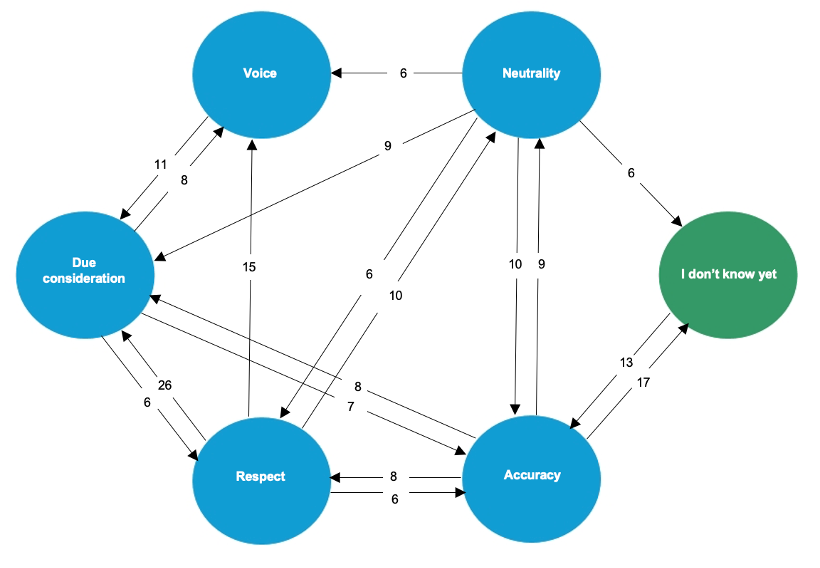
When answering questions about the components of procedural justice, the answers of respondents often included elements of or references to multiple procedural justice components. Thus, when respondents were asked about a component of procedural justice, they often referred to another. Figure 1 presents an overview of the interrelation of procedural justice components. All components were interrelated to some extent, meaning that respondents referred at least once to another procedural justice component (respect, voice, due consideration, accuracy or neutrality) when asked about these components.
Notably, respect, due consideration and accuracy were very well interrelated with other procedural justice components. Respondents thus often referred to other procedural justice components when asked about respect, due consideration and accuracy and mentioned elements of respect, due consideration and accuracy regularly when talking about other components. ‘Voice’ was less interrelated with other components, compared to the others.
Figure 1. Interrelations of procedural Justice Components.
Note. This figure shows the relationships among procedural justice components. The arrows, starting at the circles, represent respondents referring to other procedural justice components when asked about the component shown in the circle. Numbers indicate the number of respondents who mentioned a certain component or the code “I don’t know yet” when asked about procedural justice components or when stating “I don’t know yet.” For clarity of interpretation, only relationships between components mentioned by more than five respondents are shown.
In addition to respondents referring to other procedural justice components in their answers, the perceptions they shared during the interviews showed similarities too. Perceptions of feeling treated with respect (respect) or taken seriously by the judge (due consideration) were often based on how the opponent was treated by the judge during the court hearing. If the respondent was treated with (similar) respect and due consideration, then this made respondents feel being treated with respect and due consideration too, they explained. We observed similar overlaps of respect and due consideration when looking at the answers to questions about neutrality of the judge. The following respondent shared during the interview that the judge made sure that everyone could say what they wanted to say, which made the respondent feel heard as well:
Do you think the judge was impartial? Why so? “She was impartial. She gave me enough time to respond and the other party too, so both sides. She listened, did not show any emotion, was even making some jokes to lighten the atmosphere, and made sure everyone had their stage and said what he/she wanted to say. She didn’t show any preference, not at all. The only thing she said to the other party was ‘what if…’ to find a middle ground. But I really had the feeling she was weighing both sides.” (Respondent 4)
Furthermore, when asked about the accuracy of the judge, respondents indicated that respect and voice important considerations as well. A respondent who was asked about voice mentioned that this perception was for instance very closely linked to the judge being well prepared, which respondents also considered to be a part of accuracy:
Were you able to share your side of the story? “Yes, I was really able to do that. It was of course a very complicated story, but we explained short and concise what we wanted to say. Also, because the judge was really focused on the case (…) The judge was very to the point on the merits and well prepared, we all really liked that, that made it easier to share our side of the story.” (Respondent 60)
Taken together, a closer examination of the relations between procedural justice components suggests that several components were often closely related. Respondents referred regularly to procedural justice components, when asked about another component (interrelation). Descriptions of individual procedural justice perceptions also showed similarities. We found references to how the judge treated the opponent in perceptions of due consideration, respect and neutrality. When asked about accuracy, respondents often referred to voice and respect.
With our study, we were interested in whether respondents gave any accounts of informational uncertainty during the interviews. Only some respondents shared expressions of informational uncertainty directly after the hearing (5 respondents; spontaneous procedural justice perceptions) and when asked about fair treatment (3 respondents; prompted procedural justice perceptions). A respondent shared, for instance, directly after the hearing (spontaneous perception):
How did it go? “Well, we’ll wait and see. I find it is a difficult question, it is difficult to say how it went. I hope for a good outcome. The conversation with the judge went well. Now it is just waiting.” (Respondent 6)
Most perceptions of informational uncertainty were, however, shared when asked about individual procedural justice components (22 respondents) and more generally throughout the interview when respondents were not asked specifically about procedural justice (67 respondents). The overview in Table 3 includes the number of respondents who referred to situations of informational uncertainty spontaneously and when prompted.
When asked about individual procedural justice components, notably, most respondents expressed informational uncertainty when talking about the accuracy of the judge (17 respondents). To a lesser extent, perceptions of informational uncertainty were shared when asked about other procedural justice components, such as neutrality (6 respondents), voice (3 respondents) or respect (2 respondents).5 Figure 1 also shows that responses such as “I don’t know yet” were mostly given by respondents who talked about the accuracy of the judge.
When taking a closer look at the accounts of informational uncertainty shared after our accuracy-question, we noticed that respondents referred to having limited knowledge of the law and legal procedures as reasons why they could not share these procedural justice perceptions yet. A respondent explained this as follows during the interview:
What do you think about the accuracy of the judge? “As far as I know, the judge was accurate. I find it difficult to say something about that. I don’t know the details of what they [judges] should do and what that means exactly, but as far as I know, the judge was accurate.” (Respondent 47)
Another respondent shared a similar response, again mentioning that it was difficult to interpret whether the judge did their job correctly:
Do you think the judge was accurate? “Sure. I don’t have an opinion about whether the judge did or did not do a good job. I don’t know how they should do their job.” (Respondent 54)
In addition to having limited legal knowledge to determine whether the judge was accurate, respondents referred to the course of the procedure as a reason why they did not know yet about the accuracy of the judge. Some respondents mentioned that the opponent did not come to the hearing, and they thus had only limited information on the judge and his or her interaction with the opponent to base such perceptions on. A respondent who was asked about the neutrality of the judge also shared that it was due to the course of the procedure that he could not evaluate the impartiality of the judge yet:
What do you think about the neutrality of the judge? “I cannot judge that yet, because I was the only one there [in the courtroom]. The opponent did not show up. (…) It was now like a soccer match: the opponent did not come, so I win with 3-0, while the opponent also had a story and they [the judge and the clerk] did not ask any further questions about that, such as: How come? What happened exactly?” (Respondent 35)
Another respondent shared a similar story:
What do you think about the accuracy of the judge? “It cannot judge that. He [the judge] did not ask questions and it [the hearing] was very short and concise. The casefile couldn’t tell me much either.” (Respondent 2)
When taking another look at the informational uncertainty accounts, we noticed that those respondents more often expressed literacy difficulties or, more generally, that they found it hard to follow the court hearing. A respondent shared:
Do you think that the judge was accurate? “Well, I don’t know. She came with all these [legal] terms I did not know. But she also did not explain. And then she did not care anymore and just left it at that.” (Respondent 56)
A respondent who expressed informational uncertainty when talking about the accuracy of the judge, mentioned earlier in the interview:
Were you able to follow the hearing? “That is… well, I am not strong in Dutch, so I could follow a little bit, but it was difficult. The last hearing, the judge gave an explanation at the beginning, but this time, we immediately started after we came in. The last time, I knew what was going to happen.” (Respondent 11)
Having trouble understanding the (legal) language that was used during the hearing was mentioned by a total of 24 respondents during the interviews. Some respondents expressed having issues with the Dutch language (8 respondents) including native speakers (6 respondents). Some respondents expressed specifically and spontaneously that they did not follow the hearing very well due to the legal terminology that was used (10 respondents).
All in all, very few respondents shared informational uncertainty after our first, general question (spontaneous fairness perceptions) or when asked about fair treatment (prompted fairness perceptions). A third of the respondents did share accounts of informational uncertainty when asked about procedural justice components, mostly when asked about the accuracy of the judge. Those respondents mentioned themselves that they still lacked some information on the judge, the opponent, or the course of the procedure and therefore experienced informational uncertainty. Furthermore, respondents who had accounts of informational uncertainty more often expressed having literacy difficulties during the interview or were otherwise unable to (completely) follow the hearing.
Respondents were also asked to rate their trust in the judge and their trust in the judiciary on a scale of 1 (very low) to 10 (very high).
Overall, respondents rated their trust in the judge very high with an average grade of 8.43 out of 10 (SD = 1.74). When asked about trust in the judge, a few respondents referred to being treated fairly by the judge with some respondents referring specifically to perceived procedural justice components, mostly due consideration (4 respondents), accuracy (4 respondents) and voice (3 respondents).
Some respondents shared perceptions of informational uncertainty when asked about their trust in the judge (4 respondents). The following respondent referred, for instance, to the accuracy of the judge when expressing informational uncertainty:
Can you tell me a little bit about your trust in the judge? “I cannot say something about that. I also don’t know if he is familiar with the case, maybe he just scanned it briefly, I don’t know.” (Respondent 2)
Similarly to other perceptions of informational uncertainty that were shared spontaneously, those respondents who experienced language difficulties that prevented them from following the hearing, shared perceptions of informational uncertainty. Respondents who had a very short hearing or a hearing in which the opponent did not attend, also shared accounts of informational uncertainty.
Furthermore, respondents were asked about their trust in the judiciary. Trust in the Dutch judiciary was rated high by those respondents who were able to do so, with an average of 7.45 out of 10 (SD = 2.00). Many respondents expressed that they “did not know (yet)” about their trust in the Dutch justice system (17 respondents). Some respondents explained that they “normally don’t have much to do with the justice system” (7 respondents) or mentioned that this was “only their first time going to court” (6 respondents) as reasons why they could not rate or elaborate on their trust in the Dutch judiciary.
While respondents referred to the procedure when asked about their trust in the judge, respondents who were able to share trust perceptions of the Dutch judiciary referred to sources outside the court procedure such as general notions about judges that they had (8 respondents), any political views they had (5 respondents), or what they saw on the news (4 respondents). Respondents who did have a previous experience with the judiciary or knew someone who had, often referred to this experience when asked about their trust in the judiciary.
Can you share your thoughts on the Dutch justice system? “Yes, I have been here before for some traffic violations, but then it is a bureau that will do it for you [go to court], whereas when I did it by myself that one time, I would never get my money back. I think that is so weird. Maybe because they [the opponent] is someone from the municipality? They [the judges] will then not listen to your side of the story. But those are not big cases.” (Respondent 38)
Respondents also shared personal experiences when asked about trust in the justice system. Particularly respondents with a migration background would share personal experiences when talking about trust in the judiciary, comparing their experience in the Netherlands with the country where they were born (5 respondents). When asked about trust in the Dutch justice system, a respondents shared for example:
“Judges in your country and the justice system here, is very fair and holy for me. Justice in my own country is something different. That is why I also want to follow the rules and make it okay.” (Respondent 25)
Overall, respondents separated their trust perceptions related to the judge from trust perceptions related to the Dutch justice system. Respondents expressed that trust in the justice system was “something different” from their trust in the judge they just met. A respondent who rated his trust in the judge quite high (8 out of 10), mentioned for instance that his trust in the justice system was not as high:
How would you rate your trust in the Dutch judiciary from a scale of 1 to 10? “I would say a 2. I don’t like coming here [to court]. But this judge today was really nice. He did listen very well and wanted to what was going on, was really looking for a fitting solution.” (Respondent 21)
Even though Respondent 21 expressed a low level of trust in the Dutch justice system, he did recognise the judge listening and looking for a fitting solution which can be considered part of the procedural justice component of “due consideration.”
This paper presents the results of 58 interviews conducted after hearings in small claims procedures with self-represented litigants. We asked respondents about perceived procedural justice and trust in the judge and the Dutch justice system. Respondents spontaneously talked about perceived procedural justice after the hearing (1), when prompted (2), and shared fairness perceptions when asked about individual procedural justice components (3). Our thematic analysis showed the interrelation of procedural justice components. Additionally, what respondents considered to be relevant when talking about a procedural justice component, was often closely related to other components, which suggests that respondents were able to share rich and nuanced fairness perceptions.
Regarding some procedural justice components, accuracy in particular, respondents shared perceptions of informational uncertainty during the interviews. Similar perceptions of informational uncertainty were shared when asked about trust in the Dutch justice system. Respondents who did express such perceptions spontaneously during the interviews shared that they found it difficult to determine the accuracy of the judge and their trust in the Dutch justice system due to their limited legal knowledge and experience. When asked about accuracy, respondents also referred to the course of the procedure and literacy difficulties as reasons why they experienced informational uncertainty.
We think our study yielded some interesting results. First, our study provides insights into how self-represented litigants perceive court procedures with limited knowledge of the law and legal procedures. Respondents found (components of) procedural justice to be important and shared these perceptions spontaneously and when prompted. In particular, respondents articulated detailed perceptions of due consideration and voice, which aligns with earlier research on self-represented litigants (Ansems et al. 2020; Oishi 2023; Tyler and Zimmerman 2010) and with our previous study in which respondents were interviewed in early stages of small claims procedures (Janssen et al. 2025). All components of procedural justice (respect, due consideration, voice, neutrality, and accuracy) were interrelated.
When taking a closer look at the perceptions of individual procedural justice components, we noticed that respondents considered the interaction with the judge relevant when describing (the absence of) respect, due consideration, and neutrality. It is notable that respondents found the treatment of their opponent to be an important indicator of whether they were treated with respect, due consideration, and neutrality themselves. Moreover, self-represented litigants regarded even small details of the court hearing relevant for fair treatment. Respondents mentioned, for instance, whether the judge interrupted them (or not) when describing being treated with respect or with due consideration by the judge. Respondents also noted how much time the judge gave each party during the hearing and how many questions were directed at each party, and referred to this when asked about due consideration and neutrality. These findings further stress the importance of interpersonal treatment during court hearings (Ansems et al. 2020; Cropanzano et al. 2015; Oishi 2023) and how even subtle behaviour of the judge may contribute to self-represented litigants’ procedural justice perceptions.
Against this background, it is interesting that self-represented litigants shared accounts of informational uncertainty spontaneously and when asked about individual procedural justice components, albeit to a limited extent. This suggests that some litigants may still have limited information on which to base fundamental fairness and trust perceptions, even in later stages of court procedures when they have already had a court hearing (Janssen et al. 2025). Litigants who shared informational uncertainty accounts referred to difficulties following the hearing, due to language deficiencies or difficulties understanding the legal terminology that was used. We encourage future studies to research further how factors such as the degree of legal knowledge and literacy may affect fairness and trust perceptions of self-represented litigants.
The relevance of information about the course of the procedure and the decision-making authority for social judgments, resembles findings of earlier experimental studies using the uncertainty management model (Van den Bos et al. 1999; Van den Bos 2001). Interestingly, these experimental studies also stress the relevance of even very minor aspects of the procedure, such as the (in)ability to voice an opinion, for procedural justice perceptions (Van den Bos et al. 1999). In our study, we also noticed that respondents referred to the (in)ability to voice their opinions when asked about procedural justice (voice in particular).
More accounts of informational uncertainty were shared by respondents when asked about the accuracy of the judge and, to a limited degree, when asked about neutrality. The importance of information about the legal merits of a court case for constructing perceptions of procedural justice (particularly accuracy and neutrality) was also found in the qualitative study by Ansems et al. (2020), who interviewed self-represented defendants in criminal hearings at Dutch district courts. In interviews conducted in early stages of Dutch small claims procedures, respondents also shared accounts of informational uncertainty more often when talking about accuracy and neutrality of the judge (Janssen et al. 2025). Overall, these findings highlight the value of coding separate procedural justice components through a qualitative and open approach that allows for uncertainty in litigants’ perceptions, rather than having respondents react to quantitative statements about a predetermined set of components (Colquitt 2001).
When reflecting on this further, it makes sense that with limited knowledge of the law and legal procedure, it may still be difficult for self-represented litigants to determine whether the judge was accurate and impartial, even after a substantive part of the procedure has already passed. Determining whether the judge did an accurate job does indeed require some legal knowledge and understanding of what a judge needs to do in a specific court case. That respondents recognise this and mention it spontaneously in an interview is interesting, especially as they seem less in need of (legal) information to form other procedural justice components such as voice, due consideration, and respect. This finding fits the results of other procedural justice studies on self-represented litigants (Ansems et al. 2020; Oishi 2023; Zimmerman and Tyler 2010). While self-represented litigants may consider accuracy to be a relevant procedural justice component, our study cautiously suggests that their perceived procedural justice may be predominantly formed by other procedural justice components, for which respondents have (more) information. The interrelation of accuracy with other components fits within this line of reasoning as well. We encourage future studies to study the relationship between informational uncertainty and individual procedural justice components further and on a larger scale. It may be particularly interesting in this regard to research the relationship between accuracy, procedural justice, and informational uncertainty after respondents have received the outcome of their court case.
When taking a closer look at the trust perceptions that respondents shared, we noticed that respondents made a nuanced distinction between their trust in the judge and their trust in the Dutch justice system. Respondents we spoke to shared fairness perceptions when talking about trust in the judge, just as they did when they were asked directly about fair treatment and procedural justice components. When asked about trust in the Dutch justice system, however, respondents shared more often perceptions of informational uncertainty. These distinct perceptions resemble findings from other behavioural studies on trust in individual actors and in their institutions. Respondents in these studies expressed having trust in an individual actor that they had met, such as a doctor or governmental representative, while expressing distrust toward the institutions of which they are a part (healthcare system or governmental institution) (Blendon et al. 2014; Lammers et al. 2022). Considering growing levels of distrust in societal institutions, the finding that self-represented litigants may differentiate constructively between various fairness and trust perceptions (and mention this spontaneously in an interview) is very promising. Even more so, considering that the self-represented litigants that we interviewed have characteristics that may consider them part of more marginalized groups in society, which consistently express lower levels of trust in societal institutions (OECD 2024; Statistics Netherlands 2025).
Our study has some important limitations, of course. First, our study is based on a relatively limited number of interviews conducted after hearings in small claims procedures. In the rental and insurance procedures that we studied, it regularly happens that litigants do not attend the court hearing. This presented some challenges during the data collection, including a limited number of respondents being eligible to participate in our study. Similar challenges occurred in studies conducted with defendants in earlier stages of small claims procedures (Janssen et al. 2025). More generally, respondents without legal representation regularly do not show up in Dutch civil procedures nor respond to the summons (Kramer et al. 2015; Van der Kraats 2022). Similar methodological difficulties have been observed in other studies including vulnerable respondents (Ellinas 2023; Noy 2008). Taking these challenges into account, we aimed to lower the participation burden as much as possible, encouraging respondents who did come to the hearing, to participate. We also included interviews conducted via telephone later that day, upon the request of the respondent. We do hope, however, that future studies will build on our findings and conduct similar studies on a larger scale.
Furthermore, respondents we spoke to were involved in court procedures about rental and insurance invoices. We chose these hearings because these types of small claims procedures occur regularly and often involve litigants without legal representation. In such hearings, however, the legal merits are not considered particularly complex (Dutch Judiciary 2018). Various respondents had to come to court, for instance, because they did not pay their rent or insurance invoice due to financial difficulties they experienced. Even though such arguments are very understandable, they often do not translate into a complex legal defence, as having limited financial means is not considered an exemption from contractual obligations according to Dutch contract law and tenancy law. In other types of civil court procedures, the legal merits may be more intricate and claims and defences may require more legal expertise. We are therefore careful about drawing any conclusions from our findings that apply to accounts of litigants in civil procedures more generally (see also Whelan 1990, 22–23). We do believe, however, that the accounts of informational uncertainty that respondents shared (particularly about the accuracy of the judge) indicate that even in ‘rather easy’ court procedures, self-represented litigants may have limited information to base fairness perceptions on.
Moreover, our study did not include an analysis of procedural justice and the outcome of the court procedure. In Dutch small claims procedures, litigants normally receive the final judgment four weeks after their court hearing (Website Dutch Judiciary 2025). Due to ethical concerns, we did not follow up with respondents after their hearing, as we did not collect contact details or details on their pending court case. A few respondents who did agree to participate in a follow-up interview did not respond to follow-up emails about a second interview. Furthermore, it was difficult to determine when these respondents would receive the outcome of their court case as they often did not know themselves, and in legal practice it regularly occurs that the deadline of four weeks is not met (Dutch Judiciary 2019). We hope future studies will include outcome perceptions. Most respondents in our study were able to elaborate on fairness and trust perceptions without receiving a definitive outcome. It is interesting that a few respondents who mentioned informational uncertainty, mentioned not knowing the outcome of their court procedure yet, when doing so. We encourage future studies to include outcome perceptions when studying procedural justice and informational uncertainty.
Finally, we conducted interviews with self-represented litigants because we wanted to learn more about their perceived procedural justice. Furthermore, we believe that it is most likely for self-represented litigants who have limited knowledge of, and assistance with the law, to experience informational uncertainty in court procedures. Our study did not include a comparison with litigants in situations with less informational uncertainty, such as litigants who have received legal assistance. We do recognise that it might be interesting for future research to compare accounts of self-represented litigants with those of litigants who do have legal representation. During our interview study, we did conduct a few interviews with litigants who had a lawyer, but this number was insufficient to make such a comparison, as most litigants we encountered did not have legal representation. Our study did, however, allow us to study fairness perceptions of self-represented litigants who often hold a vulnerable position in society. We hope that our study can provide a starting point for future studies to build upon.
In sum, our study provides an in-depth account of the perceived procedural justice of self-represented litigants after hearings in small claims procedures. Our interviews provided insights into what self-represented litigants in real-life hearings consider relevant when talking about fair treatment and procedural justice components. Interestingly, some respondents shared accounts of informational uncertainty during the interviews, particularly when asked about the accuracy of the judge and trust in the Dutch judiciary. Such accounts suggest that while litigants find procedural justice relevant, they may still have limited information on which to base certain fairness and trust perceptions. From a legal perspective, it is important to consider such effects of having limited information during court procedures on fair treatment and trust. Furthermore, insights on how fairness and trust perceptions are formed in real-life settings, demonstrate the importance of studying fundamental perceptions in real-life court procedures by means of open-ended qualitative studies, letting litigants speak for themselves.
We would like to thank Jeanine Fraanje for her assistance with the inter-rater reliability check.
Ansems, Lisa F. M., Kees Van den Bos, and Elaine Mak. 2020. “Speaking of justice: A qualitative interview study on perceived procedural justice among defendants in Dutch criminal cases.” Law & Society Review 54 (3): 643-679. https://doi.org/10.1111/lasr.12499.
Boeije, Hennie. 2010. Analysis in qualitative research. Sage Publications.
Blendon, Robert J., John M. Benson, and Joachim O. Hero. 2014. "Public trust in physicians – U.S. medicine in international perspective." The New England Journal of Medicine 371(17) : 1570-1572. https://doi.org/10.1056/NEJMp1406707.
Braun, Virginia, and Victoria Clarke. 2006. “Using thematic analysis in psychology.” Qualitative Research in Psychology 3 (2): 77-101. https://doi.org/10.1191/1478088706qp063oa.
Colquitt, Jason A. 2001. “On the dimensionality of organizational justice: A construct validation of a measure.” Journal of Applied Psychology 86(3): 386-400. https://doi.org/10.1037/0021-9010.86.3.386.
Creutzfeldt, Naomi, and Ben Bradford. 2016. “Dispute resolution outside of courts: Procedural Justice and decision acceptance among users of ombuds services in the UK.” Law & Society Review 50 (4): 985-1016. https://doi.org/10.1111/lasr.122234.
Cropanzano, Russell, Marion Fortin, and Jessica F. Kirk. 2015. “How do we know when we are treated fairly? Justice rules and fairness judgments.” In Research in Personnel and Human Resources Management 33: 279–350, edited by M. Ronald Buckley, Anthony R. Wheeler, and Jonathan R. B. Halbesleben. Emerald Group Publishing Limited. https://doi.org/10.1108/S0742-730120150000033010.
De Mesmaecker, Vicky. 2014. Perceptions of Criminal Justice. Routledge. https://doi.org/10.4324/9781315885964.
Dutch Judiciary. 2018. Incassozaken. The Hague: Dutch Judiciary Report. https://www.rechtspraak.nl/SiteCollectionDocuments/rapport-incassozaken-Rechtspraak.pdf
Dutch Judiciary. 2019. Doorlooptijden in beweging: Eindrapport project doorlooptijden Rechtspraak. The Hague: Dutch Judiciary Report.
Emery, Lydia F., David M. Silverman, and Rebecca M. Carey. 2023. “Conducting research with people in lower-socioeconomic-status contexts.” Advances in Methods and Practices in Psychological Science 6 (4): https://doi.org/10.1177/25152459231193044.
Ellinas, Antonis A. 2023. “The interview method in comparative politics: The process of interviewing far-right actors.” Government and Opposition 58 (4): 661-681. https://doi.org/10.1017/gov.2021.58.
Gau, Jacinta M. 2011. “The Convergent and Discriminant Validity of Procedural Justice and Police Legitimacy: An Empirical Test of Core Theoretical Propositions.” Journal of Criminal Justice 39 (6): 489-498. https://doi.org/10.1016/j.jcrimjus.2011.09.004.
Glaser, Barney G., and Anselm L. Strauss. 1967. The discovery of grounded theory: Strategies for qualitative research. Aldine Transactions.
Grieshofer, Tatiana. 2014. “Legal-lay discourse and procedural
justice in family and county courts.” In Elements in Forensic
Linguistics, edited by Tim Grant and Tracy Gales.
Cambridge University Press. https://doi.org/10.1017/9781009378031.
Grootelaar, Hilke A. M., and Kees van den Bos. 2018. “How litigants in Dutch courtrooms come to trust judges: The role of perceived procedural justice, outcome favorability, and other sociolegal moderators.” Law & Society Review 52 (1): 234-268. https://doi.org/10.1111/lasr.12315.
Harry, Beth, Keith M. Sturges, and Janette K. Klingner. 2005. “Mapping the process: An exemplar of process and challenge in grounded theory analysis.” Educational Researcher 34 (2): 3-13. https://doi.org/10.3102/0013189X034002003.
Janssen, Anne A. A., Kees van den Bos, and Kim G. F. van der Kraats. 2025. “’I Do Not Have an Opinion About That Yet’: Qualitative Research on Perceived Procedural Justice of Self-Represented Litigants in Early Stages of Small Claims Procedures in the Netherlands.” Law and Human Behavior 49 (3): 222-236. https://doi.org/10.1037/lhb0000612.
Jolowicz, J. A. 2003. “Adversarial and inquisitorial models of civil procedure.” International and Comparative Law Quarterly 52 (Part 2): 281-296. https://doi.org/10.1093/iclq/52.2.281.
Kramer, Xandra, Ivo Tillema, and Mark L. Tuil. 2014. “De verstekprocedure getoetst: Een empirisch onderzoek naar de verstekprocedure in het licht van het KEI-programma.” Tijdschrift voor Civiele Rechtspleging 22 (1): 1-11. https://doi.org/10.5553/TCR/092986492014022001001.
Lammers, Joris, Eileen Pauels, Alexandra Fleischmann, and Adam D. Galinsky. 2022. “Why people hate congress but love their own congressperson: An information processing explanation.” Personality and Social Psychology Bulletin 48 (3): 412-425. https://doi.org/10.1177/01461672211002336.
Lareau, Annette. 2021. Listening to people: A practical guide to interviewing, participant observation, data analysis, and writing it all up. University of Chicago Press. https://doi.org/10.7208/chicago/9780226806600.001.0001.
Leitch, Jennifer A. 2013. “Looking for quality: the empirical debate in access to justice research.” 31Windsor Yearbook of Access to Justice 31 (2): 229-255.
Lind, E. Allan, and Tom R. Tyler. 1988. The social psychology of procedural justice. Springer. https://doi.org/10.1007/978-1-4899-2115-4.
Lind, E. Allan. March 1992. “The fairness heuristic: Rationality and “relationality” in procedural evaluations.” Paper presented at the Fourth International Conference of the Society for the Advancement of Socio-Economics, Irvine, CA.
Lind, E. Allan. 2001. “Fairness heuristic theory: Justice judgments as pivotal cognitions in organizational relations.” In: Advances in organizational justice, edited by Jerald Greenberg and Russell Cropanzano. Stanford University Press.
Liang, Juan, Hongyu Ma, Kees van den Bos, Xiaoring Cheng, Bin Wang, Hengqing Tong, and Xucheng Guo. 2016. “Ease-of-retrieval effects on procedural justice judgements under conditions of informational and personal uncertainty.” Asian Journal of Social Psychology 19: 336-346. https://doi.org/10.1111/ajsp.12152.
McKeever, Gráinne, Lucy Royal-Dawson, Eleanor Kirk, and John McCord. 2022. “The snakes and ladders of legal participation: Litigants in person and the right to a fair trial under Article 6 of the European Convention on Human Rights.” Journal of Law and Society 49 (1): 71-92. https://doi.org/10.1111/jols.12344.
Noy, Chaim. 2008. “Sampling knowledge: The hermeneutics of snowball sampling in qualitative research.” International Journal of Social Research Methodology 11 (4): 327-344. https://doi.org/10.1080/13645570701401305.
Organisation for Economic Co-operation and Development (OECD). 2024. OECD survey on drivers of trust in public institutions: 2024 results – Country notes: Netherlands. https://www.oecd.org/en/publications/oecd-survey-on-drivers-of-trust-in-public-institutions-2024-results-country-notes_a8004759-en/netherlands_d71d7263-en.html.
Oishi, Nina L. 2023. “Judging Debt: How Judges’ Practices in Consumer-Credit Court Undermine Procedural Justice.” The Yale Law Journal Forum, 271-304.
Pleasence, Pascoe, and Nigel J. Balmer. 2018. Legal confidence and attitudes to law: Developing standardised measures of legal capability. Pascoe Pleasence.
Statistics Netherlands. 2025. ”Vertrouwen in mensen en in organisaties; persoonskenmerken.” Accessed May 7, 2025. https://www.cbs.nl/nl- nl/cijfers/detail/85533NED.
Storgaard, Asbjørn. 2023. “Access to justice research: On the way to a broader perspective.” Oñati Socio-Legal Series 13 (4): 1209-1238. https://doi.org/10.35295/osls.iisl/0000-0000-0000-1352.
Thibaut, John W., and Laurens Walker. 1975. Procedural justice: A psychological analysis. Erlbaum.
Tyler, Tom R. 1990. Why people obey the law. Yale University Press.
Van den Bos, Kees. 2024. The fair process effect: Overcoming distrust, polarization, and conspiracy thinking. Cambridge University Press.
Van den Bos, Kees 2001. “Uncertainty management: The Influence of Uncertainty Salience on Reactions to Perceived Procedural Fairness.” Journal of Personality and Social Psychology 80 (6): 931-941. https://doi.org/10.1037/0022-3514.80.6.931.
Van den Bos, Kees. 1999. "What are we talking about when we talk about no-voice procedures? On the psychology of the fair outcome effect." Journal of Experimental social psychology 35 (6): 560-577.
Van den Bos, Kees, and E. Allan Lind. 2002. “Uncertainty management by means of fairnessjudgments.” Advances in experimental social psychology, 34: 1–60. https://doi.org/10.1016/S0065-2601(02)80003-X.
Van den Bos, Kees, Henk A. M. Wilke, and E. Allan Lind. 1998. “When do we need procedural fairness? The role of trust in authority.” Journal of Personality and Social Psychology 75 (6): 1449–1458. https://doi.org/10.1037/0022-3514.75.6.1449.
Van der Kraats, Kim G. F. 2022. Het civiele procesrecht als struikelblok. Boom Juridisch.
Website Dutch Judiciary. 2025. “Dagvaardingsprocedure beginnen bij de kantonrechter.”Accessed on July 10, 2025. https://www.rechtspraak.nl/Naar-de-rechter/rechtszaak-beginnen-particulier-of-organisatie/Paginas/dagvaardingsprocedure-beginnen-kantonrechter.aspx#b3629e28-7565-4022-b440-19c8e1758f3947efa6c7-8a98-4cf3-bd8d-4e9cf14eec0185.
Whelan, Chris J. 1990. Small Claims Courts: A comparative study. Oxford University Press.
Zimmerman, Nourit, and Tom R. Tyler. 2010. “Between access to counsel and access to justice: A psychological perspective.” Fordham Urban Law Journal 37 (1): 473–507. https://ir.lawnet.fordham.edu/ulj/vol37/iss1/15.
School of Law, Utrecht University, Utrecht, The Netherlands, a.a.a.janssen@uu.nl, https://orcid.org/0000-0002-9670-0479.↩︎
School of Governance, Utrecht University, Utrecht, The Netherlands https://orcid.org/0000-0003-2777-9344.↩︎
School of Law, Utrecht University, Utrecht, The Netherlands.↩︎
No respondents indicated having a middle income (between 41,001/60,001 and 60,000/75,000 euros a year).↩︎
Some of these respondents overlap, expressing informational uncertainty when asked about for example both accuracy and neutrality of the judge. In total, 22 respondents shared perceptions of informational uncertainty.↩︎