
Article History Submitted 27 August 2025. Accepted 05 Keywords EU law, preliminary ruling procedure, article 267 TFEU, judicial behaviour, judicial dialogue |
Abstract While domestic judges ultimately decide whether to refer questions to the Court of Justice of the European Union (CJEU), little is known about how the idea to refer is introduced in national litigation or about the decision (not) to refer. The preliminary ruling procedure (PRP) allows the CJEU to safeguard the uniformity of EU law, but that task can be hindered when national courts withhold questions. This article explores how often questions are sent to the CJEU, compared to the decisions not to refer, and to what extent referrals are driven by national judges acting on their own motion, compared to the parties. Despite challenges in accessing such data, an analysis of 728 referred and non-referred cases from all Swedish courts reveals that, although the PRP formally excludes party involvement, it is mostly the parties who raise the issue. However, they often struggle to have their questions referred. Importantly, 42 per cent of the questions sent came from the judges acting on their own initiative, sometimes against the parties’ wishes. Courts with a duty to refer show the highest tendency to request preliminary rulings, likely in part due to their legal obligation. These findings suggest that both judges and parties should be viewed as co-drivers of the PRP, nuancing narratives that emphasise one over the other. Nevertheless, most questions of EU law stay at the national level, adding to the large pool of questions that never reach the CJEU. |
|---|
The preliminary ruling procedure (PRP) has been described as “one of the most important Treaty Provisions” (Craig and de Búrca 2024, 493). As the mantra goes, its significance cannot be overstated: the smooth functioning of the PRP is vital for successful EU legal integration (Skouris 2015, 17), both as a mechanism for securing uniform interpretation of Union law,2 and for safeguarding EU citizens’ rights ‘on the ground’.3 The EU legal system depends on national courts referring questions to the CJEU (Tridimas and Tridimas 2004, 134). Without national courts asking the CJEU about the interpretation or validity of EU law, the Luxembourg Court will be stripped of opportunities to provide answers, clarify the law, and shape its development (Bebr 1981, 362). Requests for preliminary rulings in many ways set the agenda and “control which types of cases that the CJEU is allowed to decide upon” (Leijon 2018, 17). Mapping how the idea of referral arises at the national level — and which actors initiate it (Pertek 2015, 462) — is therefore key to understanding how the procedure functions in practice (Hoevenaars 2018, 270).
This article contributes to the field by examining how Swedish judges use their discretion to refer, focusing on who initiates the PRP and how the domestic judges approach their role in making references. It draws on data from 728 judgments across all court types and levels, in which the decision (not) to refer is explicitly mentioned. The article makes two main contributions. First, existing research almost exclusively studies questions that were sent,4 which (presumably) make up only the tip of the iceberg compared to all requests for referral raised in national disputes. It broadens the scope of inquiry to include questions that were not sent. Hence, it makes it possible to quantitatively map the decision (not) to refer.
Second, the literature has traditionally emphasised the cooperation of national judiciaries in tandem with the CJEU as the key contributors to EU legal integration,5 particularly highlighting the empowerment of lower court judges (Weiler 1991, 2426),6 while also noting the alleged reluctance of Nordic judges (Wind 2010; Bernitz 2018; Göransson 2014, 484–486). The emphasis has been put on domestic judges identifying the need for referral and consequently asking the CJEU for a preliminary ruling. However, more recent qualitative research shifts the focus away from national judges as active agents and towards the parties and especially their counsel (Pavone 2022, 6; Passalacqua 2025, 6; Leijon and Glavina 2022, 273–274). Still, it is largely unknown what this process looks like at the national level,7 beyond the evidence from interview studies. Is the decision to refer primarily driven by national judges, the parties and their attorneys, or both?
The legal framework clearly states that the decision to refer rests solely with domestic judges being “completely independent of any initiative by the parties.”8 Still, there are reasons to expect a more complex interaction of interests. Questions only reach the CJEU if an actor in the legal proceeding, typically the judges or the parties, has an interest in a preliminary ruling. It must then also be in the national judge’s interest to refer.
Domestic judges may not always act (exclusively) in line with the CJEU’s vision of the PRP. Instead, they might seek assistance in resolving specific cases, asking questions to receive helpful answers and avoiding being left twisting in the wind of unclear EU law when resolving disputes. This approach, while narrower, is not foreign to the CJEU because questions must be relevant to the national dispute,9 but the main interest for referral is not necessarily to secure the uniform interpretation of EU law. Beyond correctly judging individual cases, national judges have various interests at the national level, such as ensuring the expediency of justice by closing cases and avoiding delays. These interests may steer them away from sending questions to Luxembourg (Kommerskollegium 2005). Although Union law does not recognise the parties as a force in the decision whether to refer,10 they may also pursue interests that do not align with the CJEU’s objectives, such as winning the case or setting precedent. Bringing the parties and their counsel to the centre of analysis aligns with the long-standing research agenda on legal mobilisation and the PRP (e.g., Conant 2002; Cichowski 2007; Kelemen 2011; Pavone 2022; Hofmann 2024; Passalacqua 2025). The interaction between the differing interests of the parties, national judges, and the CJEU may therefore help explain when initiatives are taken and questions are referred.
This article explores the roles and interactions between judges and parties in the decision to make a reference. Specifically, it seeks to answer: (1) who raises the proposal to refer, (2) what is the judge’s inclination to refer, and (3) to what extent the parties’ attitudes influence the judge’s decision to refer. It proceeds as follows. First, the article theorizes who takes the initiative for a preliminary ruling and in which legal areas. Second, the data, methods and Sweden as a case study are presented. Third, the findings on who brings the PRP to the table and the judges’ inclinations to refer are discussed, followed by an analysis of how the attitudes of the parties influence the decision to refer. Finally, the article concludes.
The main takeaways are that Swedish judges, while seemingly receptive to EU law compared to the number of preliminary rulings requested (Derlén and Lindholm 2017, 714),11 are generally hesitant to ask questions compared to the number of party requests. Although parties are typically the main initiators, the results show that judges are not entirely passive. Several judges actively refer questions without relying on the parties and these cannot be characterized as ‘reluctant’. Overall, 42 per cent of the instances with questions sent came from the initiative of judges. Party attitudes, however, are not insignificant. There is evidence that judges are, on average, more likely to consult the CJEU after a party request when the parties collectively support a referral. Also, courts with a duty to refer show the highest tendency to request preliminary rulings, likely in part due to their legal obligation.
In sum, theories suggesting that parties and their counsel drive the PRP, emphasising the empowerment of lower court judges, or highlighting that judges are reluctant to refer out of loyalty to the national legislator, do not seem accurate for the Swedish example during the timeframe studied. Instead, the findings indicate that both parties and judges should be considered drivers of the ‘jewel in the crown’ of the EU legal order. The relative influence of each may vary across and within different Member States.
This section outlines the theoretical framework for understanding the interplay between judges and parties under the PRP. It examines the types of interests likely to guide these actors and the legal landscape in which initiatives to refer are most likely to be made.
Examining why certain actors seek a referral through the lens of EU law clearly places national judges at the centre. The PRP is characterized as a dialogue between national courts and the CJEU,12 in the spirit of building EU law together, “juge à juge” (Lecourt 1976, 266). The CJEU expects national judges to engage with the PRP when relevant, regardless of the attitudes of the parties. There is a legal obligation for all national judges to refer if they deem EU law to be invalid.13 For courts against whose decisions there is no judicial remedy, this is also the main rule concerning questions about the interpretation of EU law.14 This makes a difference to lower courts, which may refer. Despite having considerable discretion regarding when to ask questions, lower court judges — like all national judges — are responsible for correctly applying EU law and are expected to function as ‘EU judges of first instance’ (Lecourt 1976, 8). To fulfil this role effectively, they may need to request preliminary rulings to ensure the proper interpretation and application of Union law.
From this point of view, it is expected that most referrals will result from national judges taking the initiative. The position of the parties, whether they argue for or against a referral, should not matter. National judges ought to refer ex officio when necessary, guided by the legal requirements of EU law and the judicial goals of ensuring uniformity of Union law and safeguarding individuals’ EU rights.15
National judicial traditions may, however, impact the thinking about referral, or the lack thereof. For example, in cases amenable to out-of-court settlement, the parties play an enhanced role in accordance with the party disposition principle. Generally, this principle is stronger in adversarial systems and weaker in inquisitorial systems. In cases where the parties have an elevated role in civil procedure, judges are expected to act primarily upon the parties’ requests and be sensitive to their wishes (Chalmers 2000, at iv; Glavina 2019, 209). This tendency may also spill over into other legal matters, where first instance judges in general courts may prioritise the parties’ preferences and refrain from referral without their approval.
Domestic judges might not worry too much about the development of EU law and the importance of uniformity in their day-to-day activities (Claassen 2019, 186). In this setting, the parties can highlight the potential relevance of EU law and the PRP (Glavina 2019, 209; Pavone 2022, 84; Krommendijk 2021, 83, 85).16 It may very well be, as Verburg has put it, that “[o]nly in those rare cases where [EU] law is explicitly invoked by the litigating parties, the judge is obliged to at least consider the options. In all other cases [EU] law is probably left unspoken, sometimes deliberately, but mostly unconsciously” (Verburg 1997, 24).
Turning to the parties, what are their interests in the PRP? Evidently, the parties must believe that EU law, and especially the CJEU, adds something beyond what national law and its remedies can offer (Passalacqua 2021, 771; Burley and Mattli 1993; Hofmann 2024, 863). Union law can be a ‘promised land’, providing rights and freedoms to individuals and corporations.17 The PRP serves as a tool for challenging discriminatory practices in domestic law against non-nationals — generally by claiming that national laws run contrary to EU provisions — but also for challenging the legality of Union law through the back door.18
Although the above reasons may direct the parties to seek a preliminary ruling, their main concern is arguably winning the case and occasionally intending to develop a specific precedent. Sometimes this will co-occur with a claim for referral, sometimes it will not. It would be misleading to suggest that parties generally view the PRP as something positive. A reference can significantly delay the outcome,19 add costs (Chalmers 2000, viii), and there are no guarantees that the CJEU will provide a favourable answer.
In brief, the CJEU primarily perceives the PRP with the aim of securing uniformity regarding the interpretation of Union law. From the national judges’ point of view, however, it makes sense to approach the PRP as a form of assistance in resolving cases. Additionally, it is expected that the parties and their counsel play a more prominent role in the decision to refer than is suggested by Article 267 TFEU and the CJEU case law, with the parties sometimes even writing the questions for referral (Pavone 2022; Lester 1987; Krommendijk 2019, 786), or potentially drafting the full order for reference.
One prerequisite for a preliminary ruling is that the questions are ‘relevant’.20 If not, the case may be declared inadmissible — for example, because a preliminary ruling is deemed unnecessary for the national court to give judgment,21 or because the question does not concern EU law and therefore falls outside the CJEU’s jurisdiction.22 For courts of final resort, the exceptions of acte éclairé and acte clair, only apply when EU law may affect the outcome of the case.23 In other words, national courts generally have “the widest discretion” to refer relevant questions,24 while courts against whose decisions there is no judicial remedy under national law must refer relevant questions, if no further exceptions apply. Questions unrelated to the dispute should not be sent (Broberg and Fenger 2021, 208).
In an attempt to classify the content of EU law, Dyevre, Glavina, and Ovádek analysed 200,000 legislative acts and 55,000 court rulings and opinions. They conclude that Union law remains principally oriented toward economic activity, though the emphasis has moved from agriculture and customs administration to movement of capital, taxation, and safety requirements (Dyevre et al. 2021, 978).
Derlén and Lindholm investigated the areas in which Swedish lower courts cited CJEU case-law between June 2013 and December 2015. They found that administrative lower courts cited the jurisprudence four times more frequently than district lower courts in civil law cases, and 75 times more than in criminal law judgments. However, they concluded that this did not correspond to the number of preliminary rulings sent from each area of law, representing one third each (Derlén and Lindholm 2017, 703). Thus, it is not evident that a higher frequency of applying EU law translates into more referrals, although it creates more opportunities for doing so.
Still, a large portion of cases involving the decision to (not) refer is expected to be found in administrative courts, because preliminary rulings are given on points of Union law, administrative courts have more opportunities to consider whether a preliminary ruling is necessary to resolve the case at hand. This also allows parties to base their claims on Union law and invoke the PRP. In addition, administrative law deals with disputes between natural and legal persons and government authorities. Hoevenaars found in his sample of cases sent to the CJEU from Dutch courts that, for individuals, the area of law was mainly public law. He explains this as reflecting the way EU law most frequently affects individuals at the national level: by shaping administrative rules that constrain governmental action and by creating enforceable rights that citizens can rely on in their interactions with public authorities (Hoevenaars 2018, 61).
It might therefore be expected that these individuals have strong incentives to propose that the domestic judges request a preliminary ruling, using EU law as a shield against the state.25 This reasoning also applies to criminal law in general courts, but the intuition is that there is a lower frequency of Union law in these cases compared to administrative law.
Taken together, this suggests that while judges remain the formal gatekeepers of the PRP, party initiative is likely to be a key practical driver of the PRP. It is further expected that questions to refer particularly arise in the administrative courts where EU law seemingly is more present, conferring rights to natural and legal persons, hence prompting them to invoke these and call on referral to the CJEU.
The dataset consists of two different components.26 The primary source is the legal database JUNO,27 maintained by Norstedts Juridik, which contains approximately 2.7 million judgments from Swedish courts spanning the period 1901 to present.28 Given that the collection is nearly exhaustive from 2013 onward,29 the dataset is limited to the period 2013–2021. Additionally, the dataset for this article includes information on referred cases with questions identified through EUR_Lex, as well as IUROPA,30 and gathered from the respective national courts by accessing the relevant case files from the record sheets.
It is important that the great majority of decisions, where the judges consider whether to submit questions, are observable in judgments. If judges address the issue of a preliminary reference through an earlier decision that leaves no trace in the final judgment, we risk missing the forest for the trees. To examine this risk, judges were consulted about when, during the proceedings, they decide on the (non-)use of the PRP.
Because explicit decisions not to refer are expected to be relatively uncommon within the universe of cases, it can be challenging to identify judges with direct experience of them. I therefore relied on a purposive sampling strategy (Tansey 2007), aimed specifically at locating judges who have dealt with non-referrals, by contacting the official email addresses of a broad set of courts. This approach generated responses, by email or phone, from judges who had handled such cases, or from judges who, after consulting colleagues, could describe how these decisions are generally dealt with at their court.
The courts providing answers were the following (total population in parentheses): seven District Courts (48), four Courts of Appeal (6), seven Administrative Courts (12), and all four Administrative Courts of Appeal. The relatively high proportion of administrative courts included is advantageous, given that these courts are expected to handle EU law to a greater extent and are thus more likely to engage with decisions on whether or not to refer. Hence, identifying the practices of these judges, selected for their experience, reveals important insights.
First, questions arise in relatively few cases compared to a judge’s total workload. Second, Swedish law requires judges to address such motions, but it is up to the individual judge to decide when to make that decision. Third, the overall impression is that the great majority of decisions will be observable in judgments.31 However, it is challenging to safeguard against dismissive decisions made outside of the judgment, as it is difficult for courts to identify these decisions in their case-management systems. In sum, the judges’ answers indicate that in the overwhelming majority of cases, the referral decision will be made or at least mentioned in the judgment.32 While certain decisions might not be included, these are likely few and missing more or less at random.
The novelty of the dataset collected for this study lies in its inclusion of cases where the issue of referral was mentioned in some capacity in a judgment, but no question was sent. This approach identifies instances where judges explicitly reflect on whether to refer, either ex officio or in response to a request from a party or third-party intervener. Judges are generally obliged to address claims from the parties,33 and under EU law,34 the ECHR,35 and Swedish law,36 judges of last instance have an explicit obligation to provide reasons for not referring. A potential risk could be that judges underreport party claims for referral, when deciding not to refer. However, Swedish procedural law mandates that party claims and objections, as well as the factual circumstances on which they are based must be included in the written judgment.37 Moreover, the judges contacted emphasised that party claims must be explicitly rejected. Thus, the risk of missing party requests is considered minimal.
This approach, focusing on explicit decisions to refer or not to refer, provides the necessary information for mapping the type of actor that brings the proposal to refer, and investigating the decision whether to refer or not. The downside of the data is that it does not capture instances where a preliminary ruling could have been relevant, but was not advocated by the parties or commented on by the judges.
The search was conducted in two steps. First, terms associated with the decision whether to refer were identified.38 Second, these were used to formulate a query designed to achieve high recall without generating a large number of false positives.39 False positives and doublets were subsequently removed manually. Also, identical cases were collapsed into one representative judgment if they shared the same issue, court, one of the parties, reasons given by the court regarding the question of referral, and timeframe.40
The methodological approach in this study is twofold, combining descriptive statistics with logistic regression to explore patterns and relationships in the data. In this study, the particular interest lies in the number of cases sent/not sent, the type of actor who initiated the referral, the expressed attitudes of the parties toward referral, as well as the types and levels of the courts involved. By quantifying and summarising these elements, general patterns and trends can be identified.
Building on the descriptive findings, logistic regression models were estimated to dissect the effect of party attitudes on the decision to refer. These models test the relationship between the independent variable — party attitudes — and the dependent variable — the referral decision, while controlling for court type and level.
The variable requesting actor captures the actor that first raised the issue of referral. The coding has some uncertainty because it is not possible to fully safeguard against an actor raising the issue outside of the observable written materials. However, it is generally clear that the judges raised the issue on their own motion if both parties opposed referral, took a passive stance, or did not comment at all. In some of the cases with questions sent, the casefiles show no engagement from the parties regarding a preliminary ruling until the court had decided to refer and communicated this decision to the parties, giving them the opportunity to comment. Additionally, in most cases, it is straightforward from the claims or appeal that one of the parties is the requesting actor. When it was difficult to identify who took the initiative, the code ‘uncertain’ was used.
To fully understand the activities of national courts in relation to the PRP, it is essential to access comprehensive data on the decision to refer or not to refer. Relying on information from only one Member State, however, has a clear limitation: the lack of representativeness. It is therefore necessary to consider how the findings of this study may diverge from patterns observed elsewhere and to situate Sweden comparatively within the broader landscape of national judiciaries. Eckstein’s framework of crucial case studies (Eckstein 1975; Gerring 2007), such as least-likely cases,41 is helpful in this regard, as it subjects the factors associated with judicial (dis)engagement with the PRP to more rigorous scrutiny.
It has often been argued that the Swedish judiciary has been, and continues to be, particularly unwilling to participate in the PRP (Wind 2010, 1041; Bernitz 2018, 31; Schmauch 2023, 656). This position is mainly supported by comparing the number of judgments from the CJEU deriving from each national judiciary (Bernitz 2021, 82; Bernitz 2016, 15).42 Additionally, Sweden faced an infringement proceeding in 2004 regarding how the apex courts handled the PRP,43 further supporting this view. The alleged reluctance is often attributed to Sweden’s legal tradition (Wind 2010, 1041; Bernitz 2018, 31), characterized by strong parliamentarism and popular sovereignty, with courts playing a background role (Zetterquist 2008, 742), and exercising a weak form of judicial review (Wind 2010, 1057). It is said that the judges act loyally to the legislator and avoid referring questions to the CJEU to prevent potential disruptions to the national legal system and majority rule (Wind, 2010). At first glance, these features make Sweden a plausible least-likely case for engaging in dialogue with the Luxembourg court. Yet closer examination tempers this conclusion, as it is important to investigate the case study in relation to the specific factors underpinning the decision whether to refer.
Institutional characteristics, such as majoritarian democracy versus constitutional democracy, or weak versus strong judicial review, have not been shown to exert the clear effects one might anticipate in light of the ‘reluctancy account’ (Krommendijk 2021, 4). For example, Carrubba and Murrah found that “nations with judicial review do not make more references on average than nations without judicial review” (Carrubba and Murrah 2005, 412). The observed statistic of ‘few’ references may reflect alternative, competing explanations beyond legal tradition as described above, including the possibility that judges simply apply EU law, or disapply national laws, without making references (Vink et al. 2009, 8), which aligns with Swedish judges’ emphasis on avoiding overburdening the CJEU (Leijon 2018, 181).
More generally, the allegation that Swedish courts are reluctant is necessarily a simplification. Variations in how different types and levels of courts approach the PRP within a Member State can be equally as interesting as differences between countries at large (Krommendijk 2020, 751).
Judges’ propensity to identify the need for a preliminary ruling without a party’s request may depend on their experience acting ex officio, being embedded in an inquisitorial or adversarial legal system (Krommendijk 2021, 87). Accordingly, some Member States may have more or less proactive judges regarding the PRP, shaped by their procedural law culture. Swedish civil procedure is adversarial (Maunsbach 2022, 464), but shifts closer toward an inquisitorial model in areas of administrative law. Member States with a clear inquisitorial tradition may therefore experience higher rates of judge-initiated referrals and may rely less on, or be less responsive to, party attitudes than Sweden.
Similarly, the role of litigants in calling for the courts to refer may carry less weight in this context compared to other EU countries. As Wind observes, the anticipation of adversarial legalism (Kelemen 2011), as an enforcement model, does not seem to fit well with the Nordic picture (Wind 2017, 314).
Hierarchical judiciary structures may also play a role (Pavone 2022, 100).44 For example, the French administrative judges seem to leave the matter of referral to the French Conseil d’État to avoid disrupting the rigid national hierarchical system by involving the CJEU. The Swedish judicial system expects lower and appellate courts to adhere closely to Supreme Court precedent, creating a relatively hierarchical structure even in the absence of a formal rule of stare decisis. It remains difficult however to predict how this dynamic affects referral behaviour, particularly given the evidence from decentralised judicial systems, where lower courts also seem to prefer to leave referral to higher instances (Passalacqua 2020, 170). This pattern, however, may rather reflect pragmatic factors such as heavy caseloads or limited familiarity with Union law and the PRP (Passalacqua 2020, 170; Dyevre et al. 2020, 919).
Judges in the Swedish lower courts also operate under generally high workload levels, with three out of four reporting that they regularly exceed normal working hours (Johnsson 2024). Across the Council of Europe, including the EU Member States, lower courts generally face greater efficiency challenges than higher judicial levels (European Commission for the Efficiency of Justice 2024). Regarding knowledge of Union law and the PRP, broader concerns persist, with seemingly little difference between older and newer Member States.45 Hence, with respect to both workload and levels of knowledge, Sweden does not appear exceptional within the broader European landscape.
In sum, although Sweden has often been characterized as ‘reluctant’ and, at face value, appears to represent a least-likely case, closer analysis does not clearly support the view that it would deviate substantially from other Member States. This does not mean that relevant differences are absent. Certain factors that may affect referral patterns do differ, such as stronger traditions elsewhere of judges acting ex officio without party claims, being less guided by the parties’ preferences, and facing more active pressure from litigants to refer than is typically expected in Sweden. Leijon and Glavina also find, in the Swedish context specifically, that judges sometimes refrain from referring questions out of concern for the CJEU’s workload (Leijon and Glavina 2022), a practice that may result in fewer but more carefully selected referrals.
Accordingly, while caution is warranted in generalising these findings beyond the specific context and timeframe studied, and simultaneously highlighting that some deviations exist that stop short of constituting a clear least-likely case, this article contributes to identifying general patterns in judge-party relations in the decisions on whether to refer.
A limited number of questions are referred to the CJEU (Dyevre and Lampach 2021), but the data also reveal that it is rare that Swedish judges are asked to refer or that they openly reflect on sending questions. Out of approximately 1.5 million Swedish judgments available for the timeframe,46 this only occurred in 728 cases. Moreover, in just 60 of those (8%), the court decided to make a reference. Thus, compared to the judges’ collective workload, deciding whether to refer is a highly uncommon task. Still, on average, at least one Swedish court each week explicitly considers referral,47 and asks questions in 7.5 cases per year.
This result should be viewed in light of Derlén and Lindholm’s finding that ”for every case where the lower courts request a preliminary ruling, there are at least 1,200 cases where they rule based on the case law of the CJEU” [translation by the author] (Derlén and Lindholm 2017, 714). Thus, national judges rarely request preliminary rulings, not only compared to the total number of cases but also compared to the number of cases in which they apply existing CJEU case law.
Hence, explicitly reflecting on the potential need for referral is only one part of the picture. There are cases where there is arguably no need to refer, but EU law is applied anyway, as well as instances where dubious interpretations are made without referral. It is also likely that cases exist where the Union law dimension is completely overlooked.
A simple explanation could be that relatively few cases raise issues of EU law that call for a preliminary ruling.48 However, this explanation sits uneasily with both empirical evidence and the theoretical framework outlined above. A more plausible account is that domestic judges at times fail to identify situations in which a reference could be warranted (European Parliament Directorate-General for Internal Policies 2011, 114). It is often stressed that the parties and their legal counsel play a crucial role in placing referral on the agenda (Pavone 2022). Consequently, the rarity of explicit decisions on whether or not to refer likely reflects limited party mobilisation: litigants may be unaware, or believe that a referral would not serve their interests (Micklitz 2005, 41; Herbert 1987, 199).
Moreover, domestic legal rationales may divert judges’ attention away from proactively identifying EU law questions that could justify engaging with the CJEU. Together, this indicates that the low number of observations is unlikely to reflect a scarcity of relevant cases alone. At the same time, it is difficult to assess how often cases with potentially relevant questions go unnoticed by judges and parties, and the extent to which implicit decisions not to refer exist.
Regardless, the findings that judges rarely reflect openly on whether to refer, and that only 8 per cent of proposals are sent, indicate that the PRP plays a minor role in the everyday tasks of the Swedish courts. However, it has a significant impact in the cases where they decide to refer, and potentially negative consequences for the uniformity of EU law when they abstain. No reference does not however per se equal issues for the coherence of Union law or for effective judicial protection. It all depends on how the judges deal with the legal issue without asking for a preliminary ruling, and whether or not they apply existing CJEU case-law, refrain from dubious acte clair practices, and give full effect to the EU law provisions generally. Not requesting a preliminary ruling deprives the CJEU of an opportunity to develop the law. However, where settled case law already exists, refraining from a request helps avoid adding to the Court’s already substantial docket.
Regardless, when they do reflect on asking for a preliminary reference, it raises the question of who takes the initiative, in which courts, and whether the inclination to refer varies based on the type of actor making the proposal and the attitudes of the parties involved.
Figure 1 (below) shows that it varies by type of court, and whether it is the parties or judges that take the initiative, for a preliminary ruling ultimately being requested or not.
In 92 per cent of the 728 instances where a proposal to refer was presented, the initiative came from the parties, rather than the judges.49 This trend holds across all court categories, and is especially pronounced in administrative courts, where the parties bring the issue forward in 96 per cent of all instances. Although Article 267 TFEU stipulates that the PRP is a procedure for judges, in practice, the parties almost always are the ones to call on a preliminary ruling to be requested from the CJEU.50
Figure 1. Portraying the number of cases, the actor identifying the potential need for referral, and the proportion of referred cases for each actor class, by court type.
Corporations initiated the majority of cases with a decision whether or not to refer from the administrative courts, totalling 242 instances. Private persons followed with 173 instances, while public authorities accounted for 48. The rest of the party classes brought 31 requests. Consequently, the potential of the PRP is by far the most identified in the administrative courts, with 514 instances, compared to 126 in special courts and 88 in general courts. It is thus introduced primarily by natural and legal persons seeking to challenge decisions of government agencies within the fields of administrative law. These results correspond closely with the theoretical expectations: party initiative is the predominant driver for placing referrals on the agenda, and administrative courts constitute the main arena. This is likely because administrative law is the field in which EU law plays a particularly prominent role and where Union law confers rights against the state that litigants can mobilise.
In contrast, it is difficult to see why a government body defending its previous administrative decision would benefit from having the case referred. However, government agencies should, in addition to correctly applying Union law, follow the principles of objectivity and equal treatment. This may require involving the CJEU to resolve doubts about the interpretation of Union law. For example, the Tax Authority requested that the national court seek a preliminary ruling in order to clarify the interpretation of the relevant EU acts. It argued that “it is of the common interest for the Member States to have a uniform interpretation of Union law …, especially considering that differences in interpretation may lead to double taxation, alternatively no taxation”.51 This connects well with the CJEU’s view of the PRP as a tool for achieving uniform interpretation. Thus, a preliminary ruling may be necessary for the public authority to apply the law objectively and uniformly. Since public authorities themselves cannot ask questions to the CJEU, they are left with persuading national courts to do so.52
Next, the central question begs, what is the response from the judges if the parties propose to refer? Figure 1 shows that the highest rate is found in the general courts with 16 per cent sent for a party initiative, including both civil and criminal law. In contrast, administrative courts have a 3 per cent sent rate, while special courts have a 5 per cent rate. Interestingly, in absolute numbers, administrative and general courts refer about the same number of cases initiated by parties, namely 14 and 12 respectively. Part of the explanation for the differences between the court types might be the underlying rationales in national law guiding these specific fields with civil law affording the parties a more central role. The areas of law for the referred cases from general courts after claims from the parties include both cases where out-of-court settlement is acceptable and those where it is not.53
Although administrative courts handle the most referral decisions among all court types, most of these cases never leave the national level. Generally, Swedish judges rarely approve requests from the parties for referral.
In absolute numbers, there is not a huge difference between cases with questions referred after the initiative by the parties (31) and those by judges ex officio (25) without party requests.54 Domestic judges heavily filter which cases to ask for a preliminary ruling, and thus the parties generally fail to convince Swedish judges to refer. Interestingly, despite qualitative literature often placing parties and their counsel at the centre, judges themselves initiate over two-fifths of the referred cases with questions.55 Overall, judges are not inclined to refer based on party claims, but they do at times refer on their own motion.
Figure 2 highlights how the parties fare contrasted with judge-led initiatives for preliminary rulings in the judicial hierarchy. It shows that parties have almost no success in lower and second-level courts.
The story is different for courts adjudicating at last instance, which have a 14 per cent referral rate for the parties. While lower courts handle the most decisions on whether to refer in absolute numbers, which is unsurprising since they handle more cases (Pavone 2018, 309), courts of final resort request the largest number of preliminary rulings,56 and have the highest rate of questions sent.57 These results suggest that the judicial empowerment thesis may overestimate the role of lower courts compared to courts adjudicating at last instance, which today submit the greatest number of preliminary rulings. This has previously been observed in the literature (Pavone 2022, 38; Dyevre, Glavina, and Atanasova 2020).
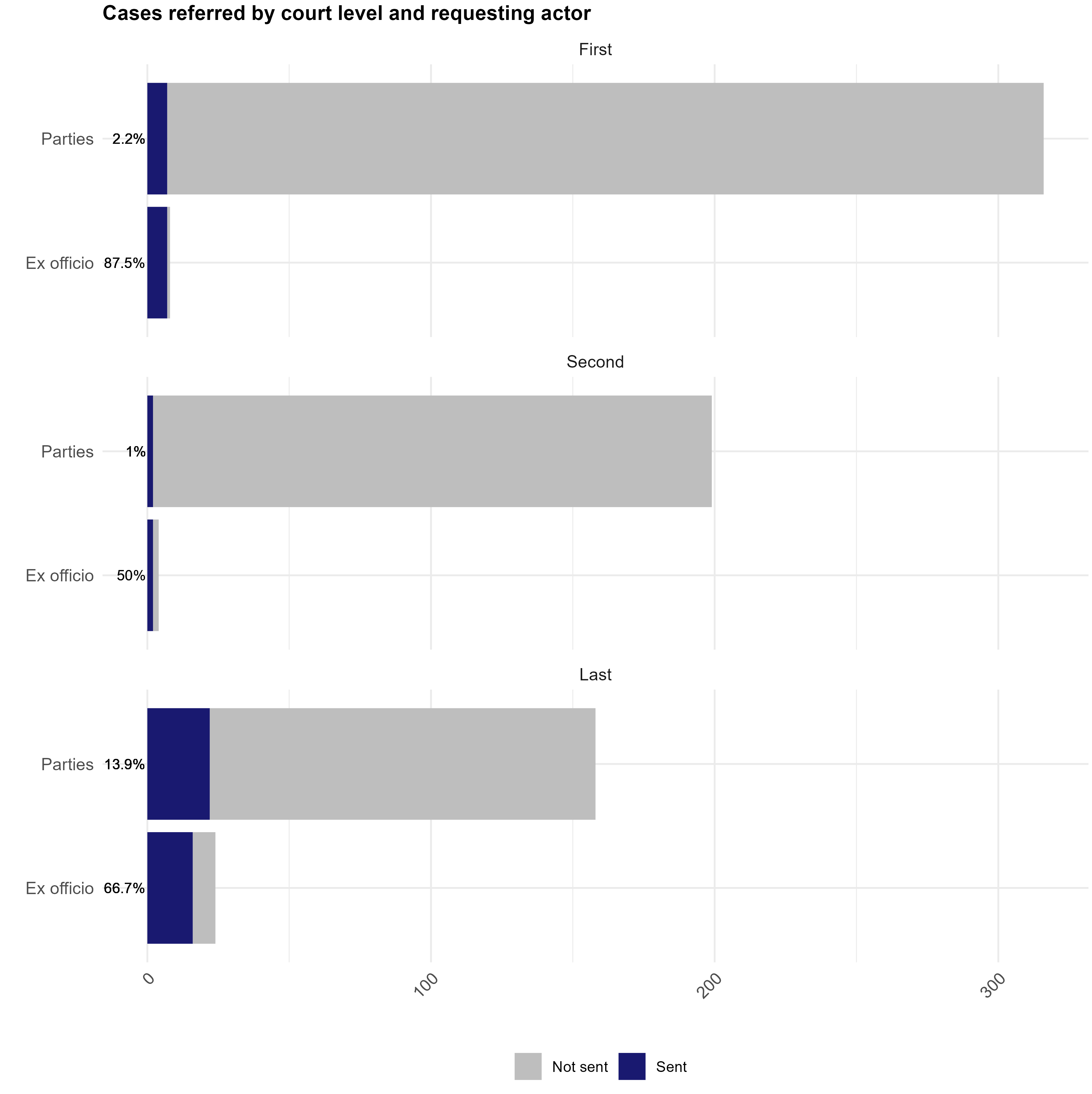
Figure 2. Illustrating the number of cases and the actor behind the initiative of referral with the proportion of referred cases, by court level. Note: The courts indicated as ‘last’ are all subjected to Article 267(3) TFEU such as the Supreme Administrative Court, the Supreme Court, the Labor Court, and the Migration Court of Appeal, but also other courts in the specific cases without a possibility to appeal, such as the Patent and Market Court of Appeal, the Land and Environmental Court of Appeal, the Administrative Court of Appeal in Stockholm, and Svea Court of Appeal.
It further indicates that the courts take the difference in legal rules seriously remembering the obligation to refer for courts adjudicating at last instance. However, it is challenging to evaluate this performance in light of the legal requirement, based solely on a comparison with lower courts. Just because courts of final appeal refer more does not necessarily mean that they adhere to Article 267(3) TFEU in each case.
Judges rarely raise questions explicitly on their own motion compared to the requests from the parties, although it does happen, especially when national courts decide to make a reference.
Judges initiated 42 per cent of the cases in which questions were sent, without any party request, mostly from courts of last resort,58 where judges are more active in raising the issues. This makes sense because courts of last instance have a legal obligation to refer and must consider whether they can abstain from referring. In contrast, lower court judges likely only reflect on whether to refer when they have already decided to ask. Additionally, courts of precedent consider the legal system as a whole in their adjudication, while lower courts focus on the parties and the individual dispute, which could affect their dependence on party requests for consulting the CJEU. However, this does not seem to be entirely reflected in the results, as first instance judges referred without any party initiative in half of their requested preliminary rulings. Moreover, if a national court of last instance breaches the obligation to refer, there is a risk of an infringement procedure,59 state liability,60 or a lower court referring instead. Therefore, apex judges need to be vigilant about when it could be relevant to refer, and provide reasons when they choose not to ask.61
A different set of potential explanations could include that courts of last instance handle referral relevant issues more frequently than other courts, but also that the party claims are better substantiated. However, these cases have mostly already been present in lower courts.62 The difference is that, even if a preliminary ruling would be relevant, lower courts can choose not to refer. Hence, the duty imposed on courts of last instance likely accounts for their higher number and propensity to refer compared to other court levels (Jaremba and Kappé 2024, 697).
The literature sometimes portrays judges at courts of last instance as acting on their own initiative more often than lower courts, which typically do not refer without a party’s request (Krommendijk 2021, 83, 85; Pavone 2022). However, lower courts do refer on their own motion, as do courts of last instance, but more referrals from the latter are initiated by parties.63 Yet, it is not possible to conclude that, in the absence of party request, judges would not have referred the questions. On the contrary, it is likely that several of these questions would have been referred anyway due to the necessity of clarifying EU law to give a judgment, especially for courts of last instance (Krommendijk 2021, 85). There is, however, a shortcoming in the data. It almost exclusively includes decisions where leave to appeal was granted. We do not know the situation when courts of last instance do not grant relief.64
The results show that judges rarely follow the requests from the parties. However, in over half of the cases where questions are sent, it is initiated by one of the parties. Do judges consider the parties’ attitudes regarding whether to refer? Qualitative research suggests they might,65 since “we do not want to give the parties unnecessary trouble”, as stated by an Irish Supreme Court judge (interviewed by Krommendijk 2021, 84). Also, Pavone highlights how judges are reactive and lack the necessary knowledge where the lawyers step in and “spoon-feed” the judges, “ghostwriting” referrals (Pavone 2022, 174). In addition, Leijon and Glavina note how judges from Sweden, Croatia, and Slovenia identified considerations for the interests of the litigants as an important factor in deciding not to seek a preliminary ruling (Leijon and Glavina 2022, 273).
From the CJEU’s perspective, the PRP makes a “system of direct cooperation between the Court of Justice and the national courts”.66 In this connection, even if the parties consider a preliminary ruling important for their own sake, it is stressed that the PRP is not a redress mechanism for the parties.67 It is thus important that national judges take ownership of the procedure.
This section explores the dynamics between judges and parties. First, it examines how parties respond when judges put the idea of referral on the table and whether party attitudes seem to influence the decision. Second, it investigates how judges react when the initiative comes from the parties.
In the 36 cases where judges raised the matter on their own motion, questions were mostly sent regardless of the parties’ opinions. Parties’ interests can vary: they might oppose a referral, have no opinion, or be positive towards it. ‘No position’ indicates that the parties did not comment on the idea of referral, and ‘no objection’ means that the party has nothing against referral.
Figure 3 indicates that when at least one party supports the judges’ motion for referral, it reinforces the judges’ inclination to refer, resulting in questions sent. In contrast, resistance from at least one party does not necessarily change the judges’ decision. Interestingly, in almost one-third of cases where judges take the initiative, neither party expresses an opinion. Counter-intuitively, when the parties do not express an opinion, judges decide not to refer in 10 out of 12 cases. This suggests that the underlying reason might be related to the characteristics of those cases rather than the lack of party position. There was only one case where both parties opposed referral, and in that instance no preliminary reference was requested, indicating that it is rare for both parties to object. A note of caution is the possibility of implicit decisions not being captured, as judges may raise the idea of making a referral but, when both parties oppose it, decide against it.
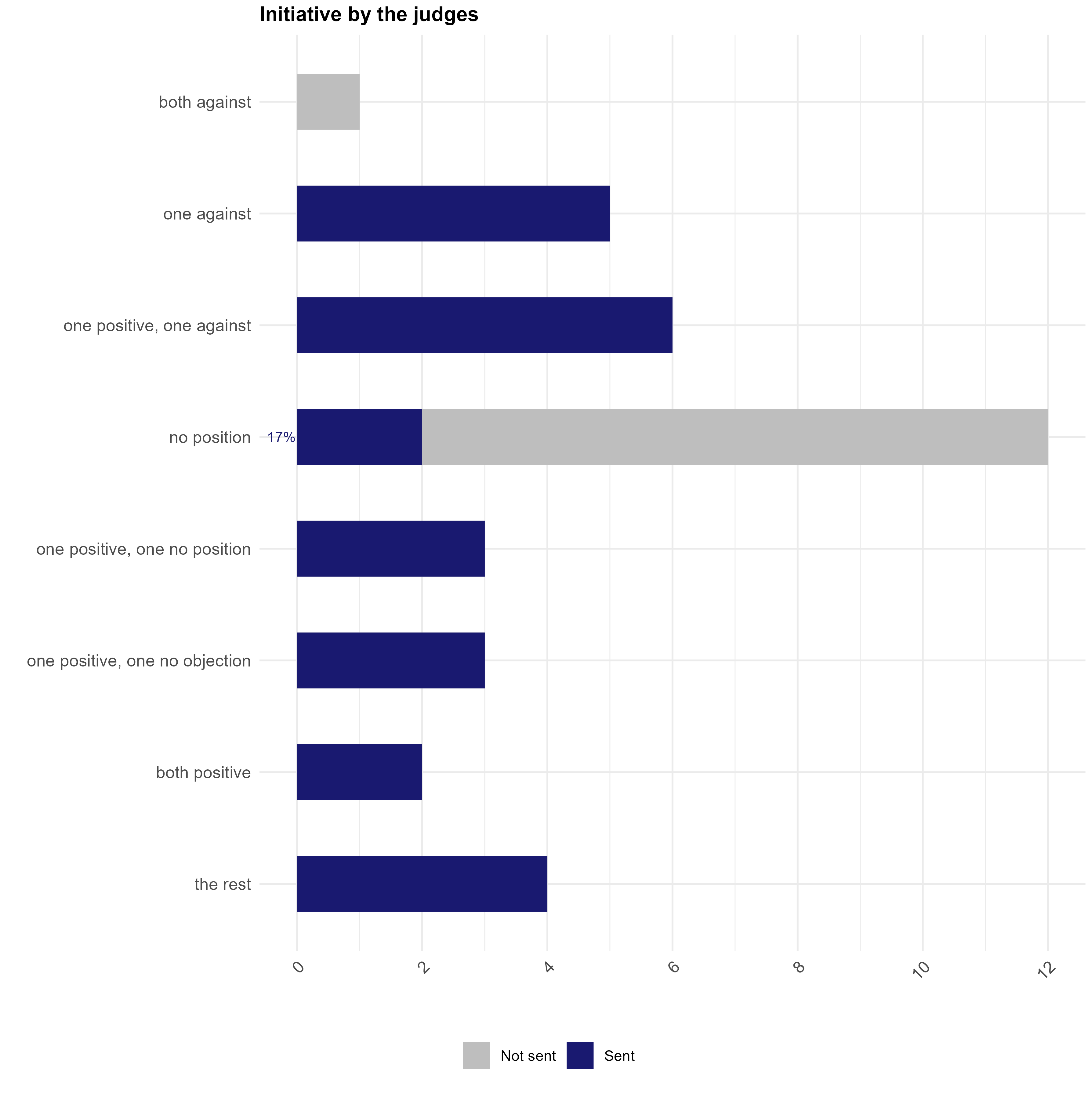
Figure 3. Visualizing the party position for judge identified referral decisions.
In total, 11 out of 12 cases with at least one of the parties taking a negative stance were referred regardless. Taken together, these findings suggest that national judges are more proactive than expected and are less influenced by party attitudes, when they themselves take the initiative to consider a reference. This makes sense, as raising the issue ex officio would typically indicate that the judges have already identified reasons to refer questions to the CJEU, prompting them to refer regardless of party attitudes.
It is rather surprising that even in cases where judges themselves raised the idea of referral, they decided to actually make a reference in only 69 per cent. However, it is not strange that courts of last instance have a lower propensity to refer ex officio. Although they have an obligation to refer, there are exceptions. What is important is that they identify the potential for a preliminary ruling and openly reflect on whether any exceptions are applicable. Since the Consorzio Italian Management judgment,68 national judges of last instance are no longer allowed to hide behind implicit deviations from the duty to refer, but must give reasons.69
The ex officio cases without requested preliminary rulings merit closer inspection. One case concerned the compatibility of the Swedish Upper Secondary School act with EU law. The Migration Court of Appeal, which is obliged to refer, raised the issue of referral and highlighted the exception of acte éclairé.70 However, a similar case had already been referred to the CJEU by the Migration Court in Gothenburg.71 Other such cases include the plenary judgment of the Swedish Supreme Court after the Åkerberg Fransson ruling,72 instances where a party pleads the invalidity of an EU law provision, situations where there are other similar ongoing cases at the CJEU, cases where the minority argue for referral and the majority needs to respond, and instances where parties have different understandings regarding the interpretation of a CJEU ruling.73 In all of these scenarios, it would arguably be difficult for the national judges not to engage with the EU law dimension and the potential need for a preliminary ruling.
Shifting from the judge-led initiatives to the more common situation with the parties as the driving force, the question arises whether judges tend to adhere to the parties’ positions.74 Of particular interest, therefore, is how the opposing party responds to such initiatives and how judges subsequently decide whether to refer or not. Yet, before showcasing those results, there is a type of request for referral that needs to be filtered out first.
There are 85 requests containing ‘conditional claims’ where the party bringing the issue to the fore argues that ‘if we do not win on other grounds’, or ‘if the court does not share our interpretation’, then the court should seek a preliminary ruling. This differs slightly from bringing a general motion for referral. In a way, it makes sense that parties primarily seek to win the outcome of the case and first and foremost wish to have the EU provisions applied in their favour, without the delay caused by a preliminary ruling (Hofmann 2024, 861). Yet, there are also requests of this type that leave the impression that referral is not something central, but rather a last-ditch effort when ‘not winning the case on other grounds’. The ‘conditional claims’ had only a single case with questions sent (1 per cent).75 This may partly be a consequence of the judges having ruled on the case based on other grounds.
How do the judges act when one of the parties wishes for a preliminary ruling and the other party opposes it, remains silent, raises no objection, or supports a reference? It can be expected that party attitudes matter, and that the likelihood of judges making a referral increases when the parties are positive toward a referral. Figure 4 partly supports this picture because the highest referral rates consist of the cases where the other party does not object (50 per cent) or when both are positive (also 50 per cent).76

Figure 4. Visualizing the opposite party position when the request comes from the other party. Note: The bar named ‘positive’ also includes when both parties are considered as the requesting actor.
Arguably, explicitly not objecting sends a similar signal to the judges as stating that a preliminary ruling would be desirable. The parties’ combined views then translate into a wish for referral. By contrast, when the other party expresses a negative attitude, the referral rate is lower at 9 per cent.77 Interview studies suggest that judges may hesitate to ask questions when faced with opposition from one of the parties (Krommendijk 2021, 58; Nowak et al. 2011, 112). Hence, when the opposite party is explicitly for, or does not object to referral, it seems that the party taking the initiative will have a better chance of judges actually referring questions. Although the underlying reason for this pattern might be something else, it may indicate that judges place weight on the parties’ expressed views (Leijon and Glavina 2022, 263). The most common position, however, is no response from the other party, also having the lowest referral rate, even lower than one party being against. The silence may be explained by the party feeling no urge to comment on the issue although a preliminary ruling would affect the specific case, for example by causing delays. An alternative explanation could be that the request for referral is weakly substantiated and hence, there is no need for the other party to engage with something that has little prospect of success either way. This may also connect to the low rate of requests referred for this category, at just 1 per cent.
The main takeaway is that the opposite party generally does not comment on whether national judges should involve the CJEU or not, but when they have an opinion, judges seem to be more likely to refer when faced with positive views rather than negative.78 Yet, the type of court may also affect how this plays out, depending on legal area and whether the judges have an obligation to refer. Without controlling for other alternative factors accounting for the referral rates and testing for statistical significance, it is difficult to determine whether there is indeed evidence for a difference between variants of party attitudes and the decision to refer.
As indicated by table 1 (below), there is evidence that judges are, on average, more likely to consult the CJEU after a party request when the parties are collectively positive toward referral with a strong positive relationship for ‘does not object’ and ‘positive attitude’ on the decision to refer, contrasted with the other party being ‘against’. The odds are 25 times higher of sending questions to the CJEU for ‘does not object’ compared to being ‘against’.79 Similarly, expressing a positive view towards referral increases the odds of having the judges asking by 21 times, compared to being ‘against’.80 It is interesting that the odds are higher for the ‘does not object’ category than for ‘positive attitude’ when put in relation to ‘against’, but both are forms of expressing a combined positive sentiment, and these results are generally in line with what would be expected. This can further be related to Pavone’s findings on how ‘Euro-lawyers’ construct cases to maximise the chances of referral while minimising opposition from the other party. One case from the Swedish courts during the timeframe clearly resembles this scenario, as both parties jointly brought forward a set of questions to be referred.81
When one party is positive toward a preliminary ruling, and the other has no opinion, the odds for judges to refer are actually lower compared to when facing resistance.82 There is no explicit resistance, nor support from the other party and hence, the judges only have the attitude clear of the one seeking a referral. It is difficult to explain why this might be the case. With more observations in this group than in the others combined, a word of caution is needed. One possibility is that the requests in this category are weaker to a greater extent, or that there are alternative underlying factors that are not controlled for.83
Interestingly, the stance of the other party accounts for a rather large portion of the variance in the decision to refer — 35 per cent. When controlling for court level and type, this figure rises to 51 per cent, indicating that the model fits the data well considering that the facts of the cases are left outside the picture. Thus, party attitudes generally seem to matter for whether judges engage in dialogue after a party request. However, it is not possible to conclude that party attitudes cause the decision to (not) refer.
| Table 1. Logistic regression models for party attitudes on the decision to refer. | ||
|---|---|---|
| Model 1 | Model 2 | |
| No comment | 0.11 *** (0.59) |
0.18 ** (0.67) |
| Does not object | 10.27 *** (0.57) |
25.03 *** (0.74) |
| Positive attitude | 10.27 *** (0.66) |
20.60 *** (0.82) |
| Administrative courts | 0.17 ** (0.62) |
|
| Special courts | 0.06 *** (0.75) |
|
| Courts of last resorts | 10.85 *** (0.54) |
|
| N | 532 | 532 |
| AIC | 168.22 | 138.59 |
| BIC | 185.33 | 168.53 |
| Pseudo | 0.35 | 0.51 |
Significance codes: *** p < 0.001; ** p < 0.01; * p < 0.05. Note: Coefficients are transformed into odds-ratio. The reference categories are ‘against’, ‘general courts’, and courts under art267(2) TFEU. The table only includes observations from the parties taking the initiative without ‘conditional claims’. |
||
Three main theories attempt to explain the judicial behaviour of national judges within the PRP. Pavone argues that parties and their counsel drive the PRP, while domestic judges, especially at the lower levels, are overburdened and lack the necessary expertise. Weiler emphasizes the empowerment of lower court judges, because the PRP “allows the [lower court judge] to become a constitutional judge for a day” (Lane 2004, 327). Wind suggests that legal culture plays a central role, with Nordic judges being reluctant to refer out of loyalty to the national legislator.
Although the case study of Sweden only presents the situation in one Member State, one with a reputation for reluctance, it reveals a different pattern that calls for a reassessment of the existing theories — highlighting both judges and parties in the driving seat. Parties are indeed active and try their utmost to convince judges to refer, especially natural and legal persons in administrative courts against governmental agencies. Also, half of the cases with questions asked stem from the parties as requesting actor, and the evidence indicates that when the parties are collectively positive toward a referral, the odds are higher on average for questions sent, compared to when facing opposition. Thus, in practical terms, the parties and the PRP go hand in hand to some extent. However, beyond these points, the results are not easily described as the parties and their counsel taking the lead.
Instead of blindly listening to the parties, judges heavily filter among the requests, blocking 95 per cent. Additionally, there are 25 cases where judges refer on their own motion, without any party initiative. These judges, who actively seek out the CJEU without waiting for parties to request a referral, do not fit the labels of reluctant or passive. These descriptions are also particularly inaccurate for the five cases where judges refer ex officio despite facing resistance.84 Judges adjudicating at last instance, who have an obligation to refer, make the most referrals both in absolute terms and in their propensity to ask,85 which contradicts the judicial empowerment theory.86
Article 267 TFEU imposes an obligation on courts adjudicating at last instance, while lower courts may ask questions, and this legal difference is likely to partly explain the decision to refer.87 The ex officio referrals also indicate that these judges take their role as ‘EU judges of first instance’ seriously.
The Swedish judges explicitly considered referral in 728 cases during the timeframe but only asked questions in 60. Even when they do not consult the CJEU, research by Derlén and Lindholm (2017) indicates that they generally,88 contrasted with the number of preliminary rulings requested, rely on CJEU case law. One explanation for not asking questions may be the legally valid reason for applying existing CJEU judgments, leading the lower courts to see no reason to refer, while courts of last instance are exempted. Future studies should investigate whether courts adhere to the legal requirements in each case,89 as it remains an open question whether national courts, especially courts of last instance, should have referred more (e.g., Engström 2022, 583).
The CJEU needs questions from national courts to ensure the uniform interpretation of Union law and to develop the legal order. The parties seek either to win the individual dispute or to set precedent by involving the CJEU, and national judges may have a variety of interests compelling them to (not) refer. There is a complex set of interactions with different interests at play, where each of the three theories highlighted above may explain certain decisions, but fails to account for the general picture. In a similar vein to Pavone, it is important to also reflect on the drivers directing the judges away from the CJEU. Here, the everyday working environment with constraints of moving dockets and limited knowledge, is a compelling account that deserves more research. Although the parties may fill the void left by passive judges at times, the findings reflect that national judges may be more active than previously assumed,90 at least in some Member States. In a sense, it is reasonable to believe that national judges generally act with a modest approach to resolving the individual dispute and involve the CJEU if needed for this purpose, while not necessarily having the uniformity and development of EU law at the top of their minds. This may explain why most questions are never sent to Luxembourg, despite the continued presence of EU law in the Swedish courts.
I am very grateful to Johan Lindholm, Daniel Naurin, Anna W Ghavanini, Marc Wever, Virginia Passalacqua, and the anonymous reviewers for their valuable comments.
Anderson, David, and Marie Demetriou. 2002. References to the European Court. 2nd ed. Sweet & Maxwell.
Bernitz, Ulf. 2016. Förhandsavgöranden av EU-domstolen Utvecklingen av svenska domstolars hållning och praxis 2010–2015, SIEPS 2016:9.
Bernitz, Ulf. 2018. “Preliminary Rulings to the CJEU and the Swedish Judiciary – Current Developments.” In The Court of Justice of the European Union: Multidisciplinary Perspectives, edited by Mattias Derlén and Johan Lindholm. Hart Publishing: 17–33.
Bernitz, Ulf. 2021. Förhandsavgöranden av EU-domstolen 1995–2020. SIEPS 2021:2.
Broberg, Morten and Niels Fenger. 2015. ”Förhandsavgörande från svenska domstolar – Är svenska domstolar väsentligt mindre benägna att begära förhandsavgörande än domstolar i andra medlemsstater?” Europarättslig tidskrift 4: 769–790.
Broberg, Morten, and Niels Fenger. 2021. Broberg and Fenger on Preliminary References to the European Court of Justice, 3rd ed, Oxford University Press. https://doi.org/10.1093/oso/9780198843580.001.
Burley, Anne-Marie, and Walter Mattli. 1993. “Europe Before the Court: A Political Theory of Legal Integration.” International Organization 47 (1): 41–76.
Carrubba, Clifford and Lacey Murrah. 2005. “Legal Integration and Use of the Preliminary Ruling Process in the European Union.” International Organization 59 (2): 399–418. https://doi.org/10.1017/S0020818305050137.
Chalmers, Damian. 2000. The Much Ado about Judicial Politics in the United Kingdom: A Statistical Analysis of Reported Decisions of United Kingdom Courts Invoking EU Law 1973-1998. Jean Monnet Center for International and Regional Economic Law & Justice.
Cichowski, Rachel. 2007. The European Court and Civil Society: Litigation, Mobilization and Governance. Cambridge University Press. https://doi.org/10.1017/CBO9780511491924
Claassen, Jesse. 2019. “Attitude or Aptitude? Explaining the Lack of Preliminary References in Dutch Competition Law Cases”. In The Eurosceptic Challenge: National Implementation and Interpretation of EU Law, edited by Clara Rauchegger and Anna W Ghavanini. Bloomsbury: 175-190. https://doi.org/10.5040/9781509927685.0005.
Conant, Lisa. 2002. Justice Contained: Law and Politics in the European Union. Cornell University Press.
Craig, Paul and Gráinne de Búrca. 2024. EU Law: Text, Cases, and Materials. 8th ed. Oxford University Press. https://doi.org/10.1093/he/9780198915522.001.0001.
Derlén, Mattias and Johan Lindholm. 2015. ”Festina Lente – Europarättens genomslag i svensk rättspraxis 1995-2015.” Europarättslig tidskrift 1: 151–177.
Derlén, Mattias and Johan Lindholm. 2017. ”Från Champagne till Ramlösa: EU-domstolens rättspraxis i svenska underinstanser.” Europarättslig tidskrift 4: 695-716.
Dyevre, Arthur, Monika Glavina, and Angelina Atanasova. 2020. “Who refers most? Institutional incentives and judicial participation in the preliminary ruling system.” Journal of European Public Policy 27: 912–930.
Dyevre, Arthur, Monika Glavina, Michal Ovádek. 2021. “The Voices of European Law: Legislators, Judges and Law Professors.” German Law Journal 22 (6): 956–982. https://doi.org/10.1017/glj.2021.47
Dyevre, Arthur and Nicolas Lampach. 2021. “Subnational Disparities in EU Law Use: Exploring the GEOCOURT dataset.” Journal of European Public Policy 28 (4): 615–631. https://doi.org/10.1080/13501763.2020.1744688.
Eckstein, Harry. 1975. “Case Studies and Theory in Political Science.” In Handbook of political science, edited by Fred Greenstein and Nelson Polsby. Addison-Wesley.
Engström, Johanna. 2022. ”Unionsrättens tillämpning i svenska domstolar – en analys av mål rörande artikel 47 i EU:s stadga om de grundläggande rättigheterna och mål rörande den allmänna unionsrättsliga principen om rätten till ett effektivt rättsskydd.” Europarättslig tidskrift: 557–585.
European Commission for the Efficiency of Justice (CEPEJ). 2024. European judicial systems CEPEJ Evaluation Report. Council of Europe. https://rm.coe.int/cepej-evaluation-report-part-1-en-/1680b272ac.
European Parliament Directorate-General for Internal Policies. 2011. Judicial Training in the European Union Member States https://www.europarl.europa.eu/RegData/etudes/STUD/2011/453198/IPOL-JURI_ET(2011)453198_EN.pdf.
Fjelstul, Joshua, Daniel Naurin, Stein Arne Brekke, and Silje Synnøve Lyder Hermansen. 2024. "The IUROPA CJEU Database Platform (v2.00.00)", in Lindholm, Johan, Daniel Naurin, Urska Sadl, Anna Wallerman Ghavanini, Stein Arne Brekke, Joshua Fjelstul, Silje Synnøve Lyder Hermansen, Olof Larsson, Andreas Moberg, Moa Näsström, Michal Ovádek, Tommaso Pavone, and Philipp Schroeder, The Court of Justice of the European Union (CJEU) Database, IUROPA, https://www.iuropa.pol.gu.se/.
Gerring, John. 2007. “Is There a (Viable) Crucial-Case Method?” Comparative Political Studies 40 (3): 231–253. https://doi.org/10.1177/0010414006290784.
Glavina, Monika. 2019. “Reluctance to Participate in the Preliminary Ruling Procedure as a Challenge to EU law: A Case Study on Slovenia and Croatia.” In The Eurosceptic Challenge: National Implementation and Interpretation of EU Law, edited by Clara Rauchegger and Anna W Ghavanini. Bloomsbury: 191–212. https://doi.org/10.5040/9781509927685.0005.
Glavina, Monika. 2024. “Private-Interest Actors as Catalysts for Actions under Public Law.” Erasmus Law Review 2: 86–101. https://doi.org/10.5553/ELR.000250.
Göransson, Frida-Louise. 2014. “Rapport suédois.” In L’obligation de renvoi préjudiciel à la Cour de Justice – Une obligation sanctionnée?, edited by Laurent Coutron. Larcier: 479–496.
Herbert, F. 1987. “Parties – Belgium.” In Article 177 EEC: Experiences and Problems, edited by Henry G Schermers. Elsevier.
Hoevenaars, Jos. 2018. A People’s Court?: Bottom-Up Approaches to Litigation Before the European Court of Justice. Eleven.
Hoevenaars, Jos. 2022. “EU Law Mobilization.” In Researching the European Court of Justice Methodological Shifts and Law's Embeddedness, edited by Mikael R Madsen, Fernanda Nicola, and Antoine Vauchez. Cambridge University Press: 82–104. https://doi.org/10.1017/9781009049818.
Hofmann, Andreas. 2024. “Who Does and Who Does Not Engage in Strategic Litigation in European Law?” German Law Journal 25 (6): 856-872. https://doi.org/10.1017/glj.2024.58.
Jaremba, Urszula and Marleen Kappé. 2024. “The Unfolding Story of Judicial Dialogue in the EU: The Coercive and Persuasive Motives Behind the Participation of Belgian Highest Courts in the Preliminary Ruling Procedure.” German Law Journal 25 (5): 690–706. https://doi.org/10.1017/glj.2024.9.
Johnsson, Emil. 2024. “Ordinarie domares arbetsförhållanden vid Sveriges tingsrätten och förvaltningsrätten En rapport till Sveriges Domareförbund baserad på resultat från en enkätstudie om underrättsdomares arbetsförhållanden”, Accessed December 5, 2025. https://domareforbundet.se/files/articles/198/rapport-enkatundersokning.pdf.
Kelemen, Daniel R. 2011. Eurolegalism: The Transformation of Law and Regulation in the European Union. Harvard University Press.
Kommerskollegium. 2005. “Europa – ja, men när?” – uppfattningen om EU:s inre marknad hos svenska domstolar.
Krommendijk, Jasper. 2019. “Why do lower courts refer in the absence of a legal obligation? Irish eagerness and Dutch disinclination.” Maastricht Journal of European and Comparative law 26 (6): 770–791. https://doi.org/10.1177/1023263X19871024.
Krommendijk, Jasper. 2020. “It Takes Two to Tango: The Preliminary Reference Dance Between the Court of Justice of the European Union and National Courts.” European Papers 5 (2): 745–754
Krommendijk, Jasper. 2021. National Courts and Preliminary References to the Court of Justice, Edward Elgar. https://doi.org/10.4337/9781800374171.
Lacchi, Clelia. 2020. Preliminary References to the Court of Justice of the European Union and Effective Judicial Protection. Larcier.
Lane, Robert. 2024. “Article 234: A Few Rough Edges Still”. In A True European: Essays for Judge David Edward, edited by Mark Hoskins and William Robinson. Bloomsbury.
Lecourt, Robert. 1976. l’Europe des juges. Bruylant.
Leijon, Karin. 2018. National Courts as Gatekeepers in European Integration: Examining the Choices National Courts Make in the Preliminary Ruling Procedure. Uppsala University.
Leijon, Karin, and Monika Glavina. 2022. ”Why Passive? Exploring National Judges’ Motives for not Requesting Preliminary Rulings.” Maastricht Journal of European and Comparative Law 29 (2): 263–285. https://doi.org/10.1177/1023263X221091768.
Lester, A. 1987. “Parties – United Kingdom”. In Article 177 EEC: Experiences and Problems, edited by Henry G Schermers. Elsevier.
Levy, Jack. 2007. “Qualitative methods in international relations”. In Evaluating methodology in international studies, edited by FP Harvey and M Brecher. University of Michigan Press: 196–214. https://doi.org/10.3998/mpub.8887.
Mattli, Walter, and Anne-Marie Slaughter. 1998. “Revisiting the European Court of Justice”, International Organization 52 (1): 177–209. https://doi.org/10.1162/002081898550590.
Maunsbach, Lotta. 2022. “Civil Procedure”. In Swedish Legal System, edited by Michael Bogdan and Christoffer Wong. Norstedts Juridik: 464–489
Matz, Henrik. 2010. Begreppet domstol i EU-rätten: En studie av domstolsbegreppet i bestämmelerna om förhandsavgörande. Iustus.
Micklitz, Hans W. 2005. The Politics of Judicial Co-operation in the EU: Sunday Trading, Equal Treatment and Good Faith. Cambridge University Press.
Nowak, Tobias, Fabian Amtenbrink, Marc Hertogh and Mark Wissink. 2011. National Judges as European Union Judges: Knowledge, Experiences and Attitudes of Lower Court Judges in Germany and the Netherlands. Erasmus School of Law.
Passalacqua, Virginia. 2020. Legal Mobilization and the Judicial Construction of EU Migration Law. European University Institute. https://doi.org/10.2870/405881.
Passalacqua, Virginia. 2021. “Legal Mobilization Via Preliminary Reference: Insights from the Case of Migrant Rights.” Common Market Law Review 58 (3): 751–776. https://doi.org/10.54648/cola2021049.
Passalacqua, Virginia. 2025. Legal Mobilization for Migrant Rights: Opportunities and Barriers at the European Court of Justice. Oxford University Press. https://doi.org/10.1093/9780198943006.001.0001.
Pavone, Tommaso. 2018. “Revisiting Judicial Empowerment in the European Union – Limits of Empowerment, Logics of Resistance.” Journal of Law and Courts 6 (2): 303–331,
Pavone, Tommaso. 2022. The Ghostwriters – Lawyers and the Politics behind the Judicial Construction of Europe. Cambridge University Press.
Pertek, Jacques. 2015. “L’avocat et le renvoi préjudiciel: sa place et son rôle devant les juridictions nationales et la Cour de Justice.” In L’identité du droit de l’Union européenne: mélanges en l’honneur de Claude Blumann, edited by Bertrand Brunessen et al. Larcier.
Schmauch, Magnus. 2023. ”Extraordinära rättsmedel i unionsrättslig belysning.” Svensk Juristtidning: 652–666.
Skouris, Vassilios. 2015. “Préface“, In Renvoi Préjudiciel et Marge d’Appréciation du Juge National, edited by Eleftheria Neframi. Larcier: 17–21.
Tansey, Oisín. 2007. “Process Tracing and Elite Interviewing: A Case for Non-probability Sampling” Political Science and Politics.” Political Science & Politics 40 (4): 765–772.https://doi.org/10.1017/S1049096507071211.
Tridimas, George, and Takis Tridimas. 2004. “National courts and the European Court of Justice: A public choice analysis of the preliminary reference procedure.” International Review of Law and Economics 24 (2): 125–145. https://doi.org/10.1016/j.irle.2004.08.003.
Verburg, Joep. 1997. “Introduction“. In European Ambitions of the National Judiciary, edited by RHM Jansen et al. Kluwer.
Vink, Maarten, Monica Claes, and Christine Arnold. 2009. Explaining the Use of Preliminary References by Domestic Courts in EU Member States: A Mixed-Method Comparative Analysis, 11th Biennial Conference of the European Union Studies Association.
Weiler, Joseph H.H. 1991. “The transformation of Europe.” Yale Law Journal 100 (8): 2403–2483.https://doi.org/10.2307/796898.
Wind, Marlene. 2010. “The Nordics, the EU and the Reluctance Towards National Judicial Review.” Journal of Common Market Studies 48 (4): 1039–1063. https://doi.org/10.1111/j.1468-5965.2010.02085.x.
Wind, Marlene. 2017. “The Transformation of Europe and of Selective Exit Twenty-Five Years After.” In The Transformation of Europe Twenty-Five Years On, edited by Miguel Poiares Maduro and Marlene Wind. Cambridge University Press: 303–316. https://doi.org/10.1017/9781316662465.
Zetterquist, Ola. 2008. “Rättens rike och EG-rätten – Envälde eller dubbelmonarki.” Europarättslig tidskrift: 93–108.
Department of Law, Umeå University, Umeå, Sweden, isak.nilsson@umu.se, https://orcid.org/0000-0002-4971-7059.↩︎
Case C-561/19, Consorzio Italian Management, ECLI:EU:C:2021:799, paras. 27, 29; Case C-144/23, Kubera, ECLI:EU:C:2024:881, para. 33.↩︎
European Court Reports 2011 I-01137, Opinion 1/09 Agreement creating a Unified Patent Litigation System, ECLI:EU:C:2011:123, para. 84.↩︎
For an overview, see the literature highlighted by Dyevre and Lampach (2021, 615-16).↩︎
See the account presented and then challenged in Pavone (2022, 4).↩︎
Note however that Weiler acknowledges that no single explanation can fully account for the phenomenon, emphasising also that it remains speculative.↩︎
The exception being Chalmers (2000). Although providing many important insights, the data relied upon has a “faute de mieux quality” in the words of Chalmers, only capturing reported judgments. Also, there has not been a recent comprehensive examination of this issue from any Member State.↩︎
Case C-2/06 Willy Kempter KG, ECLI:EU:C:2008:78, para 41.↩︎
Case 244/80, Pasquale Foglia, Santa Vittoria d’Alba and Mariella Novello, Magliano Alfieri (Foglia II), ECLI:EU:C:1981:302, para. 18. Assisting national courts in specific disputes is described by A.G. Bobek as a ‘micro-purpose’ belonging to the overarching idea of the PRP. Opinion of A.G. Bobek in Case C-561/19, Consorzio Italian Management, ECLI:EU:C:2021:291, para. 55.↩︎
The parties evidently plays an important role, not at least by bringing cases to the courts. Also, there is evidence that litigation rates are positively associated with requesting a higher number of preliminary rulings. See Vink and others (2009).↩︎
Derlén and Lindholm highlights how “for every case where lower courts request a preliminary ruling, there are at least 1,200 cases where they decide based on the case law of the Court of Justice” [translation by the author].↩︎
This is the CJEU perspective, see for example Case C-210/06, Cartesio Oktató Szolgáltató bt, ECLI:EU:C:2008:723, para. 91.↩︎
Case 314/85, Foto-Frost v. Hauptzollamt Lübeck-Ost, ECLI:EU:C:1987:452, para. 17.↩︎
The exceptions are set out in Case C-561/19, Consorzio Italian Management; Case 283/81 Srl CILFIT and Lanificio di Gavardo SpA v. Ministero della santà, ECLI:EU:C:1982:335.↩︎
See Case C-561/19, Consorzio Italian Management, para. 29.↩︎
Krommendijk also notes differences depending on legal procedural culture and between court levels.↩︎
See famously Case 26/62, NV Algemene Transport- en Expeditie Onderneming van Gend & Loos v. Netherlands Inland Revenue Administration, ECLI:EU:C:1963:1.↩︎
It is notably difficult to be granted standing before the CJEU under Article 263(4) TFEU. Case 25/62, Plaumann, ECLI:EU:C:1963:17.↩︎
In certain situations, it may in fact be the litigation strategy of a party to cause delays. See Glavina (2024, 97), with reference to Mattli and Slaughter (1998).↩︎
Case C-310/17, Levola Hengelo BV, ECLI:EU:C:2018:899, paras. 27, 28 highlighting the presumption of relevance for the questions referred.↩︎
Case 244/80, Foglia II, para. 18 in the context of an artificial case at the domestic level. See also Opinion of A.G. Emiliou in Case C-144/23, Kubera, ECLI:EU:C:2024:522: para. 46: “’necessity’ must be understood as the ability of the issue to influence the outcome of the case (put very simply: who wins, who loses and why)”.↩︎
See Case C-268/15, Ullens de Schooten v. État belge, ECLI:EU:C:2016:874, para. 55.↩︎
Case 283/81, CILFIT, para. 10; Case C-561/19, Consorzio Italian Management, para. 34.↩︎
Case C-166/73, Rheinmühlen Düsseldorf I, ECLI:EU:C:1973:162, para. 4.↩︎
Hoevenaars (2018, 268) made an interesting finding that “[b]ut for most, whether or not EU law was part of the litigation strategy, the [CJEU] was not the intended target at all. Such findings should make us aware of the disparate nature of motives behind litigation that may end up before the [CJEU]”.↩︎
The final datasets used for this article can be located here [https://github.com/Shimmeringsatyr/Article-1-EJELS/tree/main].↩︎
https://juno.nj.se/b/areas/juno.↩︎
The actual number is lower due to duplicates.↩︎
Information gathered from JUNO description of content, help and feedback. There are areas of law with missing data such as when the amount claimed does not exceed half a base amount and where the case is always determined by a single judge, default judgments divorce, dissolution of civil partnership, division of the joint property of husband and wife, inheritance, death, prenuptial agreement, adoption, and custody of children, and migration judgments unfavourable to the applicant.↩︎
Fjelstul et al., [https://iuropa.pol.gu.se].↩︎
For example, one of the judges highlighted that “I have personally made decisions on claims, but in the judgment. I cannot recall any case where it happened in a decision before the judgment, but it may have occurred [translation by the author]”. A different judge however stated that claims about referral from the parties must have the judgment provide reasons for the decision. The answers from the District Courts explained that they did not know about a case at their Court where a decision about a preliminary ruling was addressed outside of the judgment. However, one stated that there were such decisions at a Court of Appeal, but this decision was outside the timeframe for this study. One judge emphasized that “even if it surely in the majority of cases is handled in the judgment, it may be that the decision exists only in a decision not included in the judgment”. Another judge pointed out that if a decision has been made outside of the judgment, it is likely to still be addressed within the judgment.↩︎
38 of these were only mentioned in the judgment, and the individual decisions were then collected from the respective courts.↩︎
Prop. 2005/06:157 Vissa frågor om förhandsavgörande från EG-domstolen, 14.↩︎
Case C-561/19, Consorzio Italian Management, para. 51; Case C-144/23, Kubera, paras. 62-63.↩︎
Ullens de Schooten and Resabek v. Belgium, Appl. No. 3989/07 (20 Sep. 2011).↩︎
Lagen (2006:502) med vissa bestämmelser om förhandsavgörande från Europeiska unionens domstol, para 1.↩︎
17:7 rättegångsbalken; 30:5 rättegångsbalken; 13 § förordning (2013:390) om mål i allmän förvaltningsdomstol.↩︎
The query was “förhandsavgörande” OR “förhandsbesked” OR “artikel 267 FEUF”.↩︎
The following variants were identified: “förhandsavgörande från EU-domstolen” OR “förhandsbesked från EU-domstolen” OR ”förhandsyttrande från EU-domstolen” OR ”förhandsavgörande från Europeiska unionens domstol” OR ”förhandsavgörande hos EU-domstolen” OR ”förhandsavgörande från EG-domstolen” OR ”förhandsbesked från EG-domstolen” OR ”acte clair" OR “acte éclairé” OR ”klargöranden från EU-domstolen”.↩︎
In one particularly extreme example, there were over 1,000 identical cases from the Administrative Court of Appeal of Stockholm during spring 2020, and not adjusting for them would heavily influence the results.↩︎
See Levy (2002, 129): “Least-likely case research designs follow what I call the ‘Sinatra inference’—if I can make it there I can make it anywhere”.↩︎
The account that Swedish courts are reluctant based solely on the number of references is challenged by Broberg and Fenger (2015, 788), who argue that Swedish courts refer a number of questions in line with what would be expected, considering factors such as population size, litigation propensity, and the length of EU membership.↩︎
European Commission, 2003/2161. The Commission never brought Sweden before the CJEU because Sweden enacted legislation requiring the apex courts to provide reasons for decisions not to refer, including those concerning the granting of relief. Lagen (2006:502) med vissa bestämmelser om förhandsavgörande från Europeiska unionens domstol.↩︎
See however Dyevre et al. (2020, 927) with results questioning whether this factor transfers to the general picture.↩︎
European Parliament Directorate-General for Internal Policies (2011, 26). 40 per cent of the respondents answered that they only knew to a minor extent or not at all regarding “I have a good knowledge of when to refer”. The reported self-estimation showed higher confidence moving up the judicial chain, but still conveyed some warning signs. The reported scepticism expressed by certain judges is located in the qualitative research overall. See for example Krommendijk (2021, 72), and Nowak et al. (2011).↩︎
The judgments from JUNO, however, include some duplicates and have not been collapsed for identical cases, while the referral decisions have been cleaned, and lasty, the number of cases only accounts for courts in the national judicial hierarchy.↩︎
Dividing the 728 cases over eight years.↩︎
Cf. Lane (2004, 328): “This may of course simply serve as testament to the excellence of the Scottish judiciary, requiring the assistance of Luxembourg only very sparingly; but it does now hint at questions of effective judicial protection in Scotland.”↩︎
673 compared to 36. It should be noted, however, that it is unknown how often judges, on their own motion, reflect on the need to refer, decide against, and do not communicate this decision.↩︎
It remains possible that judges decide implicitly on non-referral without party requests.↩︎
Frgbg case 1330-14.↩︎
Only a “court or tribunal of a Member State” may refer questions. See Matz (2010).↩︎
The cases with questions sent concern intellectual property law with three referrals, followed by family law with two referrals both concerning child custody. There are several areas with a single referral such as crimes against the Animal Welfare Act, crimes against the Environmental Act, discrimination, arbitration, contract law, and torts.↩︎
There are two cases referred where third-party interveners took the initiative, and two are coded as unknown.↩︎
See also Hoevenaars (2022, 98) finding that “in a majority of the cases studied [cases with questions referred] there was actually no active effort or wish on the part of the parties to have their case referred to the [CJEU]”.↩︎
39 out of the 60. See also Dyevre et al. (2020, 927).↩︎
Combining both categories, judge-led and party-led initiatives.↩︎
Judges of first instance referred in seven cases, compared to two and 16 respectively for appellate and courts adjudicating at last instance.↩︎
Case C-416/17, Commission v. France, ECLI:EU:C:2018:811; Case C-516/22, Commission v. the United Kingdom, ECLI:EU:C:2024:231.↩︎
Case C-224/01, Gerhard Köbler v. Republik Österreich, ECLI:EU:C:2003:513; Case C-160/14, Ferreira da Silva e Brito, ECLI:EU:C:2015:565; Opinion of A.G. Rantos in Case C-163/24, Statul Román, ECLI:EU:C:2025:746.↩︎
See Case C-561/19, Consorzio Italian Management, para. 51.↩︎
There are exceptions such as appeals of advance rulings from the Swedish Tax Law Board. Also, cases may appear differently when they reach the court of last instance, as the legal issues are often more focused and new counsel may be involved.↩︎
In the courts adjudicating at last instance, there are 22 referred cases with the parties bringing the proposal to refer, and 16 with the judges taking the initiative without any party request.↩︎
It would have been necessary to manually check thousands of decisions rejecting leave to appeal, where the summary reasoning normally is along the lines of: “The Supreme Court has reviewed the material. No reason has emerged to grant leave to appeal” [translation by the author]. It would be interesting however to know whether the reasons given are more extensive when dismissing claims for referral in light of the duty to give reasons.↩︎
Krommendijk (2021, 162): “in the UK and Ireland, courts are unlikely to refer on their own initiative or if the parties are opposed to a referral. By contrast, most of the references of the Dutch highest courts are made without any request of the parties for a referral”. Cf. Claassen (2019, 182): “However, in general most judges recognize that a well-reasoned request for referral forces them to have a second, thorough, look at the issue. But they do indicate that the decision to refer will always remain their own and does not require a request by one of the parties”.↩︎
Case C-561/19, Consorzio Italian Management, para. 53.↩︎
Ibid., para. 54. In several national systems however, the PRP is connected to effective judicial protection and the right to a lawful judge. See Lacchi (2020, 100).↩︎
Case C-561/19, Consorzio Italian Management, para. 51; Case C-144/23, Kubera, paras. 62, 63.↩︎
Ibid.↩︎
MIG 2018:17.↩︎
Case C-526/18, AA v. Migrationsverket, ECLI:EU:C:2018:894.↩︎
NJA 2013 s. 502.↩︎
HRS t 8538-17.↩︎
For “referral by consent”, see Anderson and Demetriou (2002, 147).↩︎
This is when the requesting actor makes a ‘conditional claim’ and the opposite party is either against, does not comment, does not object, or favours a referral.↩︎
Including the ‘conditional claims’, the results are identical for ‘against’, also 1.1 per cent for ‘no position’, but 47 per cent for ‘no objection’, and 40 per cent for ‘positive’.↩︎
It is not possible to conclude that opposition is the cause for the frequency drop.↩︎
The type of decision the furthest away from ‘referral by consent’ can be found in krjpg 121-15 where both parties favored referral, including the minority of the court, but no questions were sent.↩︎
P = 0.0000126 when controlling for court type and level.↩︎
P = 0.000227 when controlling for court type and level.↩︎
Case C-28/20 Airhelp ECLI:EU:C:2021:226.↩︎
An odds-ratio of 1 indicates no effect, less than 1 signifies a negative association, and greater than 1 indicates a positive association. The observations are 532 after filtering the data to not include ‘conditional claims’, (n = 85) and combinations of attitudes (n = 56 with no reference made from this group) other than ‘no comment’, ‘does not object’, ‘positive attitude’ and ‘against’. In 42 of the 56 excluded observations, the opponent attitude was ‘NA’ due to the court’s non-granting of relief or because the cases fell under the Judicial Review of Certain Government Decisions Act. Ten observations involved the requesting actor specifying that “if the court finds it uncertain how to interpret the EU law, then a referral should be made”.↩︎
P = 0.008997. Including the ‘conditional claims’ gives a p-value for ‘no comment’ after controlling for court level and type as 0.007839 with a similar negative effect contrasted to ‘against’. See the appendix for a comparison with models including the ‘conditional ‘claims’.↩︎
11 with resistance from at least one of the parties.↩︎
Note here however the shortcoming of the data with the limited access to the decisions where leave to appeal was not granted.↩︎
See also Wind (2010, 1045), concluding that the judicial empowerment and the inter-court competition theories, identifying the lower courts as the motor in the system, poorly fits the Swedish example.↩︎
Cf. Dyevre et al, (2020, 926), highlighting how relying solely on the legal model fails to clarify the temporal shifts in referral activity between lower and last instance courts, given that the legal rules have not been modified.↩︎
Cf. Derlén and Lindholm (2015, 177), who note the difficulty of identifying an appropriate benchmark for the ‘right’ degree of Union law in the Swedish courts, while observing with respect to the apex courts that “more than nine out of ten cases have been decided without reference to EU law or the European Convention, however, seems remarkably low [translation by the author]”.↩︎
The legal obligation to refer exists for courts adjudicating as last instance regarding questions of interpretation, while the obligation extends to all court levels for questions of validity.↩︎
See also Hoevenaars (2022, 98). For a different result, see Chalmers (2000, 3): “This suggests that in the United Kingdom, at least, the preliminary reference procedure was far closer to a litigant-Court of Justice relationship, with national courts acting as a relay between the two, than a court-court dialogue, as has been suggested by some”.↩︎