Article History Submitted 4 November 2025. Accepted 10 March 2026. Keywords labor law, dismissal law, systematic case law analysis, data analysis, legal data, legal prediction |
Abstract This article examines how legal certainty and consistency can be strengthened in the application of open-ended legal norms. It investigates whether a systematic analysis of judicial decisions concerning an open standard in Dutch dismissal law can improve the prediction of future rulings. The study analyzes the reasoning in 398 court decisions addressing whether employee misconduct qualifies as reproachable behavior justifying termination of the employment contract. Prior research identified a set of indicators reflecting core legal principles that underpin judicial assessments of alleged misconduct. Building on this foundation, the present study identifies a limited number of indicator combinations associated with either a high or a low probability that courts will find sufficient grounds for dismissal. The findings furthermore show that when courts consider two or more indicators favoring the employee, the likelihood of termination nonetheless increases. Moreover, particular combinations of indicators correlate with outcomes that are either employee- or employer-oriented. The article concludes that structured case-law analysis can help mitigate the inherent indeterminacy of open-ended legal rules while preserving their capacity for context-sensitive decision-making. |
|---|
The Dutch Civil Code (DCC) contains many open-ended rules and concepts. By nature, these rules and concepts are open to interpretation. Consider, for example, the concept of reasonableness. In any given legal context, each party’s opinion on what is reasonable is affected by that party’s personal experiences, emotions, belief systems, and ethics. While the open nature of such rules allows courts to adjudicate in a wide variety of cases, the lack of consensus on the substance of open-ended rules and concepts2 undermines the predictability of case outcomes3 and the consistency of case law. These problems call for systematic research on the application of open-ended rules and concepts in jurisprudence. Despite the ubiquity of these rules and concepts in Dutch civil law, a relatively small number of research papers study them in a systematic manner (Verbruggen 2021; Verbruggen and Wijntjes 2025).
It is my contention that predictability and consistency in case outcomes may be enhanced through a systematic study of the factors that shape judicial reasoning, especially if such research aims to identify those factors at an abstract (or principled) level, independent of the specific factual circumstances of individual cases. These factors can help litigators better assess their prospects in court. They can also enable courts to improve consistency in case law by explicitly articulating which factors they rely on and explaining how those factors influence their decisions. A comprehensive account of such relevant factors may mitigate some of the disadvantages associated with open-ended rules (e.g., their unpredictability and inconsistency) while preserving the adjudicative flexibility that makes those rules valuable. Moreover, a systematic review of judicial decisions can nuance common beliefs about the law4 and reveal unexpected insights on how the law is applied in the daily practice of adjudication.
The overarching goal of this research is to explore methods to increase legal certainty and consistency in the application of open-ended legal rules. To this end, I examine whether and how a systematic study of judicial decisions concerning an open norm in Dutch labor law, Article 7:669(3)(e) DCC, allows for more accurate predictions of future decisions.
Based on Article 7:669(3)(e), both the lower courts and the courts of appeal can, upon the request of the employer, terminate an employment contract when the employee has behaved reproachably to such extent, that the employer cannot be expected to continue the employment.5 Hereinafter this statute will be referred to as “the misconduct rule.” This rule is not unique to the Netherlands. Comparable statutes exist in other European countries as well, e.g., Italy, Germany, France, Portugal (Gonçalves da Silva and Leitão 20236). The Dutch misconduct rule is an open-ended statute, which is subject to all the disadvantages noted above. Notably, it is impossible to comprehensively define the legal concept of misconduct. This is evident in the existing Dutch labor law literature, which tends to offer anecdotal descriptions, typically featuring only a limited number of examples (Meijer et al. 2022).
The importance of the continuation of the employment contract to the employee can hardly be overestimated. A vast majority of people depend on their employment to provide for their livelihood. Since misconduct can lead to the termination of the employment contract, studying how the courts interpret and apply the concept of misconduct will enable employers and employees to better assess the relative strength of their cases, which can improve legal certainty as well as case law consistency.
This article builds upon previous work in which I analyzed data collected in a systematic analysis of 398 court decisions on the open-ended concept of misconduct as reasonable grounds for terminating an employment contract (Meijer et al. 2022; Meijer et al. 2023). In the first paper, I focused on factual circumstances discussed in the corpus of cases. I analyzed whether categorizing cases by type of misconduct (answering the “what” question) would produce categories of behavior that, in themselves, have sufficient predictive value. I concluded that this was the case only for a limited number of categories in a limited number of cases (Meijer et al. 20237).
In a second paper, I analyzed the legal reasoning and argumentation on which the decisions are based (answering the “why” question). Legal arguments found in the corpus of cases are closely related to the facts of the cases. They address the facts presented to the courts and effectively link them to the judicial decision. Arguments have a persuasive nature, they aim to convince a court how to decide a case. In this way, arguments are also indicative of underlying legal values and principles. By systematically analyzing the legal reasoning found in the corpus of cases, I constructed a catalog of eighteen indicators informing the legal principles I found. Further analysis revealed that only four of these indicators have sufficient predictive value.
With the overall aim of improving the prediction of future decisions, this article takes an additional step by analyzing combinations of the indicators identified in my previous work that, individually, do not provide sufficient predictive value. In this way, the article broadens the scope of scenarios in which a sufficient level of predictability was found, going beyond the limitations of my earlier research.
In what follows, I will first describe the legal analytical framework, followed by a summary of my previous research, after which I will present and discuss the findings of my current research. The article ends with a conclusion in which I posit that a systematic review of judicial decisions can contribute to legal certainty and consistency by finding recurring patterns in the decisions that have predictive value. My study shows that employees do not benefit from combining multiple lines of argumentation in their defense, which had previously not been described. In contrast, employers do benefit from combining multiple lines of argumentation. In addition, my findings on relative strength of specific arguments can help employers and employees improve their legal strategies.
This section summarizes the existing Dutch labor law literature on the misconduct rule and analyzes whether it sufficiently explains said rule and whether it offers sufficient bases for legal certainty and case outcome prediction.
In 2015, the Work and Security Act (Wet werk en zekerheid; WWZ)8 introduced Article 7:669 DCC, which allows employers to request the court to terminate the employment contract only in certain circumstances. This means that employers can no longer terminate the employment contract on their own initiative, which they previously could.9 One of the legal grounds for such termination is misconduct or, in the wording of the law, reproachable behavior or negligence of such nature that the employer cannot be expected to continue the employment contract.
The employer must convince the court that there are reasonable grounds to terminate the labor agreement and has the burden of proof regarding the facts supporting their request. The employee has the burden of proof regarding the facts presented by them in their defense. Cases in which the employer did not satisfy their burden of proof were excluded from the dataset. In these cases, the question whether the employee had misbehaved remained unanswered, due to the employer’s inability to substantiate the employee’s alleged behavior.
When the employee appeals a lower court’s decision and successfully challenges the termination of the employment contract on the basis of Article 7:669(3)(e), the termination is deemed never to have taken place and the employment contract therefore continues to exist. The employee may alternatively allow the termination to stand and claim a fair compensation.
The Parliamentary explanation did not include a conceptual framework for interpreting and applying this new rule. It generally stated that:
“It is primarily up to the employer to assess whether the employee’s behavior provides a fair ground for terminating the labor agreement. The court will not grant a termination when the request to terminate is unreasonable or when the employer is also to blame for the incident. If the employee’s conduct is the reason to seek termination, then it should have been made clear to the employee what is and what is not acceptable on the work floor (except for obvious incidents like theft, etc.). Moreover, the employer’s expectations should be common and not excessive. An example of the latter would be to expect the employee to be willing to violate rules of law.”10
In addition to these general remarks, a limited number of categories of behavior that can constitute misconduct were mentioned, such as theft, sexual harassment and refusal to follow reasonable instructions. The existing doctrinal literature references these general remarks, as well as anecdotal examples, adding striking and sometimes spectacular examples from the case law that has developed after the introduction of the misconduct rule.
The Dutch Supreme Court has developed various strategies aimed to provide practical guidance for applying and interpreting certain other open-ended rules (Korthals Altes and Groen 2015/149). However, to date, the Supreme Court has not formulated a hard sub-rule, rule of thumb or catalog of viewpoints for the misconduct rule.11 As a result, there is no authoritative guidance on how to interpret and apply the misconduct rule. This is confirmed by various lower court and courts of appeal decisions in the dataset, which explicitly state that, when applying the misconduct rule, all relevant circumstances must be taken into consideration.12
In summary, neither the Parliamentary explanation, the existing doctrinal literature, nor Supreme Court case law outlines a cross-contextual framework that can be applied regardless the nature of the alleged misconduct. General rules for interpretation and application do not exist. As a result, the open-ended concept of reproachable behavior is undetermined. Individual courts continuously shape this concept by every case they handle and the case law they publish. This makes the lower courts’ and the appeal courts’ case law an important source of knowledge when searching for ways to improve case outcome predictability and case law consistency. The absence of a cross-contextual framework for reproachable behavior demonstrates the need to research the case law systematically.
Based on the idea that there is predictive value in identifying instances where a sufficiently high number of the decisions within a particular group of cases favors either the employee or the employer, I consecutively pursued the following two strategies to group cases.
I first analyzed whether decisions on the misconduct rule can be explained by categorizing them by type of misconduct and whether such categorization can improve case outcome predictability (Meijer et al. 202213). In line with Parliamentary documents and doctrinal sources, I coded cases by the nature of the alleged misconduct and decision outcome. Based on this data, I calculated for each type of misconduct the ratio of alleged incidents where the courts decided that the alleged behavior was reproachable (throughout the research I refer to this ratio as the “Incident Acceptance Ratio” (IAR)). I detected 37 specific types of misconduct and one residual category and found that for most of these categories (representing more than 70 percent of all decisions) the IAR was between 30 percent and 70 percent.
Factual categories on the high end of the IAR scale are corruption, conflicts of interest and bribery (IAR: 82.61%), criminal activity (IAR: 77.78%), sexual abuse and sexual harassment (IAR: 73.68%), theft and embezzlement (IAR: 69.44%), and integrity breaches (IAR: 68.97%).
Factual categories on the low end of the IAR scale are: negligence (IAR: 30.00%), inappropriate or unreasonable behavior, causing nuisance (IAR: 29.73%), violating or not following specific instructions (IAR: 28.57%), unauthorized access to information (IAR: 27.78%), disrupting the course of company processes or the cooperation between colleagues (IAR: 23.53%), rebellious or unloyal behavior, undermining authority (IAR: 22.41%), causing material or immaterial damage or the risk of such damage (IAR:15.38%), unprofessional behavior (IAR: 13.33%), uncooperative, provocative or irresponsible behavior (IAR: 12.50%), and bad performance or dysfunction (IAR 4.88%).
The higher the IAR, the higher the chance for the employment contract to be terminated. As a result, categories on either the high end or the low end of the IAR scale can be seen as having sufficient predictive value for the outcome of similar future incidents.14 These make up 40.54 percent of the categories found. Therefore, a minority of the factual categories of alleged misconduct have sufficient predictive value, while most have not.
Between these extremities I found categories like refusal to work (IAR: 52.63%), problems with alcohol and drugs (IAR: 52.38%), lack of transparency about relevant facts and circumstances (IAR: 51.72%), unauthorized leave of absence (IAR: 50%), regularly being late (IAR: 50%), and physical abuse, violence, fighting in the work place (IAR: 47.06%). For these categories, the outcome may reasonably fall either way.
As this analysis revealed that factual categories do not have sufficient predictive value, I subsequently investigated the legal reasoning in the corpus of cases.
Foundational Dutch legal literature holds that the application of open-ended rules should be guided by general legal principles that underlie Dutch law (Wiarda and Koopmans 1999, 29). This theoretical perspective formed the starting point of our second paper (Meijer et al. 2023).15
For each case, I made a full inventory on the arguments and reasons (jointly referred to as “indicators”) considered in the court’s deliberation on the alleged misconduct. For purposes of the research, indicators are primarily argumentative utterances on the issue under analysis found in the deliberation part of decision documents. Argumentative utterances are text particles that have a normative or persuasive connotation towards the decision on the legal issue under consideration. Those text particles convey an accusatory, condemning, moral, disapproving, approving, understanding, or forgiving message and explain why certain behavior is or is not thought to be reproachable. Argumentative utterances can have a strong factual nature. Nonetheless, they have a clear argumentative role and therefore are relevant to this research.
Instead of working from a predefined set of principles or indicators, I used open coding. All argumentative textual structures supporting the decision on whether an incident constitutes misconduct were selected and categorized, irrespective of decision outcome.16 Given the factual nature of these cases, some of the argumentative textual structures are very specific.
I generalized arguments when that made sense and when this did not delude their connotation, and I only selected arguments that were explicitly considered by the court in the ruling’s deliberation part. Only these arguments can be directly linked to the court’s opinion and to the reasoning underlying its decision, allowing their influence on the outcome to be assessed.17
Based on this analysis it was possible to formulate the underlying principles and to build a catalog of indicators that are the foundation of courts’ decisions on reproachable behavior (Meijer et al. 2023).
To illustrate this, consider a case in which the court discusses the fact that the employee put his colleagues in danger and considers that fact in favor of the employer’s argument of reproachable behavior. In this scenario the indicator can be described as “causing damage, injury or danger,” and the underlying principle as “one should not jeopardize one’s employer’s property or one’s colleagues’ health.”
Another example concerns courts’ considerations of responsibility and professionalism, or the lack thereof. These considerations include failure to speak up against unwanted group behavior; the employee causing their own inability to work; that the employee reported, tried to discuss or resolve a problematic situation in the work place; that the employee requested additional training needed to perform their duties correctly; that the employee did or did not take their responsibilities; that the employee downplays or continuously denies the alleged misconduct; and that the employee has insufficient self-reflection. These observations share the notion of (not) taking responsibility and were grouped as “responsibility,” which reflects the principle that irresponsible behavior should be sanctioned.
I found eighteen indicators that underlie the courts’ considerations on the misconduct rule. Two of them were found in less than 40 decisions. Because they occur so rarely, I have excluded them from the analysis. The remaining sixteen indicators are summarized below. The appendix to this article provides more detailed descriptions of these indicators, including factual examples and boundaries wherever indicators may overlap.
Accountability. The principle of accountability examines whether the employee can be held accountable for the alleged incident. Arguments may directly address accountability or being guilty of an incident that happened in the workplace.
Awareness. As a general principle, terminating the employment for misconduct requires that the employee knew beforehand that the alleged behavior was unacceptable.
Justification. When the employee’s behavior can be justified, there is less cause for termination of the employment agreement. Arguments indicating this principle include stating that the employee acted out of an honorable motive, such as the employer’s best interests or wishes, that the employee did not act out of an unacceptable motive or that the misconduct incident was meant as a prank.
Mitigating circumstances. These are circumstances that are not directly related to the incident, but to the employment in general or to the employee’s personal life and that justify lessening the severity of the employer’s response to the employee’s misconduct.
Ne bis in idem. This principle is commonly found in criminal law, meaning a defendant cannot be prosecuted for the same crime twice. An example in Dutch labor law is the argument that the incident has been previously dealt with by issuing a formal warning.
Proportionality. Terminating the employment contract should be proportional to the seriousness of the alleged incident.
Reasonableness. This category holds arguments about reasonableness of the employer’s regulations, instructions, acts, responses, and opinions.
Relevance. Incidents of misconduct that are not relevant to the employment in any way, cannot provide reasonable grounds for termination. This principle is mostly about misconduct in the employee’s private life, at home outside working hours, for example.
Employer being at fault as well. In cases where the employer has joint or full responsibility for the causes of the alleged misconduct there is less reason to terminate the employment agreement.
Employee not having good work ethics. This category comprises arguments about loyalty, discretion, insubordination, rebellious behavior, attitude problems, problems accepting authority, refusing to solve conflict, keeping agreements, collegiality and not acting professionally.
Higher ethical standards being applicable. Arguments about the employee, due to his position or profession, having to live up to higher-than-normal ethical standards are found in many cases. Common causes are being a public civil servant, being in a position of power or authority or having a special duty of care.
Morality. The principle of morality is found in arguments disapproving of aggression, violence, making threats, blurring or ignorance of moral standards, breaking the law, intimidation or manipulation.
Causing harm, damage, or danger. This category contains arguments about causing material and non-material damage, causing injury, causing safety risks, reckless behavior and taking unnecessary risks.
Being responsible. This category includes arguments about the employee acting in a responsible manner, or not, and the employee having a lack of self-insight, downplaying, or denying bad behavior.
Seriousness. Arguments about the employee’s behavior being seriously wrong and arguments decreasing seriousness are in this group, as are arguments that explicate disapproval of or understanding for the employee’s conduct.
Sincerity. This principle groups arguments about sincerity, honesty, integrity, transparency, openness and disclosure, trustworthiness and reliability.
Based on these findings, sixteen corpuses were created and each corpus’s IAR was calculated as a percentage. I considered an incident to be confirmed when the court concluded that the employee’s behavior had been reproachable. Table 1 shows the IAR for each indicator.
Out of the sixteen indicators, twelve are neutral, their IARs are in the range of 40–60 percent. Three indicators have IARs below the one-third threshold, and one has an IAR that exceeds the two-thirds threshold. Therefore, only a small number of indicators have sufficient predictive value in themselves.
In addition to calculating individual indicators’ IARs, my previous research also identified in favor of whom the courts considered the arguments found in their legal reasoning. By counting how many times the arguments that manifested the indicators listed above were considered in favor of the employee or the employer, it was established that all but one18 of the indicators found in the corpus of cases are mostly considered in favor of either the employee or the employer.19 These are called employee-friendly indicators and employer-friendly indicators, respectively.
| Table 1. Incident acceptance ratios for groups requiring the occurrence of only one indicator. | |
|---|---|
| Indicator | IAR |
| Employer at fault as well | 40.00% |
| Justification | 50.20% |
| Proportionality | 23.08% |
| Mitigating circumstances | 40.00% |
| Relevance | 26.97% |
| Awareness | 57.42% |
| Good work ethics | 60.00% |
| Seriousness | 43.98% |
| Causing harm, damage or danger | 52.83% |
| Sincerity, transparency, trustworthiness | 62.86% |
| Higher ethical standard | 75.61% |
| Immorality | 59.70% |
| Accountability | 51.85% |
| Reasonableness | 63.51% |
| Responsibility | 56.79% |
| Acknowledgement | 29.55% |
The following four indicators were found to be employee-friendly (see Table 2): “employer at fault as well,” “justification,” “proportionality,” and “relevance.” Of these four, only “proportionality” and “relevance” have IARs below the one-third threshold. These two indicators have sufficient predictive value in themselves, the others do not.
When it comes to employer-friendly indicators, only one of them exceeds the two-thirds threshold. This indicator represents the principle that employment termination is more appropriate when the employee can be held to higher ethical standards.
Most indicators are relatively weak, having IARs close to the mean of 49.65 percent. These represent principles that have limited predictive value in themselves and the outcome of the cases in which they were found depends on their relative strength and the relative strength of other principles considered in each specific case. The quintessential examples of these indicators, those closest to the mean of 49.65 percent, are “justification,” “causing harm, damage, or danger,” and “accountability.”
Findings from the second categorization can be summarized as follows.
| Table 2. Polarity of Indicators. | |
|---|---|
| Employee-friendly indicators | Employer-friendly indicators |
| Employer at fault as well | Awareness |
| Justification | Good work ethics |
| Proportionality | Seriousness |
| Relevance | Causing harm, damage or danger |
| Sincerity, transparency, trustworthiness | |
| Higher ethical standard | |
| Immorality | |
| Accountability | |
| Reasonableness | |
| Responsibility | |
| Acknowledgement | |
While the second categorization produced important insights into the misconduct rule, the predictive value of the indicators it identified was found to be limited, with four out of sixteen indicators having sufficient predictive value in themselves. It was therefore concluded that additional research was needed to study how different indicators are weighed when they co-occur in courts’ legal reasoning. This is what my current research set out to do.
In virtually every case, one or more employer-friendly indicators are weighed against one or more employee-friendly indicators. Hence, to understand how indicators interact with each other, their indicators must not exclusively be analyzed in isolation. The co-occurrence of indicators in courts’ legal reasoning and the outcome of cases must also be analyzed. Therefore, using the dataset created for the second categorization discussed above, this study investigates whether combinations of indicators with sufficient predictive value can be found in addition to the findings of my previous work. As such, I aim to widen the scope of scenarios where a sufficient level of predictability is found beyond the scope that was found in previous research.
In determining what constitutes sufficient predictive value I set the threshold at two-thirds. This means that I find predictive value to be sufficient if two-thirds or more of a group’s decisions are in favor of either the employer or the employee.
I acknowledge that this threshold is arbitrary. In the remaining part of this article, I will present the Combined Incident Acceptance Ratios (CIARs) for all combinations of indicators, allowing readers to decide for themselves whether they want to raise or lower this threshold and then re-analyze the outcomes.
This approach is further explained in Table 3.
| Table 3. Explaining Predictability Sufficiency Using Synthetic Data. | ||||||
|---|---|---|---|---|---|---|
| Group of cases where both the following indicators were considered | CIAR | CIAR smaller than 33.33%20 | CIAR larger than 66.67%21 | Sufficient predictability? | ||
| Indicator A | Indicator B | 25.00% | YES | NO | YES | |
| Indicator B | Indicator C | 50.00% | NO | NO | NO | |
| Indicator C | Indicator C | 75.00% | NO | YES | YES | |
My current research questions are as follows:
What can be learned from comparing the CIARs for pairs of indicators with the IARs that were found in my previous research for each of the two individual indicators that make up those pairs?
What is an indicator’s relative strength compared to the other indicator with which it makes up a pair?
I used the dataset I prepared together with others for our previous work. In creating this dataset, we searched the Dutch courts system’s public database for combinations of “7:669” (the relevant article in the DCC) and “reproachable” for decisions given in the years 2018–2021. Cases that are not about employee dismissal for reproachable behavior were manually removed. We included cases from the lower courts, as well as those of the courts of appeal. As a result, we allowed the dataset to include overlapping cases to a limited extend. We find this acceptable, because in our empirical legal research we are not concerned about whether the outcome of a case is correct, nor whether it gets overturned when appealed, or not. What we are concerned about is finding the reasons why a court reaches a certain decision. In addition, overlapping cases make up only 6.27 percent of the dataset. Thus, the influence of these overlapping cases on our analysis is limited.
We analyzed the legal reasoning underlying 665 decisions on alleged incidents of misconduct, found in 398 cases.22 In our coding, we did not use any pre-defined indicators. Instead, we applied an inductive research method and open coding to build the catalog of indicators from the ground up.
As noted above, principles are rarely mentioned explicitly. Selecting them involved interpreting the legal reasoning. Inter-coder reliability was tested as follows. A sample set of 10 percent of the court ruling corpus was independently re-coded and the results were compared with the initial coding. We reached intersubjective agreement for 68.68 percent of the coding decisions.
In this research I counted, for each indicator found in my previous research, the number of incidents where such indicator is part of the courts’ deliberations (N), as well as the number of incidents where the courts found the employee’s behavior constituted misconduct (M). I then calculated the ratios M/N for each of the indicators found. I call this an indicator’s Incident Acceptance Ratio (”IAR”).
Example. The “awareness” indicator was found in courts’ legal reasoning on 209 alleged incidents of misconduct. In 120 of these alleged incidents, the courts ruled that the employee’s behavior had been reproachable. The ratio 120/209 (57.42%) is the IAR for the “awareness” indicator.
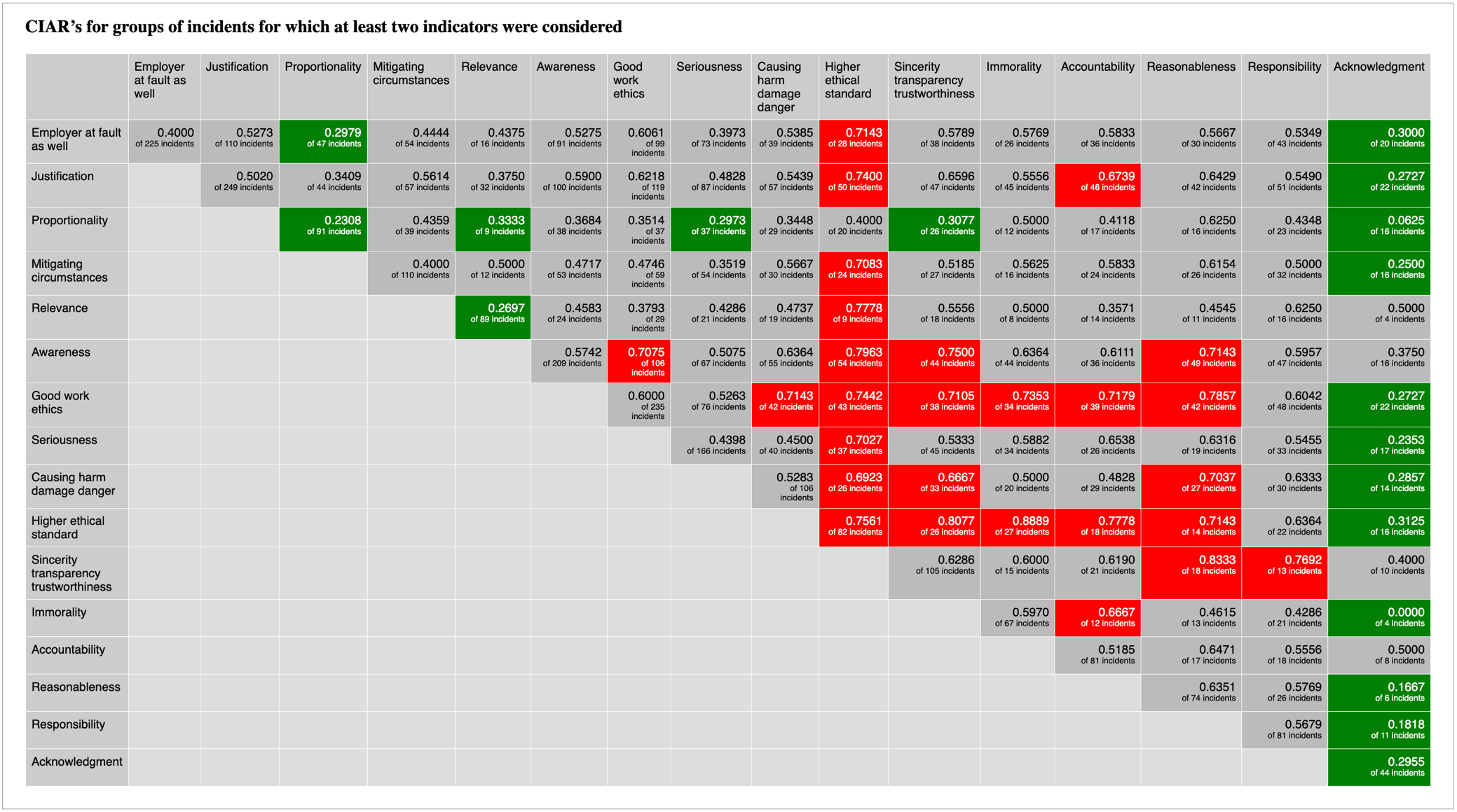
Table 1 shows the IARs I found. They can also be seen in Figure 1, by looking at the diagonal line going from the top left to the bottom right of the table.
I subsequently grouped alleged incidents of misconduct by combinations of indicators considered in the courts’ deliberations. Where I previously counted cases in which indicator A was found, I now counted cases in which indicator A and indicator B were found, cases in which indicator A and indicator C were found, and so on and so forth.
It should be noted that the categories for the indicators that were found are not disjoint, they are overlapping. For an incident to be included in an indicator’s corpus, it is sufficient if the court considered arguments that manifest that indicator when resolving the incident. Whether or not one or more other indicators could also be found in the court’s deliberations was not relevant. This is not problematic for the research, as it does not mean that the grouping is wrong. It just means that one could further refine data into subcategories in which an additional indicator is or is not included.
I then calculated for each of these groups the percentage of incidents where the courts found the alleged behavior to be reproachable and where they did not. As mentioned above, I will refer to each group’s percentage of reproachable incidents as the Combined Incident Acceptance Ratio (CIAR) for that group.
Example. As mentioned, the Incident Acceptance Ratio (IAR) for the indicator of ”awareness” is 120/209 or 57.42 percent. This ratio can be found in the sixth row, sixth column of Figure 1. The indicator of ”employer at fault as well” was found in courts’ deliberations on 225 alleged incidents of misconduct. In 90 of these alleged incidents, the Courts confirmed that the employee had misbehaved. The IAR for this second indicator is 90/225, or 40.00 percent. This ratio can be found in the first row, first column of Figure 1. The number of alleged incidents for which both these indicators were found is 91. In 48 of these alleged incidents, the courts confirmed that the employee had misbehaved. The Combined Incident Acceptance Ratio (CIAR) of these indicators is 48/91, or 52.75 percent. This ratio can be found in the first row, sixth column of Figure 1.
Because I am interested in case outcome prediction, I searched for categories that were ruled mostly in favor of either one of the parties. Categories that have a pronounced effect in being either employee-friendly or employer-friendly may be useful in predicting the outcome of future cases. I believe such a pronounced effect to exist when a category of incidents has a CIAR of either one-third or lower or two-thirds or higher.23
By comparing the difference between a combination’s CIAR and the IARs of the two indicators included in the combination, the relative strength of the two indicators can be determined. Consider, for example, indicator A having an IAR of 20 percent, indicator B having an IAR of 60 percent and the combination of indicators A and B having a CIAR of 50 percent. The difference between the CIAR and the first IAR is 30 percent, the difference with the second IAR is -15 percent. This means that indicator A is twice as affected by the combination as indicator B is, meaning the latter has more relative strength than the former.
A few words on why this study is limited to pairs of indicators and did not include groups of incidents for which more than two indicators were found. Each group of incidents for which two indicators are considered is a sub-group of both groups of incidents for which either of the indicators is considered. This pattern would repeat itself if groups of incidents for which three specific indicators are considered were analyzed. Those groups would be sub-groups of groups for pairs of two of the three indicators, they would also be sub-groups of groups of incidents for which either of the three indicators are considered. One could continue by adding more indicators.
Increasing the number of indicators makes the analysis increasingly granular, possibly bringing additional combinations of n + 1 different indicators with sufficient predictive value to the surface. However, adding additional indicators to the analysis decreases the size of the groups, which makes them less suitable as a basis for general statements about my findings. For this reason, the analysis has been limited to pairs of indicators and does not analyze combinations of three or more indicators.
This also means that the selection criteria used to create groups of decisions only required that two or more specific indicators were found in the courts’ reasoning underlying those decisions. It is important to note that it was not required that those two indicators were the only ones considered by the courts (see section 5.1). Therefore, the effects I found cannot be attributed exclusively to the principles underlying these indicators required for each group of cases.
I obtained corpuses for 120 unique combinations of two indicators and computed the CIAR as the percentage of total confirmed incidents out of the total incidents included in the corpus for each co-occurring pair. Figure 1 shows the results.
Figure 1. IARs for groups requiring the co-occurrence of at least two indicators.
The table shows the CIARs for pairs of indicators. Cells on the diagonal line going from the top left to the bottom right represent the findings of my previous research that focused on the mere occurrence of individual indicators that is depicted in Table 1.
There are 120 pairs of two different indicators. These are groups of incidents for which two or more indicators are considered in the courts’ legal reasoning. As shown in Figure 2, each of these groups contains the incidents for which two of the main groups created in my previous research on individual indicators overlap.
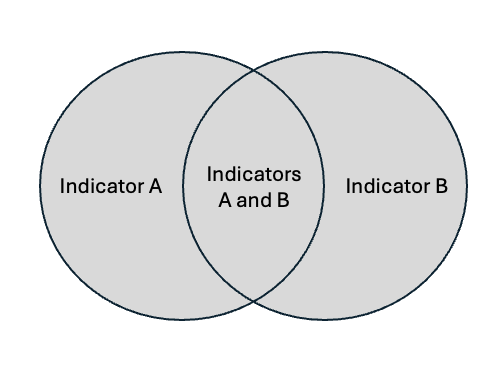
Figure 2. Overlapping groups of cases for indicators A and B.
The subgroups refine findings for the main groups where only one indicator was required. They deepen our understanding of the indicators found in my previous work.
Fifteen of the pairs of two different indicators are combinations of two employee-favoring indicators, 26 of them are combinations of two employer-favoring indicators, and 69 are mixed combinations. For most of the possible combinations, the CIARs stay between the one-third boundaries, these have limited predictive value. In the following sub-sections, I will address the combinations that do have sufficient predictive value.24
Forty-one combinations of two indicators were found for which the CIAR is either below one-third or greater two-thirds. Some of these combinations include one or two indicators that meet either of those thresholds by themselves (see further section 6.1.1). I also found pairs that meet either of those thresholds, while neither of the indicators included in those pairs do so by themselves (see further section 6.1.2).
In my previous research, I found four indicators that have sufficient predictive value by themselves. These are the employee-friendly indicators of “relevance” and “proportionality” and the employer-friendly indicator that employment contract termination is more likely when a higher-than-normal ethical standard applies to the employee, and the employer-friendly indicator of “acknowledgment.”
When analyzed in co-occurrence with other indicators, the two employee-friendly indicators of “relevance” and “proportionality” lose much of their predictive strength. When analyzing CIARs for pairs of indicators, only one of the pairs that include the indicator for “relevance” has a CIAR that is below the one-third threshold. Only four out of fourteen pairs that include the indicator for “proportionality” have a CIAR that is below that threshold.
By contrast, the employer-friendly indicator of a higher ethical standard being applicable retains much of its predictive strength, twelve out of fifteen pairs have a CIAR that exceeds two-thirds.25
I found thirteen pairs of indicators that have sufficient predictive value, while neither of the indicators that make up those pairs does so individually. These pairs of two different indicators have a CIAR of less than one-third or more than two-thirds.26 These pairs are important, as they widen the scope of scenarios that have sufficient predictive value beyond those I found in my previous work. Their cells have been given a green or red background, respectively, in Figure 1. Table 4 summarizes these findings.
The indicators in the columns for “Indicator 1” and “Indicator 2” benefit up to differing extents from being combined with other indicators. These subgroups have sufficient predictive value, while neither of their parent groups does.
For example, “good work ethics” and “awareness” have IARs of 60.00 percent and 57.42 percent, respectively. Neither exceeds the two-thirds threshold set for sufficient predictive value. When found together, their CIAR is 70.75 percent, which means that together they do have sufficient predictive value. Similarly, “sincerity, transparency and trustworthiness” and “awareness” have IARs of 62.86 percent and 57.42 percent, respectively, and their CIAR is 75.00 percent. By themselves, neither has sufficient predictive value, but as a pair they do.
Almost half of these thirteen pairs contain the employer-friendly indicator of “good work ethics.” They have CIARs that exceed the upper threshold of two-thirds. While it lacks sufficient predictive value for employment termination by itself, this indicator does exceed the predictability threshold when found together with six of the other employer-friendly indicators. Almost all pairs that include the “higher ethical standard” indicator have sufficient predictive value. The only exception is the employee-favoring indicator of “proportionality.” “Good work ethics” and “higher ethical standard” can be seen as high-risk indicators for employees, who should pay special attention to potential issues related to these themes during court proceedings.
| Table 4. Pairs of indicators that have sufficient predictive value, while neither of the indicators that make up those pairs do. | ||||||
|---|---|---|---|---|---|---|
| Indicator 1 | Type | IAR | Indicator 2 | Type | IAR | CIAR |
| Good work ethics | Employer-friendly | 60.00% | Awareness | Employer-friendly | 57.42% | 70.75% |
| Good work ethics | Employer-friendly | 60.00% | Causing harm, damage or danger | Employer-friendly | 52.83% | 71.43% |
| Good work ethics | Employer-friendly | 60.00% | Sincerity, transparency, trustworthiness | Employer-friendly | 62.86% | 71.05% |
| Good work ethics | Employer-friendly | 60.00% | Immorality | Employer-friendly | 59.70% | 73.53% |
| Good work ethics | Employer-friendly | 60.00% | Accountability | Employer-friendly | 51.85% | 71.79% |
| Good work ethics | Employer-friendly | 60.00% | Reasonableness | Employer-friendly | 63.51% | 78.57% |
| Causing harm, damage or danger | Employer-friendly | 52.83% | Reasonableness | Employer-friendly | 63.51% | 70.37% |
| Sincerity, transparency, trustworthiness | Employer-friendly | 62.86% | Awareness | Employer-friendly | 57.42% | 75.00% |
| Sincerity, transparency, trustworthiness | Employer-friendly | 62.86% | Causing harm, damage or danger | Employer-friendly | 52.83% | 66.67% |
| Sincerity, transparency, trustworthiness | Employer-friendly | 62.86% | Reasonableness | Employer-friendly | 63.51% | 83.33% |
| Sincerity, transparency, trustworthiness | Employer-friendly | 62.86% | Responsibility | Employer-friendly | 56.79% | 76.92% |
| Accountability | Employer-friendly | 51.85% | Justification | Employee-friendly | 50.20% | 67.39% |
| Accountability | Employer-friendly | 51.85% | Immorality | Employer-friendly | 59.70% | 66.67% |
It is striking that none of the subgroups in Table 4 are made up of two employee-favoring indicators. The data shows that combining employee-friendly indicators does not benefit employees. In fact, in most cases, the CIAR for the combination of two employee-friendly indicators is higher than each of the IARs for the individual indicators.
For example, “justification” and “mitigating circumstances” have IARs of 50.20 percent and 40.00 percent, respectively. When found together, their CIAR is 56.14 percent. Paradoxically, the chance of employment termination is higher when these two employee-friendly indicators have been considered, in comparison with each of their IARs.
Table 5 details the IARs and CIARs for each possible pair of two employee-friendly indicators.
| Table 5. CIARs and IARs of pairs of employee-friendly indicators. | ||||||
|---|---|---|---|---|---|---|
| Indicator 1 | Type | IAR | Indicator 2 | Type | IAR | CIAR |
| Employer at fault as well | Employee-friendly | 40.00% | Justification | Employee-friendly | 50.20% | 52.73% |
| Employer at fault as well | Employee-friendly | 40.00% | Proportionality | Employee-friendly | 23.08% | 29.79% |
| Employer at fault as well | Employee-friendly | 40.00% | Mitigating circumstances | Employee-friendly | 40.00% | 44.44% |
| Employer at fault as well | Employee-friendly | 40.00% | Relevance | Employee-friendly | 26.97% | 43.75% |
| Justification | Employee-friendly | 50.20% | Proportionality | Employee-friendly | 23.08% | 34.09% |
| Justification | Employee-friendly | 50.20% | Mitigating circumstances | Employee-friendly | 40.00% | 56.14% |
| Justification | Employee-friendly | 50.20% | Relevance | Employee-friendly | 26.97% | 37.50% |
| Proportionality | Employee-friendly | 23.08% | Mitigating circumstances | Employee-friendly | 40.00% | 43.59% |
| Proportionality | Employee-friendly | 23.08% | Relevance | Employee-friendly | 26.97% | 33.33% |
| Mitigating circumstances | Employee-friendly | 40.00% | Relevance | Employee-friendly | 26.97% | 50.00% |
To further improve case outcome predictability, I also calculated how CIARs of pairs of indicators differ from the individual IARs of each of the two indicators involved. Figure 3 displays my findings for each pair of indicators, quantifying the differences between the CIARs and the IARs for both indicators involved for each of the pairs. The table shows how the outcomes for pairs of indicators deviate from the outcome of each of the indicators included in those pairs.
Figure 3 shows CIARs for combinations of indicators and how they differ from each of the IARs of the indicators that make up those combinations. A few examples may help readers understand how to analyze the data in Figure 3.
Example 1. “Good work ethics” has an IAR of 60.00 percent, “relevance” has an IAR of 26.97 percent. The CIAR for the pair of these indicators is 37.93 percent. The comparison with the IAR for “good work ethics” is seen in row five, column seven of Figure 3. Here, we read that the CIAR is 22.07 percent lower than the IAR for “good work ethics” (37.93% minus 60.00%). In row seven, column five we read that the CIAR is 10.96 percent above the IAR for “relevance” (37.93% minus 26.97%). Compared to its IAR, “good work ethics” gives in more to ‘relevance’ than the other way around. Therefore, “relevance” has more relative strength than “good work ethics.”
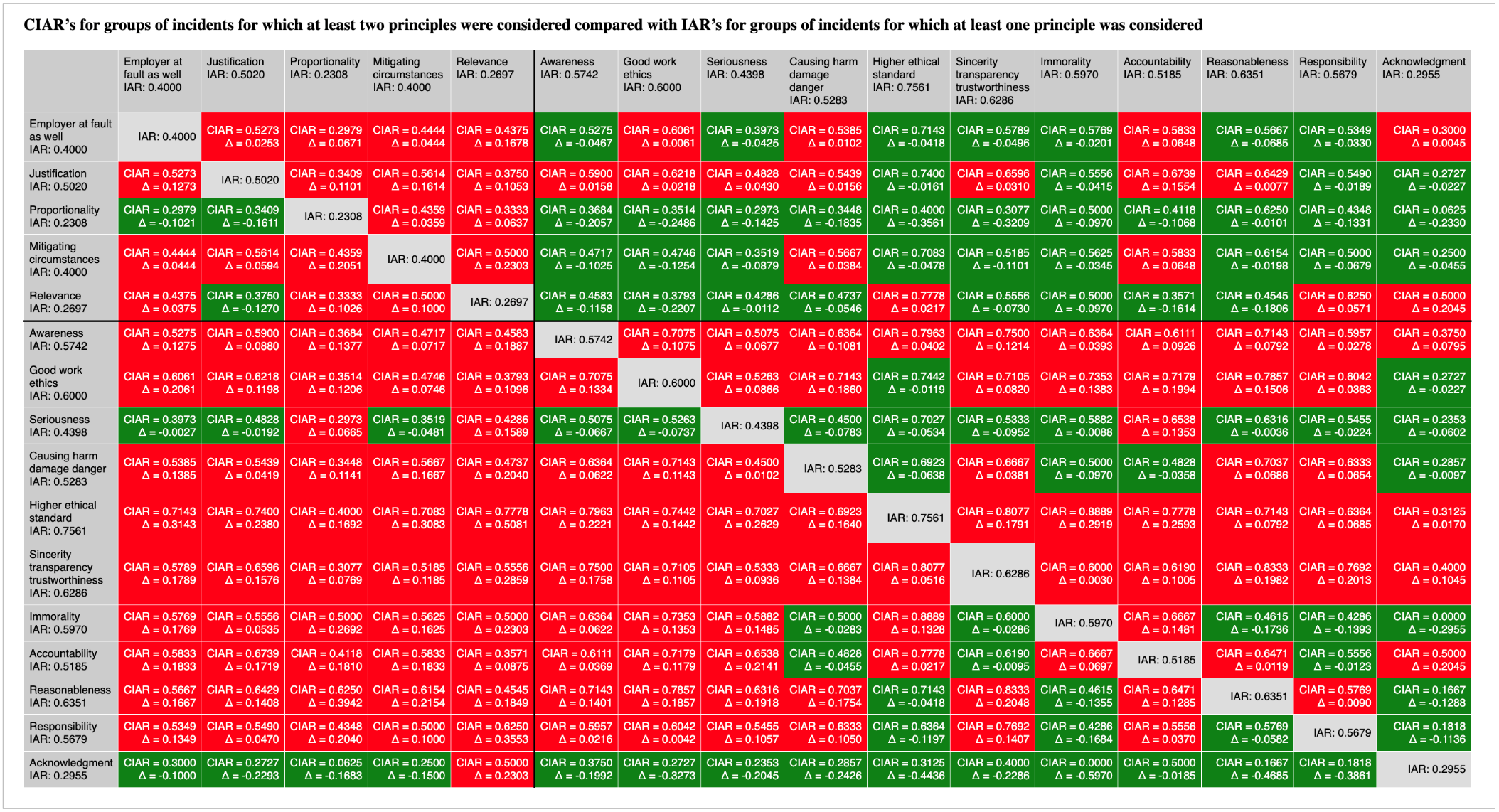
Figure 3. CIARs and IAR’s compared.
Example 2. The combination of “higher ethical standard” (IAR = 75.61%) and “proportionality” (IAR = 23.08%) has a CIAR of 40.00 percent. The comparison with the IAR for “higher ethical standard” is seen in row three, column ten of Figure 3. Here, we read that the CIAR is 35.61 percent below the IAR for “higher ethical standard” (75.61% minus 40.00%). In row ten, column three we read that the CIAR is 16.92 percent above the IAR for “proportionality” (40.00% minus 23.08%). Compared to its IAR, “higher ethical standard” gives in more to “proportionality” than the other way around. Therefore, “proportionality” has more relative strength than “higher ethical standard.”
Example 3. The combination of “employer at fault as well” (IAR = 40.00%) and “awareness” (IAR = 57.42%) has a CIAR of 52.75 percent. The difference with the IAR for “awareness” is seen in row one, column six of Figure 3. Here we read that the CIAR is 4.67 percent lower than the IAR for “awareness” (57.42% minus 52.75%). In row six, column one we read that the CIAR is 12.75 percent higher than the IAR for “employer at fault as well” (52.75% minus 40.00%). Compared to its IAR, “employer at fault as well” gives in more to “awareness” than the other way around. Therefore, “awareness” has more relative strength than “employer at fault as well.”
Table 6 shows the relative strength of employee-friendly indicators when found in co-occurrence with employer-friendly indicators. As described in the examples above, I compared how much the CIAR is above the employee-friendly indicator’s IAR with how much the CIAR is below the employer-friendly indicator’s IAR. The one with the lowest delta is deemed to have more relative strength than the one with the highest delta.
For practical reasons, this analysis is limited to combinations of indicators where the delta between the CIAR and one or both of the IARs exceeds 10.00 percent.27 This limits the table to the most telling examples. Combinations where both deltas are less than 10.00 percent have less pronounced effect, which makes them less interesting. The explanation given in the three examples above can be applied to all other combinations of indicators listed in Figure 3, the third example is represented by the first line in Table 6.
For most of the pairs of indicators listed in Table 6, the employee-friendly indicator is weaker than the employer-friendly indicator. For example, in nine out of ten pairs that include the indicator that there is less cause for employment termination when the employer has been at fault as well, this indicator is weaker than the employer-friendly indicator. For “justification,” it is five out six pairs, for “mitigating circumstances” it is all seven pairs, and for “relevance” it is eight out of ten pairs. For most of these combinations, employers come out stronger than employees.
| Table 6. Indicators’ relative strength. | |||||
|---|---|---|---|---|---|
| Employee-friendly | Delta | Relative Strength | Employer-friendly | Delta | Relative Strength |
| Employer at fault as well | +12.75% | Weaker | Awareness | -4.67% | Stronger |
| Employer at fault as well | +20.61% | Weaker | Good work ethics | +0.61% | Stronger |
| Employer at fault as well | +13.85% | Weaker | Causing Harm, damage or danger | +1.02% | Stronger |
| Employer at fault as well | +31.43% | Weaker | Higher ethical standard | -4.18% | Stronger |
| Employer at fault as well | +17.89% | Weaker | Sincerity, transparence, trustworthiness | -4.96% | Stronger |
| Employer at fault as well | +17.69% | Weaker | Immorality | -2.01% | Stronger |
| Employer at fault as well | +18.33% | Weaker | Accountability | +6.48% | Stronger |
| Employer at fault as well | +16.67% | Weaker | Reasonableness | -6.85% | Stronger |
| Employer at fault as well | +13.49% | Weaker | Responsibility | -3.30% | Stronger |
| Employer at fault as well | +12.75% | Weaker | Awareness | -4.67% | Stronger |
| Employer at fault as well | +20.61% | Weaker | Good work ethics | +0.61% | Stronger |
| Employer at fault as well | +13.85% | Weaker | Causing Harm, damage or danger | +1.02% | Stronger |
| Employer at fault as well | +31.43% | Weaker | Higher ethical standard | -4.18% | Stronger |
| Justification | +11.98% | Weaker | Good work ethics | +2.18% | Stronger |
| Justification | +23.80% | Weaker | Higher ethical standard | -1.61% | Stronger |
| Justification | +15.76% | Weaker | Sincerity, transparency, trustworthiness | +3.10% | Stronger |
| Justification | +17.19% | Weaker | Accountability | +15.54% | Stronger |
| Justification | +14.06% | Weaker | Reasonableness | +0.77% | Stronger |
| Proportionality | +13.77% | Stronger | Awareness | -20.57% | Weaker |
| Proportionality | +12.06% | Stronger | Good work ethics | -24.86% | Weaker |
| Proportionality | +6.65% | Stronger | Seriousness | -14.26% | Weaker |
| Proportionality | +11.41% | Stronger | Causing harm, damage or danger | -18.35% | Weaker |
| Proportionality | +16.92 | Stronger | Higher ethical standard | -35.61% | Weaker |
| Proportionality | +7.69% | Stronger | Sincerity, transparency, trustworthiness | -32.09% | Weaker |
| Proportionality | +26.92% | Weaker | Immorality | -9.70% | Stronger |
| Proportionality | +18.10% | Weaker | Accountability | -10.68% | Stronger |
| Proportionality | +39.42% | Weaker | Reasonableness | -1.01% | Stronger |
| Proportionality | +20.40% | Weaker | Responsibility | -13.31% | Stronger |
| Mitigating circumstances | +16.67% | Weaker | Causing harm, damage or danger | +3.84% | Stronger |
| Mitigating circumstances | +30.83% | Weaker | Higher ethical standard | -4.78% | Stronger |
| Mitigating circumstances | +11.85% | Weaker | Sincerity, transparency, trustworthiness | +11.01% | Stronger |
| Mitigating circumstances | +16.25% | Weaker | Immorality | +3.45% | Stronger |
| Mitigating circumstances | +18.33% | Weaker | Accountability | +6.48% | Stronger |
| Mitigating circumstances | +21.54% | Weaker | Reasonableness | -1.98% | Stronger |
| Mitigating circumstances | +10.00% | Weaker | Responsibility | -6.79% | Stronger |
| Relevance | +18.87% | Weaker | Awareness | -11.58% | Stronger |
| Relevance | +10.96% | Stronger | Good work ethics | -22.07% | Weaker |
| Relevance | +15.89% | Weaker | Seriousness | -1.12% | Stronger |
| Relevance | +20.40% | Weaker | Causing harm, damage or danger | -5.46% | Stronger |
| Relevance | +50.81% | Weaker | Higher ethical standard | +2.17% | Stronger |
| Relevance | +28.59% | Weaker | Sincerity, transparency, trustworthiness | -7.30% | Stronger |
| Relevance | +23.03% | Weaker | Immorality | -9.70% | Stronger |
| Relevance | +8.75% | Stronger | Accountability | -16.14% | Weaker |
| Relevance | +18.49% | Weaker | Reasonableness | -18.06% | Stronger |
| Relevance | +35.53% | Weaker | Responsibility | +5.71% | Stronger |
Striking combinations are found for the two strongest indicators, “proportionality” (employee-friendly) and “higher ethical standard” (employer-friendly). Arguments for “proportionality” are, for example, that a less severe sanction than employment termination is appropriate, that the employee deserves a second chance, or should be given the benefit of the doubt. Examples of arguments for the application of a “higher ethical standard” are that the employee is a role model or in a position of leadership or power. While “proportionality” strongly defends the employee in general, its strength diminishes when co-occurring with the indicator for “reasonableness.” In these cases, the “reasonableness” indicator manifests in remarks indicating that it is reasonable for the employer to find certain conduct unacceptable or to stand up against it.28 On the other hand, my findings show that the indicator for “proportionality” remains strong when found in co-occurrence with either “higher ethical standard” or “sincerity, transparency and trustworthiness.”29 Arguments for the latter are, for example, that the employee lied or responded to the allegations with implausible statements, that they tried to hide their actions, that they were insufficiently transparent about the alleged incident, that they cannot be trusted, or are lacking integrity.
The principle that there may be more reason for employment contract termination when higher-than-average ethical standards apply to the employee has the highest IAR and the highest CIARs. Table 6 shows great relative strength when co-occurring with most of the employee-friendly indicators. For the combination of “higher ethical standard” and “employer at fault as well,”30 the percentage of incidents for which the courts confirmed the employee misbehaved is 71.43 percent. This exceeds the stand-alone percentage of “employer at fault as well” by 31.43 percent, while it is only 4.18 percent lower than the stand-alone percentage of “higher ethical standard.” A small drop in the chance of a favorable outcome for employers corresponds with a large drop in the chance of a favorable outcome for employees. Employers are much less affected by this scenario than employees are. The same was found for the combination of “higher ethical standard” and “mitigating circumstances”31 (30.83% and 4.78%, respectively) and for the combination of “higher ethical standard” and “relevance”32 (a staggering 50.81% and 2.17%, respectively).
The only employee-friendly indicator that is stronger than the employer-friendly “higher ethical standard” is the indicator for “proportionality.”33 For this combination, the percentage of incidents for which the courts confirmed that the employee misbehaved is 40.00 percent. This exceeds the stand-alone percentage of “proportionality” by 16.92 percent, while it is 35.61 percent lower than the stand-alone percentage of “higher ethical standard.” The drop in the chance of a favorable outcome for employers is roughly twice the drop in the chance of a favorable outcome for employees.
Both when analyzed on a stand-alone basis and when analyzed in co-occurrence with other indicators, the indicator that represents the principle that there is more cause for employment contract termination if the employee is subject to a higher ethical standard comes out as a decisive matter in many cases.
In my previous work, I found four indicators that have sufficient predictive value in themselves. I analyzed to what extent those indicators retained sufficient predictive value when combined with other indicators and found that most employee-friendly indicators do not. In this research, thirteen pairs of indicators were identified that—as a pair—have sufficient predictive value, while neither of the indicators that make up those pairs do so individually. Therefore, I broadened the scope of scenarios with sufficient predictive value. Table 4 lists these thirteen combinations of indicators.
I demonstrated that much can be learned from comparing the CIARs for pairs of indicators with the IARs I found in my previous research for each of the two individual indicators that make up those pairs.
Comparing groups of decisions in which one or more employee-favoring indicators were considered on the one hand with groups of decisions in which two or more employee-favoring indicators were considered on the other hand, revealed a striking difference. Unexpectedly, percentages of cases in which the courts found the employee’s behavior to be reproachable were mostly higher in the latter groups than those in the former groups. This effect was visible in seventeen of the twenty groups of decisions (85%) in which two or more employee-favoring indicators were considered. In other words, finding two employee favoring indicators in the court’s considerations tends to be detrimental to the employee’s chances of a favorable outcome, it increases the likelihood of their employment contract being terminated.
For employer-favoring indicators this effect was found to be much weaker. Finding two employer favoring indicators in the court’s considerations is detrimental to the employer’s chances of a favorable outcome for (only) 40 of the 120 possible combinations (33.33%).
This falsifies the hypothesis that combinations of employee-friendly indicators lower the chance that a court will find the employee’s behavior reproachable and confirms the hypothesis that combinations of employer-friendly indicators increase that chance.
A possible explanation why combinations of employee-favoring indicators are detrimental to employees’ cases that can be found in the data is, that in some cases, the court considers an employee-friendly indicator in its negative form. For example, in a case ruled by the Lower Court of Amsterdam on February 17, 2020, the Court considered that the employee did not provide a reasonable explanation for the alleged behavior. This means the employee could not provide justification for her actions.34 Other possible explanations are that courts explicitly find that an employee-friendly indicator does not match up to an employer-friendly indicator,35 or to the court’s findings in support of employment termination. For example, in a ruling of the Lower Court of Amsterdam, the Court considers that even if the employee had always functioned well in the past, this would not change its assessment of the alleged behavior.36 I also found cases in which the employee insufficiently substantiated an argument, which led the court to reject it.37 These can also explain why an employee-friendly argument found in a court’s ruling does not support the employee’s case.
Apart from these data driven explanations, the following three possible causes can be considered: (1) lawyers may argue for multiple employee-favoring indicators when they feel they have a weak case; (2) arguing for more employee-favoring indicators may weaken the case in the eyes of the court; and (3) when a court leans towards terminating an employment contract, it discusses more employee-favoring indicators, making sure that every possible legal defense has been considered, which would be in line with Dutch labor law’s objective to protect employees against unjust termination.
To investigate the third possible cause, I analyzed who put forward arguments that represent employee-favoring indicators in these groups of cases where two of these indicators had been considered by the courts. Table 7 shows my findings. The data shows that in these cases a large majority of employee-favoring indicators have been appealed to by the employees themselves. In the coding phase, no indications were found that, in general, the courts would systematically consider employee-favoring indicators out of their own initiative. This largely rules out the third possible reason why combinations of employee-favoring indicators are detrimental to employees’ cases.
| Table 7. Breakdown of arguments considered for incidents where at least two employee-friendly indicators were found in courts’ considerations by party putting forward those arguments. | |||||
|---|---|---|---|---|---|
| Indicators | In combination with indicator | Arguments put forward by | |||
| Employee | Employer | Both | Court38 | ||
| Employer at fault as well | Justification | 150 | 8 | - | 56 |
| Employer at fault as well | Proportionality | 27 | - | - | 12 |
| Employer at fault as well | Mitigating circumstances | 57 | - | - | 19 |
| Employer at fault as well | Relevance | 15 | 1 | 1 | 1 |
| Justification | Proportionality | 37 | 1 | - | 17 |
| Justification | Mitigating circumstances | 82 | 21 | ||
| Justification | Relevance | 25 | 1 | - | 9 |
| Proportionality | Mitigating Circumstances | 21 | - | - | 21 |
| Proportionality | Relevance | 5 | 1 | - | 3 |
| Mitigating circumstances | Relevance | 12 | 1 | - | 3 |
| Totals | 431 (71%) | 13 (2%) | 1 (0%) | 162 (27%) | |
Apart from this, courts occasionally mentioned that the employee did not put forward a specific additional argument and that there is no indication that such argument would be successful in the case at hand.39 An exception applies where employees did not contest the employer’s request for labor law termination. In such cases, the courts would weigh all available information and employee-favoring arguments can be found in their deliberations. These arguments have obviously been presented by the courts themselves.
Lastly, I demonstrated that analyzing CIARs for pairs of indicators in comparison with the IARs of the individual indicators involved makes visible the relative strength of indicators, determined by empirical data. To give one example, I found that “proportionality” is the strongest employee-friendly indicator, but it lost a significant part of its strength when it was found together with arguments representing the employer-friendly indicator of “reasonableness.”40 Understanding relative strength of arguments by knowing the relative strength of their underlying indicators can be a powerful tool for determining legal strategy.
Limited availability of court cases can be a cause of publication bias. In the Netherlands a limited percentage of all cases is published; for 2021, this percentage was 7.8 percent.41 Research found this percentage to be higher for employment termination cases (Kruit and Kersten 2020, 2021). For 2020, the authors report a percentage of 20 percent of all lower court cases, which they deem to be a proper degree of representation, they report 28.9 percent for 2019, including Court of Appeal cases. Hall and Wright acknowledge the possibility of publication bias in their seminal paper. They state that even if the published corpus of documents reflects a distorted view on the actual state of affairs, it would still be a valuable source for systematic analysis, because it would still be one of the most important parts of the existing legal reality (Hall and Wright 2008).
Limited access is not the only possible cause for publication bias. During my previous research, I found that a limited number of judges presided a relatively large part of the published cases. There is a possibility that these judges’ opinions have distorted the analysis. This would be the case if those opinions have led to certain indicators being over- or underrepresented in my calculations.
Third, the analyses are based on the content of the courts’ written decisions, as published on the courts’ official website. In the practical reality of day-to-day adjudication processes, it is conceivable that not every indicator discussed or thought of during the court proceedings makes it into the written verdict. This could have affected my analysis. This is a data limitation similar in nature to publication bias; I refer to my remarks above.
As noted in the description of the legal analytical framework, employers have the burden of proof for the facts presented by them in support of their request to terminate the employment agreement and employees have the burden of proof for the facts presented by them in their legal defense.
The burden of proof does not only apply to the alleged behavior, it also applies to arguments either in support of or contesting the claim that such behavior should lead to the termination of the labor agreement. Out of a total of 2,680 arguments, I counted 100 that were rejected for being insufficiently substantiated. While acknowledging that burden of proof issues may have affected my analysis up to some extent, I conclude that such impact would be limited, as they only concern 3.73 percent of all arguments.
I have not analyzed whether certain indicators correlate with other variables—such as type of employment, sector, gender, age, or legal representation—that might also help explain my findings. During the data analysis phase, it was briefly explored by examining whether correlations exist between the principles found on the one hand and the type of misconduct on the other. I did not pursue this, as focusing on such combinations of selection parameters quickly made the groups of cases too small to be statistically relevant and the possible influence of randomness too large. Additional research may create a new dataset that selects more cases for one or more of these other variables to examine the existence of such correlations.
As mentioned in the introduction, the overarching goal of my research is to increase legal certainty and consistency in the application of open-ended legal rules. This case study research proves that a systematic review of judicial decisions contributes to this goal by finding recurring patterns in the decisions that have predictive value. In this research, such patterns provided a basis for developing a cross-contextual framework that is grounded in legal principles. Taken together, these findings support the broader claim advanced in the introduction that systematic case-law analysis can partially offset the structural indeterminacy in open-ended legal rules, without undermining their capacity for context-sensitive adjudication.
I have no doubt that this methodology can be applied to numerous other open-ended legal rules. It would make clear, in detail, how such rules are applied. It would make them less of a legal black box and would give legal practitioners access to valuable ‘new’ and actionable knowledge. The current article shows that employees do not benefit from combining multiple lines of argumentation in their defense, which had previously not been described in Dutch labor law literature. Employers, however, do benefit from combining multiple lines of argumentation. In addition, my findings on arguments’ relative strength will help employers and employees improve their legal strategies.
The research revealed a catalog of indicators underlying some of the law’s basic principles that are at the basis of courts’ decisions on employees’ alleged reproachable behaviors. It is not a coincidence that the misconduct rule was found to be rooted in ethics, which is a very principles-based domain. When applying the methodology on other legal rules, recurring patterns may present themselves differently; for example, they may be more fact-driven.
As mentioned in the description of the legal framework, the Dutch Supreme Court has developed various strategies aimed to provide practical guidance for applying open-ended rules (see section 2). One of these strategies is to define a so-called catalog of viewpoints, comprising facts and circumstances, that the lower courts either can or must take into consideration. My research shows that systematic analyzes of lower court and appeal court decisions can provide solid bases for future viewpoint catalogs, which in turn would increase predictability and legal certainty.
I acknowledge that my attempts to provide input for future viewpoint catalogs has been only partially successful. This likely stems from the fact that the principles that were identified are open-ended themselves. In some respects, the solution falls prey to the very issue the research aims to address. However, this does not invalidate my work. Ambiguity is an inherent feature of our legal system—it allows the law to adapt to societal developments and the specific circumstances of individual cases. Ideally, there should be a balance between flexibility in the legal system and legal certainty. My findings indicate that, in the case of the misconduct rule, this balance is lacking, with legal certainty being insufficient. These findings also directly bear on the central tension outlined in the introduction: how to preserve the flexibility of open-ended norms while improving predictability and consistency. Based on these findings, I suggest that there may be good reasons for the legislator to consider clarifying the interpretation of reproachable behavior in the law.
Executing a systematic case law analysis involves a significant amount of work. This could be less so if courts add more detail to their written considerations. In the current study, for example, it would have helped if courts had explicitly mentioned the principles they believe to be decisive and then linking those principles to arguments and key facts of the case. This would have brought additional clarity to the courts’ reasoning. Over time, an explicit catalog of principles would have come to the surface. This would have reduced the need for interpretation of the legal reasoning and any distortions caused by it would have been avoided. Moreover, courts would be supported by having a strong framework for decision-making, which would likely increase case law consistency.
Finally, my findings also have implications for automated case-law analysis, based on Natural Language Processing. Having key decision factors explicitly mentioned in judicial decisions using a shared vocabulary would decrease ambiguity on these factors in case law text data.
Gonçalves da Silva, Luís, and Sara Leitão. 2023. "Individual Labour Law." In Constitutional Framework of European Labour Law in Italy, France, Germany, Portugal and Spain. Springer International Publishing.
Hall, Mark A., and Ronald F. Wright. 2008. “Systematic content analysis of judicial opinions.” California Law Review 96: 63-122.
Korthals Altes, E. and H.A. Groen. 2015. Asser Procesrecht 7. Wolters Kluwer.
Kruit, Pascal and I.H. Kersten. 2020. “Statistiek Ontbindingsprocedure 2018-2019: de WWZ werkt toch! Of toch niet…” ArbeidsRecht 2020 (3): 14-27.
Kruit, Pascal and I.H. Kersten. 2021. “Statistiek Ontbindingsprocedure 2020, een bijzonder WAB en coronajaar.” ArbeidsRecht 2021 (12): 27-40.
Meijer, Diederik et al. 2022. “Verwijtbaar handelen of nalaten, een categorisering.” Tijdschrift voor Ontslagrecht 2022 (4): 111-22. https://doi.org/10.5553/TvO/254253152022006004003.
Meijer, Diederik et al. 2023. “Rechtsbeginselen als beoordelingskader voor de open norm van verwijtbaar handelen als redelijke grond bij de ontbinding van de arbeidsovereenkomst.” Arbeidsrechtelijke annotaties 22 (3): 27-49. https://doi.org/10.5553/ArA/156866392023022003002.
Skolimowski, H. 1974. “Evolutionary rationality.” In PSA: Proceedings of the Biennial Meeting of the Philosophy of Science Association. Cambridge University Press.
van Lochem, Justine P. 2019. “Open normen in het huurrecht: Ruimte versus rechtszekerheid.” PhD diss., Utrecht University.
Verbruggen, Paul, ed. 2021. Methoden van systematische rechtspraakanalyse: Tussen juridische dogmatiek en data science. Boom Juridisch.
Verbruggen, Paul, and Lianne Wijntjens. 2025. “Methodological Accountability in Systematic Case Law Analysis: Insights from an Empirical Analysis in the Netherlands.” European Journal of Empirical Legal Studies 2 (1). https://doi.org/10.62355/ejels.25885.
Wiarda, G.J. 1999. Drie typen van rechtsvinding. Edited by T. Koopmans. W.E.J. Tjeenk Willink.
Wijntjes, Lianne. 2020. “Als ik nu sorry zeg, beken ik dan schuld? Over het aanbieden van excuses in de civiele procedure en de medische tuchtprocedure.” PhD diss., Tilburg University.
Vrije Universiteit Amsterdam, Amsterdam, The Netherlands, diederik@kennisbank.tax, https://orcid.org/0009-0001-8692-4823.↩︎
Skolimowski posits: “Open-ended concepts will allow us to describe without distortion living phenomena in the process of change, particularly in the process of qualitative change. […] Open-ended concepts seem to violate the principle of the invariance of meaning” (Skolimowski 1974, 190–213).↩︎
Van Lochem discusses the tension between open-ended rules and legal certainty in section 2.4.2 of her dissertation (van Lochem 2019).↩︎
In a structured analysis of 4,000 judicial decisions on liability law and medical malpractice law, Wijntjes found that offering apologies does not automatically mean that the defendant acknowledges liability, as had been argued in the literature (Wijntjes 2020).↩︎
The position and function of this provision within Duch labor law are explained in section 2.↩︎
The authors describe statutes governing dismissal due to the employee’s behavior applicable in Italy, Germany, France, Portugal and Spain. These statutes seem comparable to the Dutch misconduct rule. While their study does not focus on whether these rules are open-ended, their descriptions of these statutes indicate that they are.↩︎
The authors considered a category to be sufficiently predictive, if either in 70% or more of its decisions the court terminated the employment contract, or 30% or less of the decisions resulted in such a termination. Out of a total of 37 specific categories and one rest category, three categories scored a labor agreement termination ratio higher than 70% and ten scored a ratio of 30% or less. Sixty-six percent of the categories had employment contract termination ratios between 30% and 70%.↩︎
Law of June 14, 2014, amending multiple laws in relation to reforming dismissal law, changing the legal position of flex-workers and amending various laws in relation to the Unemployment Act, etc.↩︎
For the sake of completeness, it should be noted that the Civil Code did, and continues to, permit employers to terminate an employment contract on their own initiative in the event of gross misconduct. This aggregated form of reproachable behavior, however, falls outside the scope of this article.↩︎
Parliamentary explanations (Memorie van toelichting), Kamerstukken II 2013/14, 33818, nr. 3, 99 (my translation).↩︎
It should be noted that in its decision of October 19, 2021, the Court of Appeal of Amsterdam (ECLI:NL:GHAMS:2021:3089) listed examples of circumstances that can be relevant when deciding on the misconduct rule. The Court quoted them from the Advocate General’s advice in the case that led to the Supreme Court’s decision of May 28, 2021 (ECLI:NL:HR:2021:781). These examples are: the level of seriousness of the employer’s misconduct (considering it relevant whether the employee acted intentionally or not, or uncareful); the employee’s role; mitigating circumstances (e.g., that the employee misbehaved only once or that the employee regrets that he behaved the way he did); the employee’s performance, whether his performance was satisfactory; the duration of the employment; and the employee’s age. This list, that resembles a viewpoints catalog, was not part of the Supreme Court’s ruling. Given the existing literature, it may not come across as complete.↩︎
See for example: Court of appeal of Arnhem-Leeuwarden, May 18, 2020 (ECLI:NL:GHARL:2020:3830), section 3.10, Court of appeal of Amsterdam, October 19, 2021 (ECLI:NL:GHAMS:2021:3089), section 3.5, Court of appeal of ‘s Hertogenbosch, November 4, 2021 (ECLI:NL:GHSHE:2021:3323), section 3.9.1, Lower court of Limburg, December 14, 2021 (ECLI:NL:RBLIM:2021:9426), section 4.11, Lower court of the Northern Netherlands, September 5, 2018 (ECLI:NL:RBNNE:2018:3601), section 5.4, Lower court of Rotterdam, August 14, 2020 (ECLI:NL:RBROT:2020:7517).↩︎
The dataset created for this paper covers the period from January 1, 2016, to December 31, 2021.↩︎
For example, in a case in which a request for termination of the employment contract is based on accusations of corruption, and there is little chance of successfully contesting the facts on which these accusations are based, the employee will have a chance of success of 17.39 percent. In this scenario, the employee may be better served by trying to reach an acceptable settlement, rather than by taking the case to court. When it comes to behavioral problems, on the other hand, employers’ chances of success in court appear to be low. This could be an incentive for the employer to pursue an out-of-court-settlement.↩︎
The dataset created for this second paper covers the period from January 1, 2018 through December 31, 2021.↩︎
Often, legal decisions are based on a string of argumentative considerations, in which one argument supports the next. All arguments were selected, also underlying or ‘lower tier’ arguments, even though they may be thought of as embedded in ‘higher tier’ arguments.↩︎
A limited number of arguments were rejected by the courts for being insufficiently substantiated; see section 7.5.↩︎
The exception being the indicator for acknowledgment, which was considered in favor of the employer in 68.09 percent of the analyzed occurrences and in 31.91 percent in favor of the employee.↩︎
In this analysis I normalized arguments presented in negative form. For example, arguments about the employee’s awareness that their behavior was unacceptable are generally presented by employers, aimed to support their request to terminate the labor agreement. However, occasionally the employee argues in their defense that they were not aware of this. In both cases, the argument presumes awareness to constitute a fair reason for courts to find the employee’s behavior to be reproachable. Such arguments presented in negative form must not affect whether the underlying principle is employee-friendly or employer-friendly and have therefore been corrected.↩︎
Throughout this article, 33.33 percent will mean the same as one-third.↩︎
Throughout this article, 66.67 percent will mean the same as two-thirds.↩︎
Each case contains one or more incidents of alleged misconduct.↩︎
I use the one-third - two-thirds approach as an estimate of acceptable litigation risks for employees and employers. I appreciate that these thresholds are arbitrary. To my knowledge, empirical data on Dutch employees’ and Dutch employers’ risk appetites is lacking. I defined these thresholds to support the analysis by making the tables presented in this paper more readable. Given that the tables display data for the complete sets of combinations of categories, readers are free to use different thresholds, should they wish to do so. The overall ratios for the courts’ incident acceptance for all cases are as follows: reproachable 43.44 percent, not reproachable 56.56 percent, and unclear 0.25%.↩︎
During the data analysis, it was found that the coding for the principle of “acknowledgment” was not accurate in all cases. Given that this principle was only found in a small number of decisions, I suggest that readers ignore findings for categories that include it.↩︎
The fourth indicator, “acknowledgment,” will not be discussed here, see the previous footnote.↩︎
Footnote 23 explains why these thresholds are used.↩︎
As explained in footnote 23, the indicator for “acknowledgment” will not be included in the analysis.↩︎
See, for example, a case about sexually transgressive behavior brought before the Lower Court of The Hague (ECLI:NL:RBDHA:2020:1158), in which the court considered that the employer is entitled to ensure that such behavior is not tolerated. The court rejected the argument for proportionality that the employee should be given a second chance. Another example can be found in a case of the Lower Court of the Middle Netherlands (ECLI:NL:RBMNE:2018:5099). In this case, an airline co-pilot did not pass the alcohol test when he was boarding an aircraft for duty. The court considered that air traffic safety justifies using strict rules against the use of alcohol. As in the previous case, the court rejected the argument that the employee should be given a second chance. In the case of irregularities committed by a prison guard and three of his colleagues, the Court of Appeal of The Hague (ECLI:NL:GHDHA:2021:1135) considered that the employee could rightfully expect that the employee would report these irregularities, confirming the employer’s reasonableness in this matter. The court rejected the argument that a termination of the employment would only be called for if all lesser penalties would have been exhausted.↩︎
See, for example, a case of various breaches of integrity and self-enrichment at the employer’s expense brought before the Lower Court of the Northern Netherlands (ECLI:NL:RBNHO:2018:5537). The court considered that, due to the employee’s role as a sales manager, he could be held to high ethical standards regarding correctly administrating personal purchases. The court also mentioned that there had been no need for the employer to suffice with a more lenient penalty, thus rejecting a plea for proportionality.↩︎
This principle indicates that there is less cause for employment termination when the employer is to be blamed for the incident as well. This can either regard the course of events that led to the incident, or how the employer responded to it. Examples of arguments for this principle point to poor supervision in the workplace, the employer failing to provide sufficient training or support, the employer holding joint responsibility for the events that happened or the employer aggravating the situation. A lack of setting appropriate policies, instructions, or regulations falls in this category as well.↩︎
Mitigating circumstances are general circumstances, often employees’ personal circumstances, that cause a court to conclude that it is not appropriate to terminate the employment contract. Examples include employees acting out of emotion, shame, fear, stress, PTSD or a personality disorder, employees who have personal problems, or situations in which termination of the employment contract would have disproportionate consequences for the employee’s personal life.↩︎
For the purposes of my research, the principle of relevance prevents that alleged misconduct that has no relation to the employee’s job can provide cause for termination of the employment contract. Examples include incidents that happened away from the workplace and outside of working hours or in the employee’s private situation, as well as alleged incidents where no part of the employment contract, no company rule, or no general rule of law had been violated.↩︎
See above for brief explanations of these principles, accompanied by examples of arguments based on these principles.↩︎
Lower Court of Amsterdam, February 17, 2020 (ECLI:NL:RBAMS:2020:962). Similarly, Lower Court of North Holland, May 14, 2020 (ECLI:NL:RBNHO:2020:5485). See also Lower Court of The Hague, January 30, 2020 (ECLI:NL:RBDHA:2020:763, a care giver for the elderly stole a sweater from a patient, justifying this by saying she felt cold) and Lower Court of the Hague, February 5, 2020 (ECLI:NL:RBDHA:2020:1158, a packaging operator cannot justify making rude and sexual remarks to female colleagues by arguing this was accepted in his department’s culture).↩︎
See for example: Lower Court of the Middle Netherlands, October 26, 2021 (ECLI:NL:RBMNE:2021:5142). In this case the Court acknowledged that the employee’s autism provides mitigating circumstances, but finds the fact that the employee failed to find a solution for his problems during multiple years provides sufficient cause for employment termination.↩︎
Lower Court of Amsterdam, December 16, 2019 (ECLI:NL:RBAMS:2019:9260). Similarly: Appeal Court of The Hague, December 18, 2018 (ECLI:NL:GHDHA:2018:3731).↩︎
See for example: Appeal Court of The Hague, March 1, 2018 (ECLI:NL:GHDHA:2018:850), the Court found that the employee failed to substantiate her argument that she acted out of her emotions, and Lower Court of North Holland, December 16, 2021 (ECLI:NL:RBNHO:2021:12178). In the latter case, the employee argued he had not complied with his re-integration obligations because he suffered from a depression. The Court considered that absent medical proof for this statement and the fact that the employee did not attend the Court’s session, it cannot confirm this argument to be valid.↩︎
Note that the numbers in the column for “Court” do not only include arguments for which the wording of a court’s decision explicitly indicates that it was the court itself, that added these arguments to the legal debate. These numbers also include arguments for which there is no clear indication who appealed to them, even when they clearly favor one of the parties and it would be perfectly logical to attribute them accordingly. This may have caused the numbers in this column to be inflated to some extent.↩︎
Normally phrased as “it has not been argued, nor found that …” (In Dutch: “gesteld nog gebleken is dat …”).↩︎
Arguments for “proportionality” are, for example, that a less severe sanction than employment termination is appropriate, that the employee deserves a second chance, or should be given the benefit of the doubt. Arguments for “reasonableness,” in these cases, point out that it is reasonable for the employer to find certain conduct unacceptable or to stand up against it.↩︎
Source: Jaarverslag van de Rechtspraak 2021, p. 63.↩︎