
Information Research
Vol. 30 No. 2 2025
30 years of Information Research papers citing Professor Tom D. Wilson: a bibliometric analysis
DOI: https://doi.org/10.47989/ir30251481
Abstract
Introduction. As part of the Information Research jubilee, we present an analysis of Professor Tom D. Wilson’s impact on the journal from a citation and bibliometric perspective.
Method. Using Scopus, we identified Information Research papers that cite Wilson. We carried out a cluster analysis based on bibliographic coupling in VOSviewer and created a map showing the interrelationships between the papers and their resulting seven clusters. We then used ChatGPT to identify the themes of the clusters and finally compared citations to Wilson’s most cited works in Information Research and Scopus.
Results. The analysis shows how Wilson’s papers have contributed to a wide variety of studies with a focus on information behaviour. Papers cited in Information Research range from reviews to empirical work, and from health information to social media, as well as emotional and organisational perspectives on the use of information.
Conclusions. The variety of papers identified in seven clusters through the analysis illustrates the core role of Wilson’s work, as an editor of Information Research, and as a researcher of information behaviour.
Introduction
The first issue of Information Research was published on 1 April 1995. It included papers on document clustering (Jones et al., 1995), curriculum development (Riding et al., 1995) and information systems strategy formation (Allen, 1995). Since then, more than 1,200 publications including conference papers have been published in the journal. Throughout the journal’s history, Professor Tom D. Wilson has been a core figure, first as the initiator of the journal and then for many years taking on the role as editor. This paper takes a bibliometric approach to study Wilson’s influence on the papers published in the journal through the years. Thus, we identify his most influential papers in the journal followed by an analysis of clusters formed by papers in the journal that have cited Wilson’s work.
Methodological Approach
We used Scopus (https://www.scopus.com/), a major citation database to search for all indexed publications from Information Research (totalling 1,323). All searches were conducted on 20 February 2025, and limited to those that cited Wilson, were not editorials, and excluded publications where Wilson is an author himself, resulting in 281 records for analysis. We used VOSviewer version 1.6.20 (https://www.vosviewer.com/) to cluster and map these documents, analysing bibliographic coupling (Kessler, 1963), where documents that share a higher number of references were clustered closer together; high coupling strengths are widely regarded as a sign of semantic similarity (see, e.g., Ahlgren & Colliander, 2009; Vladutz & Cook, 1984). A total of 273 documents shared references, resulting in seven clusters, which we mapped in 1) a single overview map in VOSviewer and, 2) extracted the portions of each cluster in a distinct map. We used the free and interactive version 4.0 of ChatGPT (https://chatgpt.com/) to extract five keywords and to summarise each cluster in two sentences based on the publication titles. Finally, we isolated references to any of Wilson’s work from Information Research papers and compared the resulting number of citations to the total number of citations in Scopus. Our aim was to identify any of his publications that have been of particular interest to Information Research authors.
Results
Citation Analysis
Seven Wilson papers received ten citations or more in Information Research (see Table 1). The most cited paper presents the nested model of information behaviour (Wilson, 1999). Other influential papers include Wilson’s historical view and status of human information behaviour (2000), his paper on motivations for seeking behaviour (1981) and a paper on the interdisciplinary nature of information behaviour (1997).
| Cited papers | Number of citations in Information Research | Number of
citations in Scopus |
| Wilson (1999), JDoc, 55(3), 249–270 | 96 | 1398 |
| Wilson (2000), Informing Science, 3(2), 49–55 | 79 | 1149 |
| Wilson (1981), JDoc, 37(1), 3–15 | 68 | 924 |
| Wilson (1997), IP&M, 33(4), 551–572 | 38 | 658 |
| Wilson et al. (2002), JASIST, 53(9), 704-715 | 13 | 120 |
| Wilson (2010), Information Research, 15(4) | 12 | 76 |
| Wilson (2006), Information Research, 11(4) | 11 | 85 |
Table 1. Most cited Wilson papers in Information Research.
Cluster Analysis
The second part of the analysis is based on the cluster map presented in Figure 1, where seven clusters are formed in the co-citation analysis. On the map, the size of the circles is determined by the number of citations received in Scopus. In this study we focus on the four largest clusters, as they are formed by papers with stronger links between them and are thus more coherent compared to clusters five (purple), six (turquoise) and seven (orange). The four largest clusters are summarised by size and keywords in Table 2.
Cluster one, the largest cluster (red) on the map, consists of sixty-five papers. This cluster covers topics such as academic and professional research, represented by a paper on the information- seeking behaviour of graduate students (George et al., 2006). Järvelin and Ingwersen’s (2004) paper on the directions of information-seeking research is general research on information-seeking behaviour, while Fisher et al.’s (2004) paper on migrant Hispanic farm workers illustrates the theme of cultural and societal influences on information behaviour. The health and medical area is exemplified by Courtright’s (2005) paper on health information seeking.
Cluster two (green) includes topics on health, affect and emotions. Highly cited papers include Kim et al.’s (2007) paper on information overload of cancer patients, Heinström’s (2000) work on personality and learning and Savolainen’s (2015) study of emotional expressions on immigration in a Finnish discussion group. Bronstein and Knoll’s (2015) study of female bloggers suffering from infertility is an example of social media studies also covered by the cluster.
Cluster three (blue) includes topics such as information behaviour in professions, represented by Demiryurek et al.’s (2008) study on dairy farmers and information, while health and lifestyle information seeking is covered by Morey’s (2007) paper on health information in an African American community. Pálsdóttir’s (2011) study of elderly Icelanders serves as an example of the cluster’s focus on everyday information behaviour.
Cluster four (yellow) covers work and organisation-oriented topics such as knowledge management, decision-making and information culture. In this cluster, highly cited papers in Scopus include Bouthillier and Shearer’s (2002) paper on knowledge and information management in organisations, Savolainen’s (2017) review on knowledge sharing and communication and Popovič et al.’s (2009) work on the impact of business intelligence maturity on information quality.
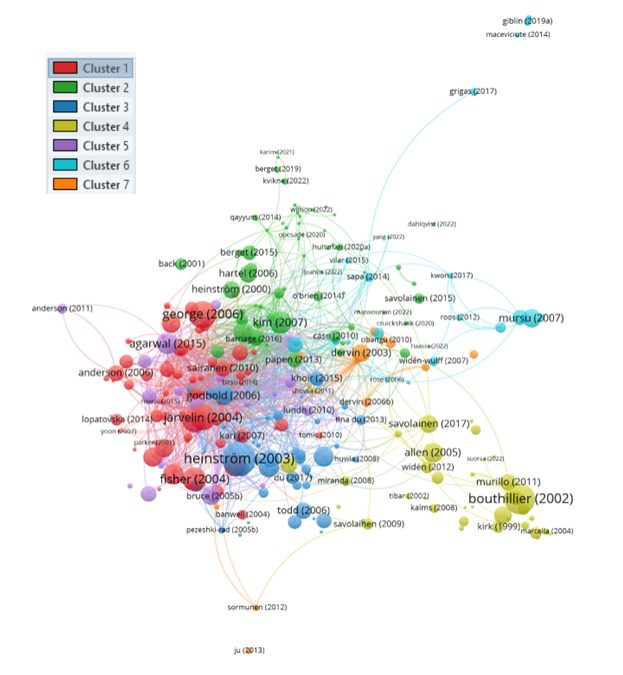
Figure 1. Cluster map of papers citing Wilson, represented by authors and year, based on document-level bibliographic coupling (Scopus data visualised using VOSviewer).
| Cluster | Number of papers | Keywords |
| 1 (red) | 65 | Information-seeking behaviour; social media & technology; health & medical decisions; academic & professional research; cultural & societal influences |
| 2 (green) | 63 | Affect & emotions in information behaviour; health & medical information seeking; social media & online interactions; academic & digital research; trust & decision-making |
| 3 (blue) | 47 | Everyday & workplace information behaviour; health & lifestyle information seeking; cultural & social influences; digital literacy & accessibility; information behaviour in professions & academia |
| 4 (yellow) | 39 | Business intelligence & knowledge management; organisational information culture; managerial & workplace information behaviour; information sharing & collaboration; environmental scanning & decision-making |
Table 2. The four strongest clusters based on
document-level bibliographic coupling
(Scopus data visualised using VOSviewer).
Concluding Remarks
This paper has focused on Professor Tom D. Wilson’s contribution to Information Research. In his most influential papers, he has outlined the field of information behaviour and the information user (e.g. Wilson, 1981, 2000), addressed interdisciplinarity (Wilson, 1997), and coined the nested model of information behaviour (Wilson, 1999). The cluster analysis has shown how these and other papers by Wilson have served as a cornerstone for later studies on information behaviour. In Information Research, Wilson’s work has laid the groundwork for empirical work on a variety of topics, such as health, the workplace, leisure and emotional aspects of information seeking. Together, these papers highlight the impact of Wilson's editorial leadership of Information Research, his research on information behaviour and his foundational contributions to both empirical and theoretical scholarship in the field.
References
Ahlgren, P., & Colliander, C. (2009). Document–document similarity approaches and science mapping: experimental comparison of five approaches. Journal of Informetrics, 3(1), 49–63. https://doi.org/10.1016/j.joi.2008.11.003
Allen, D. K. (1995). Information systems strategy formation in Higher Education Institutions. Information Research, 1(1), paper 3. https://informationr.net/ir/1-1/paper3.html (Archived at https://web.archive.org/web/20210501085422/http://www.informationr.net/ir/1-1/paper3.html)
Bouthillier, F., & Shearer, K. (2002). Understanding knowledge management and information management: the need for an empirical perspective. Information Research, 8(1), paper 141. https://informationr.net/ir/8-1/paper141.html (Archived at https://web.archive.org/web/20210425070822/http://informationr.net/ir/8-1/paper141.html)
Bronstein, J., & Knoll, M. (2015). Blogging motivations of women suffering from infertility. Information Research, 20(2), paper 669. https://informationr.net/ir/20-2/paper669.html (Archived by WebCite® at http://www.webcitation.org/6Z1FCbO0C)
Courtright, C. (2005). Health information-seeking among Latino newcomers: an exploratory study. Information Research, 10(2), paper 224. https://informationr.net/ir/10-2/paper224.html (Archived at https://web.archive.org/web/20210413004644/http://informationr.net/ir/10-2/paper224.html)
Demiryurek, K., Erdem, H. I., Ceyhan, V., Atasever, S., & Uysal, O. (2008). Agricultural information systems and communication networks: The case of dairy farmers in the Samsun province of Turkey. Information Research, 12(2), paper 343. https://informationr.net/ir/13-2/paper343.html (Archived at https://web.archive.org/web/20211010185527/https://informationr.net/ir/13-2/paper343.html)
Fisher, K. E., Marcoux, E., Miller, L. S., Sánchez, A., & Cunningham, E. R. (2004). Information behaviour of migrant Hispanic farm workers and their families in the Pacific Northwest. Information Research, 10(1), paper 199. https://informationr.net/ir/10-1/paper199.html (Archived at https://web.archive.org/web/20210413004555/http://informationr.net/ir/10-1/paper199.html)
George, C., Bright, A., Hurlbert, T., Linke, E. C., St. Clair, G., & Stein, J. (2006). Scholarly use of information: Graduate students’ information seeking behaviour. Information Research, 11(4), paper 272. https://informationr.net/ir/11-4/paper272.html (Archived at https://web.archive.org/web/20210413010118/http://informationr.net/ir/11-4/paper272.html)
Heinström, J. (2000). The impact of personality and approaches to learning on information behaviour. Information Research, 5(3), paper 78. https://informationr.net/ir/5-3/paper78.html (Archived at https://web.archive.org/web/20210418154809/http://informationr.net/ir/5-3/paper78.html)
Järvelin, K., & Ingwersen, P. (2004). Information seeking research needs extension toward tasks and technology. Information Research, 10(1), paper 212. https://informationr.net/ir/10-1/paper212.html (Archived at https://web.archive.org/web/20210413003919/http://informationr.net/ir/10-1/paper212.html)
Jones, G., Robertson, A. M., Santimetvirul, C., & Willett, P. (1995). Non-hierarchic document clustering. Information Research, 1(1), paper 1. https://informationr.net/ir/1-1/paper1.html (Archived at https://web.archive.org/web/20210518194400/http://informationr.net/ir/1-1/paper1.html)
Kessler, M. M. (1963). Bibliographic coupling between scientific papers. American Documentation, 14(1), 10–25. https://doi.org/10.1002/asi.5090140103
Kim, K., Lustria, M. L. A., Burke, D., & Kwon, N. (2007). Predictors of cancer information overload: Findings from a national survey. Information Research, 12(4), paper 326. https://informationr.net/ir/12-4/paper326.html (Archived at https://web.archive.org/web/20250511134453/https://informationr.net/ir/12-4/paper326.html)
Morey, O. T. (2007). Health information ties: Preliminary findings on the health information seeking behaviour of an African-American community. Information Research, 12(2), paper 297. https://informationr.net/ir/12-2/paper297.html (Archived at https://web.archive.org/web/20241225024212/https://informationr.net/ir/12-2/paper297.html)
Pálsdóttir, A. (2011). Opportunistic discovery of information by elderly Icelanders and their relatives. Information Research, 16(3), paper 485. https://informationr.net/ir/16-3/paper485.html (Archived at https://web.archive.org/web/20240626065545/https://informationr.net/ir//16-3/paper485.html)
Popovič, A., Coelho, P. S., & Jaklič, J. (2009). The impact of business intelligence system maturity on information quality. Information Research, 14(4), paper 417. https://informationr.net/ir/14-4/paper417.html (Archived at https://web.archive.org/web/20240603213458/https://www.informationr.net/ir/14-4/paper417.html)
Riding, P., Fowell, S., & Levy, P. (1995). An action research approach to curriculum development. Information Research, 1(1). https://informationr.net/ir/1-1/paper2.html (Archived at https://web.archive.org/web/20230417225728/https://informationr.net/ir/1-1/paper2.html)
Savolainen, R. (2015). Expressing emotions in information sharing: A study of online discussion about immigration. Information Research, 20(1), paper 662. https://informationr.net/ir/20-1/paper662.html (Archived at https://web.archive.org/web/20200731185443/https://informationr.net/ir/20-1/paper662.html#.XyRo-naw_RY)
Savolainen, R. (2017). Information sharing and knowledge sharing as communicative activities. Information Research, 22(3), 767. https://informationr.net/ir/22-3/paper767.html (Archived at https://web.archive.org/web/20250511140335/https://informationr.net/ir/22-3/paper767.html)
Vladutz, G., & Cook, J. (1984). Bibliographic coupling and subject relatedness. Proceedings of the American Society for Information Science, 21, 204–207.
Wilson, T. D. (1981). On user studies and information needs. Journal of Documentation, 37(1), 3–15. https://doi.org/10.1108/eb026702
Wilson, T. D. (1997). Information behaviour: An interdisciplinary perspective. Information Processing & Management, 33(4), 551–572. https://doi.org/10.1016/S0306-4573(97)00028-9
Wilson, T. D. (1999). Models in information behaviour research. Journal of Documentation, 55(3), 249–270. https://doi.org/10.1108/EUM0000000007145
Wilson, T. D. (2000). Human information behavior. Informing Science, 3(2), 49–55. https://doi.org/10.28945/576 (Archived at https://web.archive.org/web/20240809043051/https://www.informingscience.org/Publications/576)
Wilson, T. D. (2006). A re-examination of information seeking behaviour in the context of activity theory. Information Research, 11(4), paper 260. https://informationr.net/ir/11-4/paper260.html (Archived at https://web.archive.org/web/20250511141221/https://informationr.net/ir/11-4/paper260.html)
Wilson, T. D. (2010). Information sharing: An exploration of the literature and some propositions. Information Research, 15(4), paper 440. https://informationr.net/ir/15-4/paper440.html (Archived at https://web.archive.org/web/20250511141713/https://informationr.net/ir/15-4/paper440.html)
Wilson, T. D., Ford, N. J., Ellis, D., Foster, A. E., & Spink, A. (2002). Information seeking and mediated searching: Part 2. Uncertainty and its correlates. Journal of the American Society for Information Science and Technology, 53(9), 704–715. https://doi.org/10.1002/asi.10082
Copyright
Authors contributing to Information Research agree to publish their articles under a Creative Commons CC BY-NC 4.0 license, which gives third parties the right to copy and redistribute the material in any medium or format. It also gives third parties the right to remix, transform and build upon the material for any purpose, except commercial, on the condition that clear acknowledgment is given to the author(s) of the work, that a link to the license is provided and that it is made clear if changes have been made to the work. This must be done in a reasonable manner, and must not imply that the licensor endorses the use of the work by third parties. The author(s) retain copyright to the work. You can also read more at: https://publicera.kb.se/ir/openaccess