
Information Research
Vol. 30 No. 2 2025
Tom Wilson: The person and his influence on my research
DOI: https://doi.org/10.47989/ir30251502
Abstract
Introduction. Since my years as a Ph.D. student in the early 2000s, I have used Tom Wilson’s models in my research. They helped explain the field of human information behaviour to me. Later, I interacted with him during the review process of my papers for Information Research. I learned a lot more about the person, Tom Wilson, when I interviewed him for Project Oneness World.
Method, Results. In this paper, I summarize parts of my research that were shaped by Wilson’s models. Rather than reproducing his whole interview, which is available on the project website and its social media channels, I provide snippets from his interview that were the most compelling to me.
Conclusion. Through this write up, we get a glimpse of how Wilson’s models can influence the research journey of other researchers and how learnings from his life can inspire other people to follow in his footsteps.
Introduction
My earliest recollection of Tom Wilson’s work was around 2006 when, as a fresh Ph.D. student, I read his paper (Wilson, 1999) listing various models of information behaviour research. The paper included three of his own models, as well as those of Dervin, Ellis, Kuhlthau, Ingwersen, Saracevic, and Spink. His nested model, especially, of the information seeking and searching research areas (Figure 1) helped me understand the relationship between these areas.
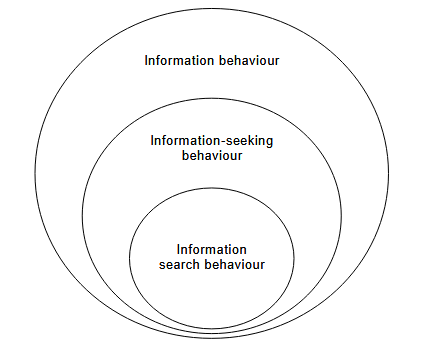
Figure 1. Wilson’s (1999, p. 263) Nested model of the information search and information seeking research areas.
In a CS6303 Information Science Theories class that I took in 2006 as part of my Ph.D. programme at the Department of Information Systems, School of Computing, National University of Singapore, I wrote a conceptual paper where I integrated various models of information seeking behaviour to come up with an integrated model. Wilson’s nested model and his 1999 paper overall were extremely helpful in that work. The way he combined Ellis’ and Kuhlthau’s framework in that paper gave me the guidance to continue that type of work with other models. It is another story that my paper went through three different journals and multiple revisions and iterations over a span of 15 years, until being finally accepted for publication in Information Research in August 2021 and published in March 2022 (Agarwal, 2022). In an email in February 2022, Wilson wrote about this paper, ‘I think it's a very useful paper - I kept saying that the various models map on to one another but never got round actually to demonstrating it, which you have done!’
Through founding and editing Information Research, Wilson showed how an open access journal could be done right and made prestigious. The thorough and rigorous review process raised the bar for the final published papers. I always noticed his announcements on the JESSE list alerting the profession to a ‘New issue of Information Research’, and to ISIC Conference – Information Seeking In Context. In January 2018, I shared information on my book, ‘Exploring Context in Information Behavior’ (Agarwal, 2018) with him. Other interactions were related to final edits for my accepted papers in Information Research.
In this paper for the special issue celebrating Tom Wilson and his contributions, I identify parts of my research where I have used Wilson’s models. I then provide snippets of my interview with him for Project Oneness World. Through this process, we can get a glimpse of how Wilson, through his models, has shaped other research journeys. Through his interview, other people can be inspired to follow in his footsteps.
Use of Wilson’s models in my research
In my first paper published in Information Research, which went through a 4-year cycle of revisions, I define serendipity in information behaviour (Agarwal, 2015). In the paper, I extend Wilson’s (1999) model shown in Figure 1 to show the place of serendipitous information encountering within information behaviour; this is presented in Figure 2. Information encountering is when you find information by chance or accident when you are not really looking for it. I map it as ‘distinct from the concept of information seeking (or purposive information seeking), although there might be overlaps’ (Agarwal, 2015).
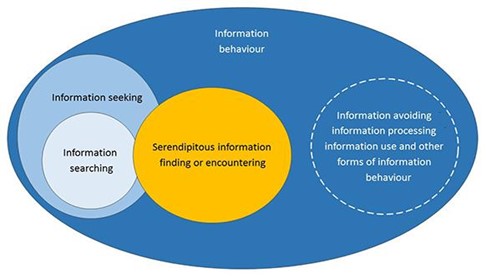
Figure 2. Seeking versus finding: placing serendipity within information behaviour (Agarwal, 2015).
In my second paper published in the journal (Agarwal, 2022) with fifteen figures and five tables, I first extend Wilson’s nested model to arrive at a model showing interrelated concepts in information seeking behaviour (Figure 3).

Figure 3. Interrelated concepts in information seeking behaviour (Agarwal, 2022).
I propose a unified model of information seeking that expands the adapted nested model of Figure 2 to include the elements from twenty-one models and eight integrated models published in the 40-year period between 1981 and 2021 (Figure 4). The model shows a person with some need looking for information from one or more sources. Wilson (1981) calls this person the information user and Wilson and Walsh (1996, ch. 7) call them the person-in-context. The sources can be human sources or books from the library. The search can also be from mobile or computer-based sources. These days, this can include search engines, social media, and artificial intelligence tools such as ChatGPT or Perplexity. The human sources may be reached face-to-face or mediated through devices. The person evaluates and processes this information that is found and might reformulate a query and repeat the process until a point when they decide to use the information or give up the search. This process happens within a certain context (see Agarwal, 2018), such as situations within a school, work, or everyday life, and is affected by several moderating variables. Wilson and Walsh (1996) term them intervening variables in their model.

Figure 4. Unified model of information seeking behaviour (Agarwal, 2022).
Among the twenty-one models that shape the unified model, two of them were Wilson’s models (Wilson, 1981; Wilson and Walsh, 1996). These include, ‘the basic steps in the seeking process, as well as moderating variables affecting seeking’ (Agarwal, 2022).
I write that Wilson (1981) ‘took a critical stance toward the term information need and preferred physiological, affective and cognitive needs as triggers of seeking’ (Agarwal, 2022). Various components of Wilson’s model map to parts of the unified model, though it does not include the overall information behaviour or context. Wilson and Walsh (1996) emphasize the context of seeking and invoke explicit theories to explain different stages of seeking.
I extend the unified model of Figure 4 to include other forms of information behaviour where a person in need of information could be collaborating with other people, looks for information from physical or online sources, may encounter information by chance, and could avoid engaging with information or even distort it leading to disinformation. This person may also organize and store information or stop using it. The person can create information or decide to share it with more people (Figure 5). In his review for my paper, Wilson pointed out that he has further expanded his model since Wilson and Walsh (1996) to include intentional and accidental modes of information discovery between activating mechanism and information seeking behaviour. An expanded model is available in Wilson (2020, p. 42).
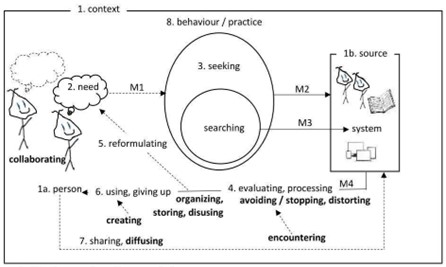
Figure 5. Unified model of information behaviour (Agarwal, 2022).
Early in 2022, I was invited to write another paper for a special issue dedicated to Tom Wilson for Informatio, a journal from Uruguay. The issue would celebrate 30 years of research in user studies, information behaviour, and information practices. I wrote about the journey so far in information behaviour research in the twenty-first century (Agarwal, 2023). As found by Wilson (2020), who I cited in my paper, information behaviour research seems to have impacted fields such as computer science, health sciences, information systems, and education.
Interviewing Tom Wilson for Project Oneness World
In August 2021, I asked Wilson if I could interview him for Project Oneness World (projectonenessworld.com), an initiative that I started in 2018, in which I interview information science leaders and stalwarts of the field. The interview itself took place over Zoom on September 17, 2021 and is available at Project Oneness World (2022) and the Project’s social media and YouTube channel. The remainder of this paper provides an overview of some aspects of the interview.
In the nearly two-hour interview, Wilson talked about his life from being born in a little rural, railway station, to losing his father early, to a 60-year career contributing to the information field, spanning several countries and continents.
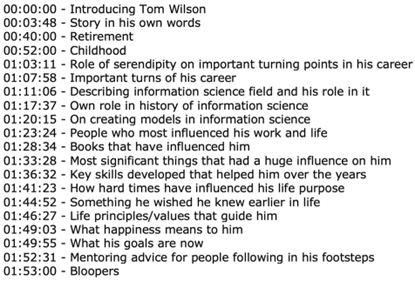
Figure 6. Timestamps in Wilson’s interview (Project Oneness World, 2022).
I provide some snippets from the interview here. He said (1:03:40), ‘I think so little in my career has been planned that probably serendipity has been dominant’.
When asked about what got him into drawing models, he said (1:20:35),
There is a crude division of people into verbalizers and visualizers … I find I'm in the middle [laughs] … Drawing diagrams helps me to think about problems … I have to try to visualize what's going on by producing a diagram … It's some innate cognitive structure that gets me doing this.
When I suggested that diagrams and models are a reduction of reality, he said,
Yes! Yes! They are not reality. They are a representation of theoretical ideas about reality…That's as close as you can get. This, of course, is why people produce different pictures for essentially the same phenomena. Because, you know, they have different minds. They have different backgrounds. They have a different understanding for what is essentially the same process: a person accessing an information resource … You will get different elaborations of that … The boxes indicate some generic phenomenon … If you wanted to get everything in the model, you would have to have a piece of paper bigger than the surface of the earth. You know it’s impossible. So, you put [generic terms] into the boxes … which the researcher can then investigate and elaborate.
When asked about life principles or values that guide him, he said (1:47:19),
I think that everybody should do their best. You know you can't ask any more of a person than that they commit to something fully and do it to the best of their ability. If they are doing that, they are doing a useful thing for humanity… So, that I think would be my primary value, ‘Do your best!’
He said that happiness to him means (1:49:12), ‘being healthy and content with what one has. That is, you know, basically it … When you get to my age [he confirmed 86 at the time of the interview], if you are healthy, you are happy! [laughs]’
After the interview, Tom Wilson emailed me: ‘Thank you - it was a pleasure - I've just thought that I should have mentioned the influence of Buddhist philosophy on my life, but perhaps that can wait for another time :-)’.
About the author
Naresh Agarwal is a Professor and Director of the Information Science and Technology Concentration in the School of Library and Information Science at Simmons University, Boston, Massachusetts, USA. He received his Ph.D. from the National University of Singapore and his research interests include information behaviour and knowledge management. He can be contacted at agarwal@simmons.edu
References
Agarwal, N. K. (2018). Exploring context in information behavior: seeker, situation, surroundings, and shared identities. SpringerNature. https://doi.org/10.2200/S00807ED1V01Y201710ICR061
Agarwal, N. K. (2022). Integrating models and integrated models: Towards a unified model of information seeking behaviour. Information Research, 27(1), paper 922. https://doi.org/10.47989/irpaper922
Agarwal, N.K. (2015). Towards a definition of serendipity in information behaviour. Information Research, 20(3), paper 675. http://informationr.net/ir/20-3/paper675.html
Agarwal, N.K. (2023). Information behavior research in the twenty-first century: The journey so far. Informatio, 28(1), a6. http://www.scielo.edu.uy/scielo.php?pid=S2301-13782023000100097&script=sci_arttext
Project Oneness World (2022, January 21). Tom Wilson: In conversation (Episode 5). https://slis.simmons.edu/blogs/projectonenessworld/?p=171
Wilson, T. D. (1981). On user studies and information needs. Journal of Documentation, 37(1), 3-15. https://doi.org/10.1108/eb026702
Wilson, T. D. (1999). Models in information behaviour research. Journal of Documentation, 55(3), 249-270. https://doi.org/10.1108/EUM0000000007145
Wilson, T. D. & Walsh, C. (1996). Information behaviour: an interdisciplinary perspective. University of Sheffield, Department of Information Studies. http://informationr.net/tdw/publ/infbehav/index.html
Copyright
Authors contributing to Information Research agree to publish their articles under a Creative Commons CC BY-NC 4.0 license, which gives third parties the right to copy and redistribute the material in any medium or format. It also gives third parties the right to remix, transform and build upon the material for any purpose, except commercial, on the condition that clear acknowledgment is given to the author(s) of the work, that a link to the license is provided and that it is made clear if changes have been made to the work. This must be done in a reasonable manner, and must not imply that the licensor endorses the use of the work by third parties. The author(s) retain copyright to the work. You can also read more at: https://publicera.kb.se/ir/openaccess