
Information Research
Vol. 31 No. 2 2026
The use of generative AI tools for students’ research support within higher education institutions’ libraries: a systematic literature review
DOI: https://doi.org/10.47989/ir31263101
Abstract
Introduction. The growth of the knowledge economy has led to the adoption of artificial intelligence (AI) tools in society, bringing opportunities and challenges in higher education. This study investigates the use of generative AI (genAI) tools for students’ research support within academic libraries and identifies emerging trends and research themes in the literature.
Method. The PRISMA guidelines were applied to the Web of Science database to collect relevant publications: seventy-one publications were selected for analysis from 256 identified items.
Analysis. We used VOSViewer software to analyse the seventy-one publications. The keyword analysis through VOSViewer allowed the identification of the research hotspots and the research focus areas.
Results. The reviewed publications covered eighteen research areas, highlighting the interdisciplinary nature of generative AI. Three research clusters representing three research areas were identified using VOSViewer. First, generative AI is reshaping the learning experiences of students in higher education; secondly, the role of academic libraries is evolving to accommodate changes brought forth by such tools; and thirdly, ChatGPT and other chatbots are being used to improve reference services for students.
Conclusion. This study highlights key trends, identifies research gaps, and suggests future directions for using generative AI tools within academic libraries to support students in their research activities, which could be extended into information literacy programmes.
Introduction
Academic libraries within higher education institutions (HEIs) worldwide are recognised for their immense information services support to teaching and learning (Adetayo, 2023). Part of this support includes the selection and acquisition of information sources, management of information systems, facilitation of literacy workshops, and provision of user-friendly study spaces (Pinto et al., 2024). Throughout the years, academic libraries have aligned their services with various developments, particularly with evolving technological innovations, to enhance the quality of students' research activities (Pierre–Robertson 2023). However, limited research has investigated the trajectory of research interest about the use of artificial intelligence (AI), particularly generative AI (genAI) tools, for students’ research support within academic libraries.
Meanwhile, research on AI in higher education has grown, focusing on three themes: the development of AI technologies, their implementation in institutional contexts, and their implications for teaching, learning, and research support (Feuerriegel et al., 2024; Kautonen, 2024; Mannheimer et al., 2024; Maphosa & Maphosa, 2021; Maphosa & Maphosa, 2023a). Traditionally, research support within higher education consists of various interventions designed to improve students' academic success (Mainardes et al., 2010). These include academic supervision, access to library resources, e-resources planning platforms, peer mentoring, writing centre support, and skills development programmes aimed at enhancing students' research capabilities (Epstein & Draxler, 2020; Gopee & Deane, 2013; Law et al., 2020; Liang et al., 2021).
Academic libraries are at the centre of research support, providing resources, such as textbooks, research tools, and scholarly databases, to support students' research activities (Epstein & Draxler, 2020; Lomness et al., 2021). Moreover, academic libraries contribute to students’ research capabilities through information and digital literacy (Deschenes & McMahon, 2024). Interestingly, the emergence of AI tools is perceived to be revolutionising the traditional students' research support activities. This is through AI systems being leveraged to formulate research questions, discover literature, and generate drafts (Feuerriegel et al., 2024; Rowland, 2023). Their 24/7 availability enables students to get immediate feedback on their writing and library reference queries (Cox & Tzoc, 2023; Panda et al., 2024).
AI systems were initially developed to classify data and find order in existing information (Bordas et al., 2024). Of late, AI systems can simulate cognitive tasks associated with humans, such as solving problems and making decisions (Bidgoli 2021; Jarrah et al., 2023; Wang 2019). To achieve this, AI uses machine learning and deep learning frameworks. Machine learning enables AI systems to learn from data without being explicitly programmed, while deep learning, a subset of machine learning, employs neural networks with multiple layers to process large, complex datasets (Bidgoli, 2021; Sherif & Ravindra, 2018). These approaches rely on foundation models, such as large language models (LLMs), to predict and generate new content (Feuerriegel et al., 2024; Mitra et al., 2024). This gave rise to generative AI tools, which are causing a paradigm shift in academia (Carroll & Borycz, 2024; Feuerriegel et al., 2024; Mitra et al., 2024).
These shifts include perceptions that generative AI tools improve students' research processes, academic writing, research project structuring, proofreading, and data analysis (Feuerriegel et al., 2024; Maphosa et al., 2026; Rowland, 2023). In some instances, lecturers are utilising generative AI tools to generate lecturing materials, presentation content, and assessment of students' content (Dogru et al., 2024; Li et al., 2024; Sekli et al., 2024). In addition, faculty and information professionals are looking at how to leverage generative AI tools to enhance information retrieval systems and knowledge synthesis (Carroll & Borycz, 2024; Zhai et al., 2024). Despite the growing interest in these tools, limited research has explored their role in supporting students' research within academic libraries.
Students’ research support in this study refers to services, tools, and interventions provided by academic libraries that assist students throughout the research process. These include searching for literature, academic writing assistance, information retrieval, research structuring, citation support, and digital literacy development (Pierre–Robertson, 2023). In the context of this review, research support was operationalised as any use of generative AI tools within academic libraries that directly facilitates students’ engagement with scholarly information, research development, or academic writing. During the study selection process, publications were included only if they discussed generative AI tools in relation to at least one of these research support activities within academic library environments.
This study investigates the use of generative AI tools for students' research support within academic library settings, using a systematic literature review to map existing research trends and identify emerging opportunities and challenges. The study is guided by two research questions:
What is the state of research on the use of generative AI tools to support academic research and writing for academic libraries?
What research themes emerge from the corpus regarding the role of academic libraries and librarians in supporting students’ use of generative AI tools for academic research and writing?
The rest of the paper is structured as follows. The next section presents the method employed for the study. This is followed by the presentation of the findings from analysing the 71 publications. Thereafter, the implications of the results are discussed. The paper concludes by summarising the implications of the findings.
Method
This study used a structured approach for synthesising existing literature (Kitchenham et al., 2009). The systematic literature review framework enables the identification, evaluation, and interpretation of literature addressing specific research questions, and facilitates the identification of research gaps, unearthing direction for future studies (Kitchenham et al., 2009; Moher et al., 2009). The Preferred Reporting Items for Systematic Reviews and Meta-Analyses (PRISMA) methodological approach guided the data collection process. This process is described in detail below.
Search strategy
We searched the Web of Science database for literature on the use of generative AI tools for students’ research support in higher education. Other databases, such as Scopus, were considered, but their outputs were relatively small. The Web of Science database was selected, because it contains high-quality, peer-reviewed publications and yielded greater results than Scopus and ERIC. The search strategy involved searching for suitable publications, using terms associated with generative AI tools and their use to support students’ research activities.
The search strategy targeted the intersection of three primary themes:
Generative AI ("generative AI" OR "artificial intelligence" OR "AI")
Research support ("research support" OR "academic research" OR "research assistance")
Target audience ("students" OR "undergraduate students" OR "graduate students" OR "higher education" OR "university students" OR "library" OR "academic library" OR "librarian" OR "information specialist")
The final search string used was as follows: TS = (("generative AI" OR "artificial intelligence" OR "AI") AND ("research support" OR "academic research" OR "research assistance") AND ("students" OR "undergraduate students" OR "graduate students" OR "higher education" OR "university students" OR "library" OR "academic library" OR "librarian" OR "information specialist")) where “TS” represents topic search. This search string was applied to titles, abstracts, and keywords within the databases to retrieve high-quality, peer-reviewed studies relevant to the topic.
The Web of Science database was chosen for its rigorous indexing standards and citation tracking capabilities. While this ensures the inclusion of high-quality studies, it may also limit the representation of emerging or practitioner-focused research that is not indexed in this database. This shortcoming is addressed in the limitations of the study.
Data extraction
We followed the PRISMA framework to identify, screen, and choose relevant literature for the study. Figure 1 summarises the process followed. The initial search yielded 265 records, which were then screened for relevance and quality. Of these, 168 records were excluded, because they were meeting notes, editorial material, datasets, abstracts, patents, letters, news, and retracted articles, leaving ninety-seven articles.

Figure 1. PRISMA flowchart for selection of publications.
This step ensured that only journal articles, books, book chapters, conference papers, dissertations, and theses were considered. We then filtered to exclude articles published in languages other than English, leaving eighty-seven articles. These eighty-seven records were assessed by reading the titles and abstracts for each publication to ascertain their eligibility. Sixteen records were excluded, because they did not pertain to all three aspects – generative AI, research support and academic libraries. Seventy-one publications met the inclusion criteria and were incorporated into the review.
Results
Descriptive statistics were used to identify the state of research by analysing publications, research trends, the geographical distribution and the subject. Qualitative and quantitative methods were employed to analyse the seventy-one publications. Keyword analysis was used to identify the research hotspots and emerging themes in this research area.
Descriptive statistics
Table 1 shows the distribution of publications across the years, with a steady growth peaking in 2024. The slight decline in 2021 could be the result of the effects of the COVID-19 pandemic that resulted in the closures of institutions, including HEIs. Despite this, there was a modest increase with 14.1% of publications in 2022 and 2023. The publications increased significantly to 64.4% in 2024. This growth in publications demonstrates a significant increase in research activity, suggesting that this topic is attracting attention from researchers and publishers.
| Year | Count | Percentage |
| 2019 | 2 | 2.8 |
| 2020 | 3 | 4.2 |
| 2021 | 1 | 1.4 |
| 2022 | 10 | 14.1 |
| 2023 | 10 | 14.1 |
| 2024 | 45 | 63.4 |
Table 1. Publication trends by year.
Table 2 shows the distribution of the articles by Web of Science research areas. It is important to note that a paper could be indexed in two subject areas. The results indicate that, in the past six years, ‘information science/library science’ has played a dominant role in the growing focus on generative AI adaptation in academic libraries to enhance students’ research activities within higher education. ‘Education Research’ follows, suggesting that there is interest in generative AI for research support within the broader education domain.
Moderate contributions emerge from ‘Computer Science’. This is expected, since AI is a computer science domain. Other areas include ‘Science and Technology’ related topics, represented by three publications and ‘Sociology’ with two publications.
| Research area | Count | Percentage |
| Information Science / Library Science | 32 | 45.1 |
| Education Research | 22 | 31 |
| Computer Science | 7 | 9.9 |
| Science and Technology | 3 | 4.2 |
| Sociology | 2 | 2.8 |
| Arts and Humanities | 1 | 1.4 |
| Communication | 1 | 1.4 |
| Geography | 1 | 1.4 |
| History | 1 | 1.4 |
| Linguistics | 1 | 1.4 |
| Literature | 1 | 1.4 |
| Mathematical Computational Biology | 1 | 1.4 |
| Psychology | 1 | 1.4 |
| Medical Research | 1 | 1.4 |
| Robotics | 1 | 1.4 |
| Social Sciences | 1 | 1.4 |
| Telecommunications | 1 | 1.4 |
| Environmental Sciences Ecology | 1 | 1.4 |
Table 2. Publication trends by year.
The remaining thirteen fields were each indexed by one publication, highlighting widespread and growing research interest. The eighteen Web of Science research areas we have represented suggest a growing research field.
Table 3 presents the geographical distribution of research contributions, using authors’ affiliations. China, the United States of America (USA), and Pakistan are the top three most producing authors, although the contributions are marginal. England, India, and Saudi Arabia each contribute four publications, with moderate contributions from Australia, South Africa, Spain, and the United Arab Emirates (UAE), with three publications. Smaller contributions with two (2.8%) publications each emerge from Indonesia, Malaysia, Romania, South Korea, and Taiwan.
The remaining countries, Canada, Chile, Colombia, Croatia, Finland, Germany, Ghana, Greece, Hungary, Ireland, Israel, Kuwait, Nigeria, Norway, Philippines, Portugal, Scotland, and Thailand, each contributed with only a single (1.4%) publication. While China and the USA dominate the landscape, the wide distribution of single contributions shows the growing interest in research in this field. The research is, however, dominated by authors based in countries in the Global North. The absence of authors based in the Global South, particularly in Africa, is a concern.
| Country | Count | Percentage |
| China | 8 | 11.3 |
| USA | 8 | 11.3 |
| Pakistan | 7 | 9.9 |
| England | 4 | 5.6 |
| Saudi Arabia | 4 | 5.6 |
| India | 4 | 5.6 |
| Australia | 3 | 4.2 |
| South Africa | 3 | 4.2 |
| Spain | 3 | 4.2 |
| United Arab Emirates | 3 | 4.2 |
| Indonesia | 2 | 2.8 |
| Malaysia | 2 | 2.8 |
| Romania | 2 | 2.8 |
| South Korea | 2 | 2.8 |
| Taiwan | 2 | 2.8 |
| Canada | 1 | 1.4 |
| Chile | 1 | 1.3 |
| Colombia | 1 | 1.3 |
| Croatia | 1 | 1.3 |
| Finland | 1 | 1.3 |
| Germany | 1 | 1.3 |
| Ghana | 1 | 1.3 |
| Greece | 1 | 1.3 |
| Hungary | 1 | 1.3 |
| Ireland | 1 | 1.3 |
| Israel | 1 | 1.3 |
| Kuwait | 1 | 1.3 |
| Nigeria | 1 | 1.3 |
| Norway | 1 | 1.3 |
| Philippines | 1 | 1.3 |
| Portugal | 1 | 1.3 |
| Scotland | 1 | 1.3 |
| Thailand | 1 | 1.3 |
| Zambia | 1 | 1.3 |
| Other (unspecified) | 12 | 16.9 |
Table 3. Geographical distribution of the authors’ affiliations.
The citation analysis showed that the seventy-one publications had been cited 657 times in 506 articles with an average of 9.25 citations per publication. These seventy-one articles have an h-index of fifteen. This means that of the seventy-one publications, fifteen have been cited at least fifteen times. The citation analysis suggests that the publications have a relatively high degree of influence within the academic community.
Table 4 shows a detailed breakdown of the citation performance for the top ten cited publications. ‘The impact of ChatGPT on higher education’ (Dempere et al., 2023) was the most cited publication, with 101 citations and an average of 33.7 citations per year. ‘AI library services conceptual framework’ (Okunlaya et al., 2022) had eighty-four citations, with an average of twenty-one citations per year. The third most cited publication is ‘The effects of HEIs' AI capability on students’ self-efficacy, creativity and learning performance’ (Wang et al., 2023), which had sixty-three citations and an average of 15.75 citations per year.
‘The awareness of AI among academic library leaders, practitioners and scientists within Indonesian HEIs’ (Harisanty et al. 2024) had forty citations and an average of ten citations per year, which is followed by ‘Implementation of AI applications among academic libraries in Taiwan’ (Huang, 2024) had thirty-five citations and an average of 8.75 citations per year. ‘Readiness of academic libraries in South Africa to support teaching, learning and research support in the Fourth Industrial Revolution’ (Ocholla & Ocholla, 2020) had thirty-four citations and an average of 5.67 citations per year. ‘Applications of AI in university libraries of Pakistan’ (Asim et al., 2023) had twenty-six citations with an average of 8.67 citations per year.
The level of knowledge of ChatGPT and the perception of its possibilities of use within HEIs’ (Lozano & Blanco-Fontao, 2023) had twenty-one citations with an average of seven citations per year. ‘Deployment of AI Chatbot virtual reference services using Google’s free Dialogflow bot platform’ (Rodriguez & Mune, 2022) had twenty citations with an average of five citations per year. ‘Academic library services extension during the COVID-19 pandemic’ (Dube & Jacobs, 2023) had nineteen citations with an average of 4.75 citations per year. These publications show that there is a growing interest in exploring the implications of generative AI on education and research within HEIs academic libraries.
| Reference | Total citation | Average per year |
| (Dempere, et al., 2023) | 105 | 35 |
| (Okunlaya et al., 2022) | 84 | 21 |
| (Wang et al., 2023) | 63 | 15.75 |
| (Harisanty et al. 2024) | 40 | 10 |
| (Huang, 2024) | 35 | 8.75 |
| (Ocholla & Ocholla, 2020) | 34 | 5.67 |
| (Asim et al., 2023) | 26 | 8.67 |
| (Lozano & Blanco-Fontao 2023) | 21 | 7 |
| (Rodriguez & Mune, 2022) | 20 | 5 |
| (Dube & Jacobs, 2023) | 19 | 4.75 |
Table 4. Citation analysis of the top ten cited publications.
Appendix A summarises the top ten cited publications. The publications are analysed through their methods, focus areas, and their core findings on the usage of generative AI tools. A wide range of research methodologies has been deployed, which reflects a growing scholarly interest in its impact on academic libraries. Quantitative methods, used in four studies, are the most frequently employed method. This is followed by the qualitative research design used in two studies. A mixed-method approach is also used in two studies, while there is only a single systematic literature review paper. The dominance of quantitative methods reflects a shift toward practical testing of generative AI’s impact on students' research activities and academic library operations.
Further analysis of the publications showed the use of several generative AI tools. The most frequently used tools include ChatGPT, Microsoft Copilot, Gemini, Claude, Perplexity AI, and AI-enabled academic search assistants, such as Elicit and Semantic Scholar integrations. Among these, ChatGPT appears most prominently in the literature, largely due to its rapid adoption within higher education. Some studies also reference locally developed chatbot systems used by academic libraries to provide virtual reference services and research assistance to students. This finding suggests that while multiple AI tools are emerging, research attention is currently concentrated on a small number of widely accessible platforms.
In addition, these tools are examined for their role in research support activities, such as academic writing assistance, proofreading, and students' learning outcomes. Generative AI tools are further applied in academic libraries to improve students' information retrieval experiences. However, concerns about fair access to advanced tools and ethical issues, such as privacy, bias, and academic integrity, persist. For instance, the unverifiability of AI-generated content raises questions about upholding academic standards. Additionally, over-reliance on these tools may hinder critical thinking and cognitive development among students.
Findings from quantitative studies reveal positive user attitudes toward generative AI tools, particularly their effectiveness in improving academic writing and the efficient information retrieval process. Nevertheless, scepticism regarding their reliability for academic research, such as literature analysis, persists, with students in one study expressing doubts about the trustworthiness of these tools (Lozano & Blanco-Fontao, 2023). Qualitative conceptual studies propose frameworks, such as AI-LSICF, to guide the ethical integration of AI tools into higher education institutions, emphasising the need for collaboration between librarians, faculty, and developers to refine these technologies for academic needs. Mixed-methods studies also highlight the potential of such tools to foster inclusivity and enhance learning experiences in developing regions, such as Pakistan and Southern Africa (Asim et al., 2023; Dube & Jacobs, 2023).
While the benefits of generative AI tools are evident in supporting academic research, enhancing library operations, and fostering inclusivity, significant challenges remain. Ethical concerns, such as privacy, trust, and reliance on outdated or non-academic sources limit their utility for rigorous academic work. Furthermore, a lack of skills in the use of these tools, and the potential for cognitive underdevelopment, resulting from over-reliance on AI, underscores the importance of balanced integration. In addition, unbalanced technological readiness across institutions and academic libraries limits the fair implementation of the tools. Collaborative efforts among librarians, faculty, and developers on ethical frameworks and tailored strategies are essential to address these challenges and ensure their responsible use.
Keyword analysis
Keyword analysis was used to uncover research hotspots and themes in the corpus. We used VOSViewer version 1.6.19 to generate a co-occurrence map based on the keywords extracted from the titles and abstracts of the seventy-one publications. During this process, we excluded structured abstract labels and copyright statements to ensure the focus remained on meaningful content. Using the full counting method, which considers the frequency of keywords in the titles and abstracts, VOSViewer identified 2,349 keywords. We set a minimum occurrence threshold to the recommended ten, resulting in fifty-nine keywords. VOSViewer then calculated the sixty percent most relevant keywords, resulting in a subset of thirty-five. To enhance clarity and avoid redundancy, we removed similar keywords and consolidated singular and plural terms, leaving thirty-two keywords.
Figure 2 shows the network visualisation map created using VOSViewer using the title, abstract and key terms of the seventy-one articles. The network visualisations show three distinct clusters, with each representing a research cluster. The red cluster is the largest, comprising nineteen keywords, followed by the green cluster with eight, and the blue cluster is the smallest with five keywords.
The red cluster focuses on generative AI and its role in reshaping the learning experience for research support. This cluster centres on educational themes, particularly the integration of AI in learning contexts. Key terms in the cluster suggest a strong focus on the competencies required for engaging with AI in higher education for research support.
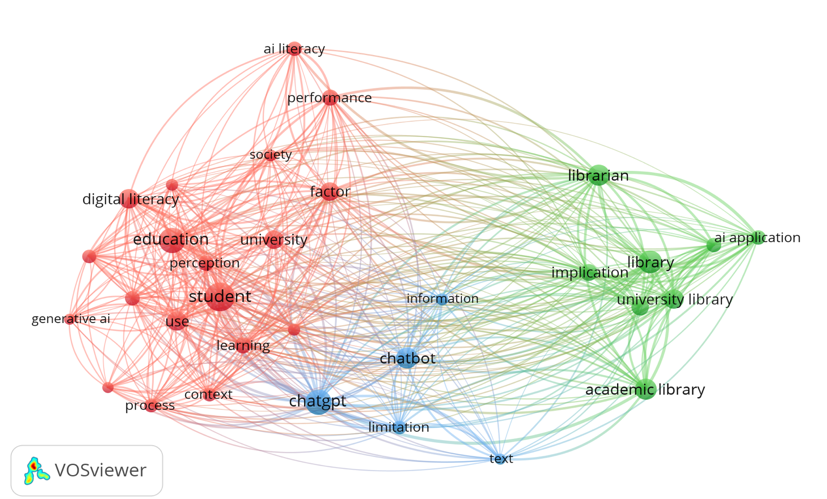
Figure 2. Network visualisation map.
The green cluster identifies academic libraries and their evolving role in supporting research activities in the AI era. Central terms, such as library, library service, university library, and implementation, suggest that this cluster explores how academic libraries are deploying generative AI tools for research support. The inclusion of implication and AI application indicates that research covers both AI use and the consequences and opportunities these technologies bring to library operations and user engagement within institutions.
The blue cluster centres on emerging AI tools, such as ChatGPT and chatbots being used by academic libraries for research support. Key terms reflect interest in both the potential and constraints of these tools. This cluster also highlights the limitations of emerging AI tools. This cluster complements the broader educational and institutional narratives, by exploring the implications of specific AI technologies currently shaping academic discourse and practice.
Figure 3 shows the density map of the research hotspots. In the map, nascent research areas are represented in turquoise, with growing research areas in green, then yellow, and the most advanced areas in red. The density map highlights distinct hotspot areas based on the frequency and co-occurrence of terms in the seventy-one publications analysed.
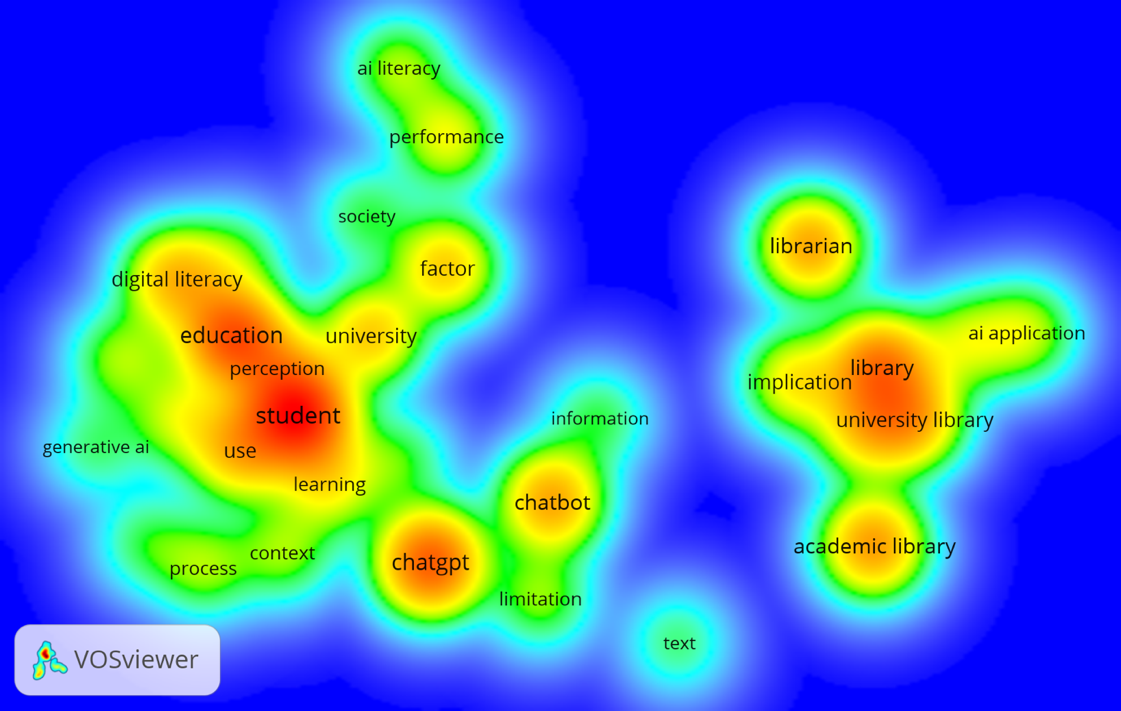
Figure 3. Density visualisation map.
The first research hotpot is centred around the key terms student, education, perception, use, and digital literacy. These terms form a research hotspot, suggesting that research focuses on how students and educational systems are engaging with AI technologies for research support. This hotspot suggests that students are still central to how academic libraries offer research support in the AI era. Surrounding this hotspot are terms context, process, and generative AI, which, while not as dominant, are frequently used to support the central discussion. Next to this hotspot, the terms university and factor appear in orange, indicating they are forming connections with the hotspot terms in research.
A second hotspot, though not as intense as the first, appears to be growing in relevance, with surrounding terms, such as implication, academic library, and AI application, also registering moderate densities. This pattern suggests an increasing scholarly interest in how academic libraries are incorporating AI technologies to enhance their services and functions for research support. The term librarian is beginning to move closer to this hotspot, indicating a possible shift in focus toward the roles and responsibilities of library professionals in adapting to generative AI tools for research support.
The third hotspot is more isolated and centres on ChatGPT, indicating moderate but growing academic attention. This hotspot is situated between the dominant student-education hotspot and a less prominent hotspot with terms chatbot, information, and limitation. While not as densely connected, the positioning of ChatGPT suggests it is becoming an area of focused inquiry for academic libraries and their role in research support. Interestingly, text appears in turquoise and stands alone, implying that it is still an emerging topic in the discourse. This positioning may signal early-stage research into the ways generative AI tools, such as ChatGPT, process and generate text, and implications for information reliability, literacy, and academic integrity.
Research on generative AI in academic libraries is evolving from exploratory discussions towards practical implementation and evaluation. Earlier studies focused primarily on awareness and conceptual frameworks, while more recent publications examine user perceptions, institutional readiness, and practical applications of the adoption of these tools, with research support. This shift indicates a maturing research field, where attention is gradually moving from theoretical exploration to applied research and institutional integration.
Discussion
For the past six years, research interest in the use of generative AI tools for student research support by academic libraries has been growing. However, this trajectory declined in 2021 because of the effects of the COVID-19 pandemic lockdown. Despite the temporary decline, there was a rush in research discourse in 2024 about generative AI within academic libraries. The growing research interest is also supported by high average citations per publication and an h-index of fifteen. However, the geographical representation of the author’s affiliation with the research interest is not balanced. This is due to authors affiliated with China and the USA dominating the research contribution, while countries in the global South are marginally represented. These findings align with an earlier study on AI in higher education that showed that global North nations lead the research contributions, while contributions from their global South counterparts are insignificant (Aigner et al., 2025; Maphosa & Maphosa, 2023b).
Despite this, countries in the global South, such as Pakistan, India, Indonesia, and South Africa, are emerging to make significant contributions in the research area. Overall, the research interest focuses on how students engage with generative AI in their research activities, their perceptions and the competencies required. The increase in the adoption of generative AI tools has resulted from their benefits in assisting students with their academic writing, proofreading, information retrieval, and literature discovery (Huang et al, 2023; Lozano & Blanco-Fontao, 2023; Wang et at., 2023; Crawford et al., 2024). Interestingly, students are using a small set of freely available generative AI tools, particularly ChatGPT (Asim et al., 2023; Ganjavi et al., 2024; Lozano & Blanco-Fontao, 2023). In addition, students also use other conversational tools, which include Microsoft Copilot, Gemini, and Claude (Abba, 2024; Iorliam & Ingio, 2024). While research assistant tools, such as Grammarly, Elicit, and Perplexity-AI, are also used by students, only a few academic libraries have subscribed to these tools on behalf of students (Asim et al., 2023; Abba, 2024; Huang, 2024). Instead, most academic libraries are exploring the potential of open access generative AI application programming interfaces to customise their traditional chatbots for reference services (Rodriguez & Mune, 2022).
Furthermore, academic librarians are redefining their roles, and those of their libraries, through adaptations of generative AI tools to improve their services. These include AI to automate indexing and cataloguing of information resources as well as 24/7 virtual reference chatbots (Dube & Jacobs, 2023; Huang, 2024; Rodriguez & Mune, 2022). There is a growing advocacy for academic libraries to adopt further guide robots for the library, such as face recognition AI for checking in and out books and natural language processing, and machine learning tools to improve database searches to meet the information needs of users (Huang, 2024; Ocholla & Ocholla, 2020). However, these benefits are associated with concerns, such as students' over-reliance on AI tools, which may impair cognitive development, privacy breaches, misuse, plagiarism, and misinformation (Dempere et al., 2023; Lozano & Blanco-Fontao, 2023). As a result, higher education institutions and academic libraries are focusing their attention on students' competencies in AI and digital literacy (Chaudhuri & Terrones, 2024). Thus, the adaptation of various frameworks, such as the Artificial Intelligence Library Services Innovative Conceptual Framework (AI-LSICF), by academic libraries have the potential to support digital transformation and integration of generative AI tools within HEIs (Okunlaya et al., 2022).
Further to this, teaching and learning practices are proposed to integrate AI and digital literacy skills to address socio-cultural factors and resource gaps (Harisanty et al., 2024; Wang et al., 2023). Despite advocacy on embedding AI frameworks within students' literacy programmes (Harisanty et al., 2024; Okunlaya et al., 2022; Wang et al., 2023), validation on the effectiveness of these is still nascent. There is also a lack of discussion on how academic libraries bridge the inequality among students when utilising paid, advanced generative AI, versus reliance on the free AI tools. However, the density map revealed key emerging and developing research hotspots in generative AI applications in academic libraries. One of the emerging trends is their impact on students' learning engagements and research activities. Furthermore, ChatGPT and the relevance of chatbots also emerge as an area of focused inquiry to improve students' research activities. Other developing research hotspots revolve around the roles of academic libraries in guiding responsible AI use, developing AI literacy programmes, and integrating AI-supported research services into existing support structures.
Conclusion
This study explored the use of generative AI tools for students’ research support within HEIs academic libraries and identified emerging trends and research themes in the literature. Our evaluation revealed that there is a growing research interest in the adaptation of these tools to enhance students’ research activities within academic libraries. This interest is centred on the potential of such tools to transform the academic writing process, literature engagement, and personalised learning. Academic libraries are also highlighted to be slowly adopting generative AI tools to improve their information services, as well as students' information engagement activities. Despite this, AI and digital literacy are emerging as key skills for students to possess to thrive in an AI-dominated educational environment and evolving knowledge economy. Academic libraries need to continue investing in training students about the ethical use of AI and digital and information literacy. This will help aid students’ capability navigating the knowledge economy transformed by AI tools. However, this cannot be the sole solution, since there is a need for synergistic universal frameworks in integrating generative AI to improve students’ research activities worldwide. Therefore, future research should explore these frameworks, as well as the long-term impacts of these tools on students’ research skills, cognitive development, and academic performance. Considering digital and information literacy as foundational skills for the usage of AI tools, there is also a need for research to map the integration of these within HEIs’ curricula. Despite the immense contribution to current knowledge on the use of generative AI, our study is limited to a systematic literature review based on Web of Science data. Therefore, it only reflects research published in indexed sources and not on grey literature and emerging studies that have not yet been indexed. Future studies may benefit from incorporating multiple databases to capture a broader representation of global scholarship, particularly research emerging from developing regions and practitioner-oriented publications.
Acknowledgements
This study has not received any funding. The authors thank the copy editors for their valuable contributions to improving the manuscript.
About the authors
Mfowabo Maphosa is a Lecturer at the Faculty of Engineering, Built Environment and Information Technology at the University of Pretoria, South Africa. He obtained an MSc in Computing from the University of South Africa and a PhD in Electrical and Electronic Engineering from the University of Johannesburg, South Africa. His research interests include artificial intelligence, STEM education, ICT4D, information systems, and project management. He can be contacted at mfowabo.maphosa@up.ac.za. ORCID: https://orcid.org/0000-0003-3702-6821.
Cyril Tlomatsana is a Librarian at the Independent Institute of Education Emeris Library in Johannesburg, South Africa. He holds a Master of Information Science from the University of South Africa. His research interests include meta-context information, information ethics, knowledge management, and information architecture. He can be contacted at stlomatsana@varsitycollege.co.za. ORCID: https://orcid.org/0009-0007-4218-7861.
References
Abba, T. (2024). Use of artificial intelligence technologies in rendering library services: An empirical evidence from university libraries in Africa. African Journal of Library, Archives and Information Science, 34(1), 23–35. https://dx.doi.org/10.4314/ajlais.v34i1.2
Adetayo, A. J. (2023). Artificial intelligence chatbots in academic libraries: The rise of ChatGPT. Library Hi Tech News, 40(3), 18–21. https://doi.org/10.1108/LHTN-01-2023-0007
Aigner, E., Greenspon, J., & Rodrik, D. (2025). The global distribution of authorship in economics journals. World Development, 189, 1–18. https://doi.org/10.1016/j.worlddev.2025.106926
Amini, L., Chen, C., Cox, D., Oliva, A., & Torralba, A. (2020). Experiences and insights for collaborative industry academic research in artificial intelligence. AI Magazine, 41(1), 70–81. https://doi.org/10.1609/aimag.v41i1.5201
Asim, M., Arif, M., Rafiq, M., & Ahmad, R. (2023). Investigating applications of artificial intelligence in university libraries of Pakistan: An empirical study. The Journal of Academic Librarianship, 49(6), 1–9. https://doi.org/10.1016/j.acalib.2023.102803
Bidgoli, H. (2021). MIS 10. Cengage. https://www.cengage.com/c/mis-10e-bidgoli/9780357418697/
Bordas, A., Le Masson, P., Thomas, M., & Weil, B. (2024). What is generative in generative artificial intelligence? A design-based perspective. Research in Engineering Design, 35(4), 427–443. https://doi.org/10.1007/s00163-024-00441-x
Carroll, A. J., & Borycz, J. (2024). Integrating large language models and generative artificial intelligence tools into information literacy instruction. The Journal of Academic Librarianship, 50(4), 1–13. https://doi.org/10.1016/j.acalib.2024.102899
Chaudhuri, J., & Terrones, L. (2024). Reshaping academic library information literacy programs in the advent of ChatGPT and other generative AI technologies. Internet Reference Services Quarterly, 29(1), 1–25. https://doi.org/10.1080/10875301.2024.2400132
Crawford, J., Allen, K. A., Pani, B., & Cowling, M. (2024). When artificial intelligence substitutes humans in higher education: The cost of loneliness, student success, and retention. Studies in Higher Education, 49(5), 883–897. https://doi.org/10.1080/03075079.2024.2326956
Cox, C., & Tzoc, E. (2023). ChatGPT implications for academic libraries. College and Research Libraries, 84(3), 99–102. https://doi.org/10.5860/crln.84.3.99
Dempere, J., Modugu, K., Hesham, A., & Ramasamy, L. K. (2023). The impact of ChatGPT on higher education. Frontiers in Education, 8, 1–10. https://doi.org/10.3389/feduc.2023.1206936
Deschenes, A., & McMahon, M. (2024). A survey on student use of generative AI chatbots for academic research. Evidence Based Library and Information Practice, 19(2), 2–22. https://doi.org/10.18438/eblip30512
Dogru, T., Line, N., Hanks, L., Acikgoz, F., Abbott, J., Bakir, S., Berbekova, A., Bilgihan, A., Iskender, A., Kizildag, M., Lee, M., Lee, W., McGinley, S., Mody, M., Onder, I., Ozdemir, O., & Suess, C. (2024). The implications of generative artificial intelligence in academic research and higher education in tourism and hospitality. Tourism Economics, 30(5), 1083–1094. https://doi.org/DOI:10.1177/13548166231204065
Dube, T. V., & Jacobs, L. (2023). Academic library services extension during the COVID-19 pandemic: Considerations in higher education institutions in the Gauteng Province, South Africa. Library Management, 44(1/2), 17–39. https://doi.org/10.1108/LM-04-2022-0039
Epstein, M., & Draxler, B. (2020). Collaborative assessment of an academic library and writing center partnership: Embedded writing and research tutors for first-year students. College and Research Libraries, 81(3), 509–537. https://doi.org/10.5860/crl.81.3.509
Feuerriegel, S., Hartmann, J., Janiesch, C., & Zschech, P. (2024). Generative AI. Business & Information Systems Engineering, 66(1), 111–126. https://doi.org/10.1007/s12599-023-00834-7
Ganjavi, C., Eppler, M., O’Brien, D., Ramacciotti, L. S., Ghauri, M. S., Anderson, I., Choi, J., Dwyer, D., Stephens, C., Shi, V., Ebert, M., Derby, M., Yazdi, B., & Cacciamani, G. E. (2024). ChatGPT and large language models (LLMs) awareness and use. A prospective cross-sectional survey of U.S. medical students. PLOS Digital Health, 3(9), 1–13. https://doi.org/10.1371/journal.pdig.0000596
Gopee, N., & Deane, M. (2013). Strategies for successful academic writing: Institutional and non-institutional support for students. Nurse Education Today, 33(12), 1624–1631. https://doi.org/10.1016/j.nedt.2013.02.004
Harisanty, D., Anna, N. E. V., Putri, T. E., Firdaus, A. A., & Noor Azizi, N. A. (2024a). Leaders, practitioners and scientists’ awareness of artificial intelligence in libraries: A pilot study. Library Hi Tech, 42(3), 809–825. https://doi.org/10.1108/LHT-10-2021-0356
Huang, Y. H. (2024). Exploring the implementation of artificial intelligence applications among academic libraries in Taiwan. Library Hi Tech, 42(3), 885–905. https://doi.org/10.1108/LHT-03-2022-0159
Iorliam, A., & Ingio, J. A. (2024). A comparative analysis of generative artificial intelligence tools for natural language processing. Journal of Computing Theories and Applications, 1(3), 311–325. https://doi.org/10.62411/jcta.9447
Jarrah, A. M., Wardat, Y., & Fidalgo, P. (2023). Using ChatGPT in academic writing is (not) a form of plagiarism: What does the literature say? Online Journal of Communication and Media Technologies, 13(4), 1–20. https://doi.org/10.30935/ojcmt/13572
Kautonen, H. (2024). Research libraries’ diverse orientations to an algorithmic future. Bibliothek Forschung Und Praxis, 48(3), 723–732. https://doi.org/10.1515/bfp-2024-0058
Kitchenham, B., Pearl Brereton, O., Budgen, D., Turner, M., Bailey, J., & Linkman, S. (2009). Systematic literature reviews in software engineering: A systematic literature review. Information and Software Technology, 51(1), 7–15. https://doi.org/10.1016/j.infsof.2008.09.009
Law, D. D., Hales, K., & Busenbark, D. (2020). Student success: A literature review of faculty to student mentoring. Journal on Empowering Teaching Excellence, 4(1), 22–39. https://doi.org/10.15142/38x2-n847
Li, J., Zong, H., Wu, E., Wu, R., Peng, Z., Zhao, J., Yang, L., Xie, H., & Shen, B. (2024). Exploring the potential of artificial intelligence to enhance the writing of English academic papers by non-native English-speaking medical students: The educational application of ChatGPT. BMC Medical Education, 24(1), 1–8. https://doi.org/10.1186/s12909-024-05738-y
Liang, W., Liu, S., & Zhao, C. (2021). Impact of student-supervisor relationship on postgraduate students’ subjective well-being: A study based on longitudinal data in China. Higher Education, 82(2), 273–305. https://doi.org/10.1007/s10734-020-00644-w
Lomness, A., Lacey, S., Brobbel, A., & Freeman, T. (2021). Seizing the opportunity: Collaborative creation of academic integrity and information literacy LMS modules for undergraduate chemistry. The Journal of Academic Librarianship, 47(3), 1–4. https://doi.org/10.1016/j.acalib.2021.102328
Lozano, A., & Blanco Fontao, C. (2023). Is the education system prepared for the irruption of artificial intelligence? A study on the perceptions of students of primary education degree from a dual perspective: Current pupils and future teachers. Education Sciences, 13(7), 1–12. https://doi.org/10.3390/educsci13070733
Mainardes, E. W., Alves, H., & Raposo, M. (2010). An exploratory research on the stakeholders of a university. Journal of Management and Strategy, 1(1), 76–88. https://doi.org/10.5430/jms.v1n1p76
Mannheimer, S., Bond, N., Young, S. W. H., Kettler, H. S., Marcus, A., Slipher, S. K., Clark, J. A., Shorish, Y., Rossmann, D., & Sheehey, B. (2024). Responsible AI practice in libraries and archives. Information Technology and Libraries, 43(3), 1–30. https://doi.org/10.5860/ital.v43i3.17245
Maphosa, M., Khoza, L., Tlomatsana, C., & Pitjo, W. (2026). Exploring postgraduate students’ use and perceptions of generative AI as a research support tool: A South African case. In A. Gerber & A. W. Pillay (Eds.), Artificial Intelligence Research (CISS, Vol. 2784,; pp. 437–451). Springer. https://doi.org/10.1007/978-3-032-11733-5_27
Maphosa, V., & Maphosa, M. (2021). The trajectory of artificial intelligence research in higher education: A bibliometric analysis and visualisation. In S. Pudaruth and U. Singh, (Eds.) 4th International Conference on Artificial Intelligence, Big Data, Computing and Data Communication Systems (icABCD), Durban, South Africa. (pp. 1–7). IEEE. https://doi.org/10.1109/icABCD51485.2021.9519368
Maphosa, V., & Maphosa, M. (2023a). Adoption of educational fourth industrial revolution tools pre and post-COVID-19 and the emergence of ChatGPT. In Reimagining education: The role of e-learning, creativity, and technology in the post-pandemic era (pp. 1–13). IntechOpen. https://doi.org/10.5772/intechopen.1001612
Maphosa, V., & Maphosa, M. (2023b). Artificial intelligence in higher education: A bibliometric analysis and topic modeling approach. Applied Artificial Intelligence, 37(1), 1–23. https://doi.org/10.1080/08839514.2023.2261730
Mitra, A., Mohanty, S. P., & Kougianos, E. (2024). The world of generative AI: Deepfakes and large language models (v1). ArXiv. https://arxiv.org/abs/2402.04373
Moher, D., Liberati, A., Tetzlaff, J., & Altman, D. G. (2009). Preferred reporting items for systematic reviews and meta-analyses: The PRISMA statement. Journal of Clinical Epidemiology, 62(10), 1006–1012. https://doi.org/10.1016/j.jclinepi.2009.06.005
Ocholla, D. N., & Ocholla, L. (2020). Readiness of academic libraries in South Africa to research, teaching and learning support in the fourth industrial revolution. Library Management, 41(6/7), 355–368. https://doi.org/10.1108/LM-04-2020-0067
Okunlaya, R. O., Syed Abdullah, N., & Alias, R. A. (2022). Artificial intelligence (AI) library services innovative conceptual framework for the digital transformation of university education. Library Hi Tech, 40(6), 1869–1892. https://doi.org/10.1108/LHT-07-2021-0242
Panda, S. K., Bhatt, A., & Satapathy, A. (2024). ChatGPT and its role in academic libraries: A discussion. New Review of Academic Librarianship, 30(4), 422–436. https://doi.org/10.1080/13614533.2024.2381510
Pierre–Robertson, P. (2023). #SuperLibrarian – The evolving role of librarians in technology spaces. Digital Library Perspectives, 39(4), 620–627. https://doi.org/10.1108/DLP-04-2023-0026
Pinto, M., Garcia-Marco, J., Caballero, D., Manso, R., Uribe, A., & Gomez, C. (2024). Assessing information, media and data literacy in academic libraries: Approaches and challenges in the research literature on the topic. The Journal of Academic Librarianship, 50(5), 1–17. https://doi.org/10.1016/j.acalib.2024.102920
Rodriguez, S., & Mune, C. (2022). Uncoding library Chatbots: Deploying a new virtual reference tool at the San Jose State University Library. Reference Services Review, 50(3/4), 392–405. https://doi.org/10.1108/RSR-05-2022-0020
Rowland, D. R. (2023). Two frameworks to guide discussions around levels of acceptable use of generative AI in student academic research and writing. Journal of Academic Language and Learning, 17(1), 31–61. https://journal.aall.org.au/index.php/jall/article/view/915/435435577
Sekli, G., Godo, A., & Véliz, J. (2024). Generative AI solutions for faculty and students: A review of literature and roadmap for future research. Journal of Information Technology Education: Research, 23, 1–23. https://doi.org/10.28945/5304
Sherif, A., & Ravindra, A. (2018). Apache spark deep learning cookbook. Packt. https://www.packtpub.com/en-us/product/apache-spark-deep-learning-cookbook-9781788474221
Wang, P. (2019). On defining artificial intelligence. Journal of Artificial General Intelligence, 10(2), 1–37. https://doi.org/10.2478/jagi-2019-0002
Wang, S., Sun, Z., & Chen, Y. (2023). Effects of higher education institutes’ artificial intelligence capability on students’ self-efficacy, creativity and learning performance. Education and Information Technologies, 28(5), 4919–4939. https://doi.org/10.1007/s10639-022-11338-4
Zhai, C., Wibowo, S., & Li, L. D. (2024). The effects of over-reliance on AI dialogue systems on students’ cognitive abilities: A systematic review. Smart Learning Environments, 11(1), 1–37. https://doi.org/10.1186/s40561-024-00316-7
Copyright
Authors contributing to Information Research agree to publish their articles under a Creative Commons CC BY-NC 4.0 license, which gives third parties the right to copy and redistribute the material in any medium or format. It also gives third parties the right to remix, transform and build upon the material for any purpose, except commercial, on the condition that clear acknowledgment is given to the author(s) of the work, that a link to the license is provided and that it is made clear if changes have been made to the work. This must be done in a reasonable manner, and must not imply that the licensor endorses the use of the work by third parties. The author(s) retain copyright to the work. You can also read more at: https://publicera.kb.se/ir/openaccess
Appendix A: A summary of the top ten cited publications
| Reference | Method | Focus | Major findings |
| (Dempere, et al., 2023) | SLR | The impact of ChatGPT in HEIs. | While there are notable benefits such as research support, automated grading and improved human-computer interaction, there are ethical concerns. |
| (Okunlaya et al., 2022) | Qualitative content design | The development of an AI library services innovative conceptual framework (AI-LSICF) to deliver value-based innovative library services. | Adaptation of AI-LSICF within academic libraries in HEIs could foster innovative change and support digital transformation of HEIs research activities through the use of AI. |
| (Wang et al., 2023) | Quantitative study design | Assessing the AI capabilities within HEIs to enhance students’ creativity, self-efficacy, and learning performance. | HEIs can effectively use AI to improve students' creativity and learning, but they first need to secure and organise three key resources, which are data, technical skills and basic resources. |
| (Harisanty et al. 2024) | Qualitative study design | The awareness of AI among academic library leaders, practitioners and scientists considering AI’s adaptation within Indonesian HEIs. | Academic library leaders are optimistic about the adaptation of AI due to its potential to support HEIs teaching, learning and research activities. |
| (Huang, 2024) | Quantitative study design | Various AI applications are used in academic libraries to improve quality of information organisation and services. | Three common AI applications are already implemented in academic libraries are automatic indexing and classification, intelligent data analysis for collection management and intelligent data analysis for circulation management. However, academic libraries need to implement guide robots, NLP and ML tools to improve database searches and facial recognition for book circulation self-services. |
| (Ocholla & Ocholla, 2020) | Quantitative content analysis | Comparison of current academic library services/trends in South Africa with the fourth industrial revolution requirements. | Academic libraries in South Africa are continuously responding to the changing environment of HEIs. These changes are associated with academic libraries adapting to emerging technological advancements that include robotics and AI. |
| (Asim et al., 2023) | Mixed-method study design | Applications of AI in university libraries of Pakistan. | AI applications deployed in Pakistan's academic libraries are limited to third parties such as Google Assistant to search through voice calls or chatbot services offered by OpenAI. Other AI applications include patrons’ recognition through bar and QR codes, face scanning and intelligent data analysis for collection development. |
| (Lozano & Blanco-Fontao 2023) | Quantitative study design | The level of knowledge of ChatGPT and its possibilities of use within HEIs from students' point of view. | Students have a positive perception of ChatGPT use within HEIs and do not perceive it as a threat to deteriorate the integrity of education if its content is verified. |
| (Rodriguez & Mune, 2022) | Experimental study design | Deployment of AI Chatbot virtual reference services on the university library website using Google’s free Dialogflow bot platform. | Implementation of AI Chatbot virtual reference services requires minimal coding knowledge using Google’s Dialogflow. This AI Chatbot is capable of helping users find information effectively beyond normal staffing hours. |
| (Dube & Jacobs, 2023) | Mixed-method study design | Academic library services extension during the COVID-19 pandemic. | Academic libraries adopted various technology advancements during COVID-19 to meet users' information needs. They used AI Chatbots to assist users with quick responses to library-related inquiries. |