
Bioarchaeological field analysis of human remains from the mass graves at Phaleron, Greece
DOI:
https://doi.org/10.30549/opathrom-12-02Keywords:
Phaleron, Greece, Archaic period, mass grave, osteologyAbstract
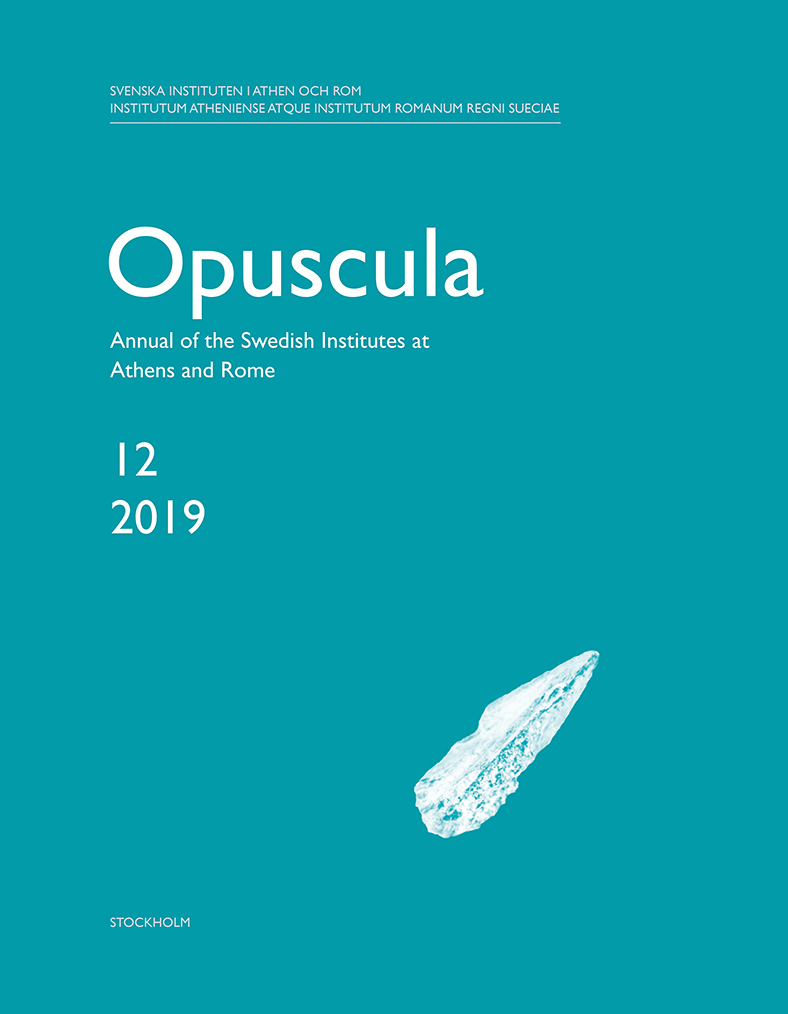
In 2016, archaeological excavations undertaken by the Ephorate of Antiquities of West Attica, Piraeus and Islands 3.8 km south-west of Athens, Greece, revealed mass burials of 79 skeletons in three rows. The burials are dated to the 7th century BC. The anthropological field documentation was undertaken by The Swedish Institute of Athens, and followed established bioarchaeological protocols regarding taphonomic processes, age, sex, injuries, and pathological changes. The descriptions and interpretations should be regarded as preliminary field observations. A majority of the individuals were young adult or juvenile males, most of them without signs of active disease and with a generally good oral health status, but with corroded iron shackles around their wrists. Cause of death could not be determined although extensive and likely perimortem fractures were observed. The only object related to injury and/or possible cause of death was an arrowhead found in the chest of one of the skeletons. Why and where the individuals were killed is a matter of conjecture; the observations from the field documentation neither validate, nor disprove the hypothesis that these individuals were captives and victims of the so-called “Cylonian conspiracy” in the 7th century BC.
Downloads
References
Angel, J.L. 1975. ‘Paleoecology, paleodemography and health’, in Population, ecology and social evolution, ed. S. Polgar, The Hague, 167–190. https://doi.org/10.1515/9783110815603.167 DOI: https://doi.org/10.1515/9783110815603.167
Arbour, L. 2008. `Blunt force trauma´, in Skeletal trauma. Identification of injuries resulting from human rights abuse and armed conflict, ed. E.H. Kimmerle & J.P. Baraybar, Boca Raton, Florida, 151–195. DOI: https://doi.org/10.1201/9781420009118-4
Aufderheide, A.C. & C. Rodrígues-Martin 1998. The Cambridge encyclopedia of human paleopathology, Cambridge.
Boehlau, J. 1887. ‘Frühattische Vasen’, Jdl 2, 33–66.
Borrini, M., P.P. Mariani, C. Murgia, C. Rodriguez & T.V. Tumbarello 2012. ‘Contextual taphonomy. Superficial bone alterations as contextual indicators’, Journal of Biological Research 85:1, 217–219. https://doi.org/10.4081/jbr.2012.4115 DOI: https://doi.org/10.4081/4115
Briggs, A.W., U. Stenzel, P.L.F. Johnson, R.E. Green, J. Kelso, K. Prüfer, M. Meyer, J. Krause, M.T. Ronan, M. Lachmann & S. Pääbo 2007. ‘Patterns of damage in genomic DNA sequences from a Neandertal’, Proceedings of the National Academy of Sciences of the United States of America 104, 14616–14621. https://doi.org/10.1073/pnas.0704665104 DOI: https://doi.org/10.1073/pnas.0704665104
Brothwell, D.R. 19722. Digging up bones. The excavation, treatment and study of human skeletal remains, London.
Buikstra, J.E. & D.H. Ubelaker, eds. 1994. Standards for data collection from human skeletal remains. Proceedings of a seminar at the Field Museum of Natural History organized by Jonathan Haas (Arkansas Archeological Survey Research Series, 44), Fayetteville, Arkansas.
Burk, M.P. 2012. Forensic pathology of fractures and mechanisms of injury. Postmortem CT scanning, London. https://doi.org/10.1201/b11494 DOI: https://doi.org/10.1201/b11494
Byers, S.N. 20083. Introduction to forensic anthropology, Boston. https://doi.org/10.4324/9781315642031 DOI: https://doi.org/10.4324/9781315642031
Calce, T. & T.L. Rogers 2007. ‘Taphonomic changes of blunt force trauma. A preliminary study’, Journal of Forensic Science 52:3, 519–527. https://doi.org/10.1111/j.1556-4029.2007.00405.x DOI: https://doi.org/10.1111/j.1556-4029.2007.00405.x
Chryssoulaki, S. forthcoming. ‘The excavations of Phaleron cemetery 2012–2017. An introduction’, in Rethinking Athens. Interdisciplinary approaches to the polis before the Persian Wars. Internationalen Workshop für junge Wissenschaftler vom 23.–24. Februar 2017 an der Ludwig-Maximilians-Universität München, eds. C. Graml, A. Doronzio & V. Capozzoli, Munich.
Cole, G. & T. Waldron 2016. ‘Purple staining of archaeological human bone. An investigation of probable cause and implications for other tissues and artifacts’, Journal of Anthropology 2016, article ID 9479051. https://doi.org/10.1155/2016/9479051 DOI: https://doi.org/10.1155/2016/9479051
DiMaio V.J. & D. DiMaio 20012. Forensic pathology, Boca Raton, Florida.
Dimitriadou, E.M. 2012. Πρώιμη Αθήνα (1100–480 π.Χ.). Παρατηρήσεις στην οικιστική εξέλιξη και στα νεκροταφεία, Ph.D. thesis, National and Kapodistrian University of Athens.
Dirkmaat, D.C., L.L. Cabo, S.D. Ousley & S.A. Symes 2008. ‘New perspectives in forensic anthropology’, Yearbook of Physical Anthropology 51, 33–52. https://doi.org/10.1002/ajpa.20948 DOI: https://doi.org/10.1002/ajpa.20948
Duday, H. 2009. The archaeology of the dead. Lectures in archaeothanatology (Studies in Funerary Archaeology, 3), Oxford. DOI: https://doi.org/10.2307/j.ctt1cd0pkv
Dufton, A. & C. Fenwick 2012. ‘Beyond the grave. Developing new tools for medieval cemetery analysis at Villamagna, Italy’, in Thinking beyond the tool. Archaeological computing and the interpretive process (BAR-IS, 2344), eds. A. Chrysanthi, P. Murrieta Flores & C. Papadopoulos, Oxford, 155–167.
Dupras, T.L. & J.J. Schultz 2013. ‘Taphonomic bone staining and color changes in forensic contexts’, in Manual of forensic taphonomy, eds. J.T. Pokines & S.A. Symes, Boca Raton, Florida, 315–340. https://doi.org/10.1201/b15424-13 DOI: https://doi.org/10.1201/b15424-13
Finegan, O. 2008. ‘Case study. The interpretation of skeletal trauma resulting from injuries sustained prior to, and as a direct result of freefall’, in Skeletal trauma. Identification of injuries resulting from human rights abuse and armed conflict, eds. E.H. Kimmerle & J.P. Baraybar, Boca Raton, Florida, 181–195.
Galloway, A. & V.L. Wedel 20142. ‘Bones of the skull, the dentition and osseus structures of the throat’, in Broken bones. Anthropological analysis of blunt force trauma, eds. V.L. Wedel & A. Galloway, Springfield, Illinois, 133–160.
Galloway, A., L. Zephro & V.L. Wedel 20142. ‘Diagnostic criteria for the determination and classification of timing and fracture mechanism’, in Broken bones. Anthropological analysis of blunt force trauma, eds. V.L. Wedel & A. Galloway, Springfield, Illinois, 47–58.
Goodman, A.H. & J.C. Rose 1990. ‘Assessment of systemic physiological perturbations from dental enamel hypoplasias and associated histological structures’, American Journal of Physical Anthropology 33, 59–110. https://doi.org/10.1002/ajpa.1330330506 DOI: https://doi.org/10.1002/ajpa.1330330506
Goodman, A., G. Armelagos & J. Rose 1980. ‘Enamel hypoplasias as indicators of stress in three prehistoric populations from Illinois’, Human Biology 52:3, 515–528.
Günther, T., H. Malmström, E.M. Svensson, A. Omrak, F. Sánchez-Quinto, G.M. Kılınç, M. Krzewińska, G. Eriksson, M. Fraser, H. Edlund, A.R. Munters, A. Coutinho, L.G. Simões, M. Vicente, A. Sjölander, B. Jansen Sellevold, R. Jørgensen, P. Claes, M.D. Shriver, C. Valdiosera, M.G. Netea, J. Apel, K. Lidén, B. Skar, J. Storå, A. Götherström & M. Jakobsson 2018. ‘Population genomics of Mesolithic Scandinavia. Investigating early postglacial migration routes and high-latitude adaptation’, PLOS Biology 16, article ID e2003703. https://doi.org/10.1371/journal.pbio.2003703 DOI: https://doi.org/10.1371/journal.pbio.2003703
Günther, T., C. Valdiosera, H. Malmström, I. Ureña, R. Rodriguez-Varela, Ó.O. Sverrisdóttir, E.A. Daskalaki, P. Skoglund, T. Naidoo, E.M. Svensson, J.M. Bermúdez de Castro, E. Carbonell, M. Dunn, J. Storå, E. Iriarte, J.L. Arsuaga, J.-M. Carretero, A. Götherström & M. Jakobsson 2015. ‘Ancient genomes link early farmers from Atapuerca in Spain to modern-day Basques’, Proceedings of the National Academy of Sciences 112, 11917–11922. https://doi.org/10.1073/pnas.1509851112 DOI: https://doi.org/10.1073/pnas.1509851112
Guyomarc’h, P., M. Campagna-Vaillancourt, C. Kremer & A. Sauvageau 2010. ‘Discrimination of falls and blows in blunt head trauma. A multi-criteria approach’, Journal of Forensic Sciences 55:2, 423–427. https://doi.org/10.1111/j.1556-4029.2009.01310.x DOI: https://doi.org/10.1111/j.1556-4029.2009.01310.x
Hansen, A., E. Willerslev, C. Wiuf, T. Mourier, P. Arctander 2001. ‘Statistical evidence for miscoding lesions in ancient DNA templates’, Molecular Biology and Evolution 18:2, 262–265. https://doi.org/10.1093/oxfordjournals.molbev.a003800 DOI: https://doi.org/10.1093/oxfordjournals.molbev.a003800
Hillson, S. 1996. Dental anthropology, Cambridge. https://doi.org/10.1017/CBO9781139170697 DOI: https://doi.org/10.1017/CBO9781139170697
Hofreiter, M., V. Jaenicke, D. Serre, A. von Haeseler, S. Pääbo 2001. ‘DNA sequences from multiple amplifications reveal artifacts induced by cytosine deamination in ancient DNA’, Nucleic Acids Research 29, 4793–4799. https://doi.org/10.1093/nar/29.23.4793 DOI: https://doi.org/10.1093/nar/29.23.4793
Keramopoulos, A. 1923. Αποτυμπανισμός. Συμβολή αρχαιολογική εις την ιστορίαν του Ποινικού Δικαίου και την Λαογραφία, Athens.
Kimmerle, E.H. & J.P. Baraybar, eds. 2008. Skeletal trauma. Identification of injuries resulting from human rights abuse and armed conflict, Boca Raton, Florida. https://doi.org/10.1201/9781420009118 DOI: https://doi.org/10.1201/9781420009118
Kircher, M. 2012. ‘Analysis of high-throughput ancient DNA sequencing data’, in Methods in molecular biology, eds. B. Shapiro & M. Hofreiter, New York, 197–228. https://doi.org/10.1007/978-1-61779-516-9_23 DOI: https://doi.org/10.1007/978-1-61779-516-9_23
Knüsel, C.J. 2014. ‘Crouching in fear. Terms of engagement for funerary remains’, Journal of Social Archaeology 14, 26–58. https://doi.org/10.1177/1469605313518869 DOI: https://doi.org/10.1177/1469605313518869
Knüsel, C.J. & J. Robb 2016. ‘Funerary taphonomy. An overview of goals and methods’, JAS Reports 10, 655–673. https://doi.org/10.1016/j.jasrep.2016.05.031 DOI: https://doi.org/10.1016/j.jasrep.2016.05.031
Kourouniotis, K. 1911. ‘Εξ Αττικής. Α΄ Ανασκαφαί Παλαιού Φαλήρου’, AEphem 50, 246–251.
Kranioti, E.F. 2015. ‘Forensic investigation of cranial injuries due to blunt force trauma. Current best practice’, Research and Reports in Forensic Medical Science 2015:5, 27–35. https://doi.org/10.2147/rrfms.s70423 DOI: https://doi.org/10.2147/RRFMS.S70423
Kremer, C., S. Racette, C.-A. Dionne & A. Sauvageau 2008. ‘Discrimination of falls and blows in blunt force head trauma. Systematic study of the hat brim line rule in relation to skull fractures’, Journal of Forensic Sciences 53:3, 716–719. https://doi.org/10.1111/j.1556-4029.2008.00725.x DOI: https://doi.org/10.1111/j.1556-4029.2008.00725.x
Krogman, W.M. 1978. The human skeleton in forensic medicine, Springfield, Illinois.
Krovitz, G.E. & P. Shipman 2007. ‘Taphonomy of immature hominid skulls and the Taung, Mojokerto, and Herto specimens’, in Breathing life into fossils. Taphonomic studies in honor of C.K. (Bob) Brain (Stone Age Institute Publication Series, 2), eds. T.R. Pickering, K. Schick & N. Toth, Gosport, Indiana, 207–232.
Larsen, C.P. 19971. Bioarchaeology. Interpreting behavior from the human skeleton (Cambridge Studies in Biological Anthropology, 21), Cambridge.
Larsen, C.P. 20152. Bioarchaeology. Interpreting behavior from the human skeleton (Cambridge Studies in Biological and Evolutionary Anthropology, 69), Cambridge.
Li, H. & R. Durbin 2010. ‘Fast and accurate long-read alignment with Burrows–Wheeler transform’, Bioinformatics 26, 589–595. https://doi.org/10.1093/bioinformatics/btp698 DOI: https://doi.org/10.1093/bioinformatics/btp698
Lieverse, A.R. 1999. ‘Diet and the aetiology of dental calculus’, International Journal of Osteoarchaeology 9:4, 219–232. https://doi.org/10.1002/(sici)1099-1212(199907/08)9:4<219::aid-oa475>3.0.co;2-v DOI: https://doi.org/10.1002/(SICI)1099-1212(199907/08)9:4<219::AID-OA475>3.0.CO;2-V
Lillie, M.C. 1996. ‘Mesolithic and Neolithic populations of Ukraine. Indications of diet from dental pathology’, CurrAnthr 37:1, 135–142. https://doi.org/10.1086/204479 DOI: https://doi.org/10.1086/204479
Liston, M.A. & L.P. Day 2009. ‘It does take a brain surgeon. A successful trepanation from Kavousi, Crete’, in New directions in the skeletal biology of Greece (Occasional Wiener Laboratory Series, 1), eds. L.A. Schepartz, S.C. Fox & C. Bourbou, Princeton, New Jersey, 57–73.
Lovell, N.C. 1997. ‘Trauma analysis in paleopathology’, Yearbook of Physical Anthropology 40, 139–170. https://doi.org/10.1002/(sici)1096-8644(1997)25+<139::aid-ajpa6>3.0.co;2-# DOI: https://doi.org/10.1002/(SICI)1096-8644(1997)25+<139::AID-AJPA6>3.0.CO;2-#
Lukacs, J.R. 2007. ‘Dental trauma and antemortem tooth loss in prehistoric Canary Islanders. Prevalence and contributing factors’, International Journal of Osteoarchaeology 17:2, 157–173. https://doi.org/10.1002/oa.864 DOI: https://doi.org/10.1002/oa.864
Lyman, L. 2010. ‘What taphonomy is, what it isn’t, and why taphonomists should care about the difference’, Journal of Taphonomy 8:1, 1–16.
Malmström, H., M.T. Gilbert, M.G. Thomas, M. Brandström, J. Storå, P. Molnar, P.K. Andersen, C. Bendixen, G. Holmlund, A. Götherström & E. Willerslev 2009. ‘Ancient DNA reveals lack of continuity between Neolithic hunter-gatherers and contemporary Scandinavians’, Current Biology 19, 1758–1762. https://doi.org/10.1016/j.cub.2009.09.017 DOI: https://doi.org/10.1016/j.cub.2009.09.017
Mann, R.W. & D.R. Hunt 20052. Photographic regional atlas of bone disease. A guide to pathologic and normal variation in the human skeleton, Springfield, Illinois.
Maples, W.R. 1986. ‘Trauma analysis by the forensic anthropologist’, in Forensic osteology. Advances in the identification of human remains, ed. K.J. Reichs, Springfield, Illinois, 218–228.
Meyer, M. & M. Kircher 2010. ‘Illumina sequencing library preparation for highly multiplexed target capture and sequencing’, Cold Spring Harbor Protocols 2010, article ID pdb.prot5448. https://doi.org/10.1101/pdb.prot5448 DOI: https://doi.org/10.1101/pdb.prot5448
Moritz, A.R. 19542. The pathology of trauma, Philadelphia, Pennsylvania.
Morris, I. 1989. ‘Attitudes toward death in Archaic Greece’, ClAnt 8:2, 296–320. https://doi.org/10.2307/25010911 DOI: https://doi.org/10.2307/25010911
Morris, I. 1992. Death-ritual and social structure in Classical Antiquity, Cambridge. https://doi.org/10.1017/CBO9780511611728 DOI: https://doi.org/10.1017/CBO9780511611728
Nawrocki, S.P., J.E. Pless, D.A. Hawley & S.A. Wagner 1997. ‘Fluvial transport of human crania’, in Forensic taphonomy. The postmortem fate of human remains, eds. W.D. Haglund & M.H. Sorg, Boca Raton, Florida, 529–548. https://doi.org/10.1201/9781439821923.sec5 DOI: https://doi.org/10.1201/9781439821923.sec5
Orlando, L., A. Ginolhac, M. Raghavan, J. Vilstrup, M. Rasmussen, K. Magnussen, K.E. Steinmann, P. Kapranov, J.F. Thompson, G. Zazula, D. Froese, I. Moltke, B. Shapiro, M. Hofreiter, K.A. Al-Rasheid, M.T. Gilbert & E. Willerslev 2011. ‘True single-molecule DNA sequencing of a Pleistocene horse bone’, Genome Research 21, 1705–1719. https://doi.org/10.1101/gr.122747.111 DOI: https://doi.org/10.1101/gr.122747.111
Ortner, D.J. 20032. Identification of pathological conditions in human skeletal remains, Amsterdam. https://doi.org/10.1016/B978-0-12-528628-2.X5037-6 DOI: https://doi.org/10.1016/B978-0-12-528628-2.X5037-6
Ortner, D.J. & G.J. Putschar 19851. Identification of pathological conditions in human skeletal remains (Smithsonian Contributions to Anthropology, 28), Washington.
Parker, R. 1983. Miasma. Pollution and purification in early Greek religion, Oxford.
Pelekidis, S. 1916. ‘Ανασκαφή Παλαιού Φαλήρου’, ADelt B2, 13–64.
Philippson, A. & E. Kirsten 1952. Die griechischen Landschaften 1:3. Attika und Megaris, Frankfurt.
Pink, C.M. 2016. ‘Forensic ancestry assessment using cranial nonmetric traits traditionally applied to biological distance studies’, in Biological distance analysis. Forensic and bioarchaeological perspectives, eds. M.A. Pilloud & J.T. Hefner, London, 213–230. https://doi.org/10.1016/b978-0-12-801966-5.00011-1 DOI: https://doi.org/10.1016/B978-0-12-801966-5.00011-1
Rodríguez-Martin, C. 2006. ‘Identification and differential diagnosis of traumatic lesions of the skeleton’, in Forensic anthropology and medicine. Complementary sciences from recovery to cause of death, eds. A. Schmitt, E. Cunha & J. Pinheiro, Totowa, New Jersey, 197–221. https://doi.org/10.1007/978-1-59745-099-7_8 DOI: https://doi.org/10.1007/978-1-59745-099-7_8
Rogers, J. & T. Waldron 1995. A field guide to joint disease in archaeology, Chichester & New York.
Rogers, J., L. Shepstone & P. Dieppe 1997. ‘Bone formers. Osteophyte and enthesophyte formation are positively associated’, Annals of the Rheumatic Diseases 56:2, 85–90. https://doi.org/10.1136/ard.56.2.85 DOI: https://doi.org/10.1136/ard.56.2.85
Sauer, N.J. 1998. ‘The timing of injuries and manner of death. Distinguishing between antemortem, perimortem and postmortem trauma’, in Forensic osteology. Advances in the identification of human remains, ed. K.J. Reichs, Springfield, Illinois, 321–332.
Sawyer, S., J. Krause, K. Guschanski, V. Savolainen & S. Pääbo 2012. ‘Temporal patterns of nucleotide misincorporations and DNA fragmentation in ancient DNA’, PLoS ONE 7, article ID e34131. https://doi.org/10.1371/journal.pone.0034131 DOI: https://doi.org/10.1371/journal.pone.0034131
Scheuer, L. & S.M. Black 2000. Developmental juvenile osteology, San Diego, California. https://doi.org/10.1016/b978-0-12-624000-9.x5000-x DOI: https://doi.org/10.1016/B978-012624000-9/50004-6
Schmitt, H., E. Dubljanin, S. Schneider & M. Schiltenwolf 2004. ‘Radiographic changes in the lumbar spine in former élite athletes’, Spine 29:22, 2554–2559. DOI: https://doi.org/10.1097/01.brs.0000145606.68189.69
Skoglund, P., B.H. Northoff, M.V. Shunkov, A.P. Derevianko, S. Pääbo, J. Krause & M. Jakobsson 2014. ‘Separating endogenous ancient DNA from modern-day contamination in a Siberian Neandertal’, Proceedings of the National Academy of Sciences of the United States of America 111, 2229–2234. https://doi.org/10.1073/pnas.1318934111 DOI: https://doi.org/10.1073/pnas.1318934111
Skoglund, P., J. Storå, A. Götherström & M. Jakobsson 2013. ‘Accurate sex identification of ancient human remains using DNA shotgun sequencing’, JAS 40, 4477–4482. https://dx.doi.org/10.1016/j.jas.2013.07.004 DOI: https://doi.org/10.1016/j.jas.2013.07.004
Smith, C. 1884. ‘Pyxis. Herakles and Geryon’, JHS 5, 176–184. https://doi.org/10.2307/623702 DOI: https://doi.org/10.2307/623702
Spitz, W.U. & D.J. Spitz, eds. 19933. Spitz and Fisher’s medicolegal investigation of death. Guidelines for the application of pathology to crime investigation, Springfield, Illinois.
Spradley, M.K. & R.L. Jantz 2011. ‘Sex estimations in forensic anthropology. Skull versus postcranial elements’, Journal of Forensic Sciences 56:2, 289–296. https://doi.org/10.1111/j.1556-4029.2010.01635.x DOI: https://doi.org/10.1111/j.1556-4029.2010.01635.x
Stewart, T.D. 1979. Essentials of forensic anthropology especially as developed in the United States, Springfield, Illinois.
Stuart-Macadam, P. 1992. ‘Anemia in past human populations’, in Diet, demography and disease. Changing perspectives on anemia, eds. P. Stuart-Macadam & S. Kent, New York, 151–170.
Svensson, E.M., C. Anderung, J. Baubliene, P. Persson, H. Malmström, C. Smith, M. Vretemark, L. Daugnora & A. Götherström 2007. ‘Tracing genetic change over time using nuclear SNPs in ancient and modern cattle’, Animal Genetics 38:4, 378–383. https://doi.org/10.1111/j.1365-2052.2007.01620.x DOI: https://doi.org/10.1111/j.1365-2052.2007.01620.x
Symes, S.A., E.N. L’Abbé, K.E. Stull, M. Lacroix & J.T. Pokines 2014. ‘Taphonomy and the timing of bone fractures in trauma analysis’, in Manual of forensic taphonomy, eds. J.T. Pokines & S.A. Symes, Boca Raton, Florida, 341–366. https://doi.org/10.1201/b15424-14 DOI: https://doi.org/10.1201/b15424-14
Ta’Ala, S.C., G.E. Berg. & K. Haden 2006. ‘Blunt force trauma in the Cambodian Killing Fields’, Journal of Forensic Sciences 51:5, 996–1001. https://doi.org/10.1111/j.1556-4029.2006.00219.x DOI: https://doi.org/10.1111/j.1556-4029.2006.00219.x
Thapliyal, G.K., R. Sinha, P.S. Menon & A. Chakranarayan 2008. ‘Management of mandibular fractures’, Medical Journal Armed Forces India 64:3, 218–220. https://doi.org/10.1016/s0377-1237(08)80096-2 DOI: https://doi.org/10.1016/S0377-1237(08)80096-2
Trotter, M. 1970. ‘Estimation in stature from intact long limb bones’, in Personal identification in mass disasters. Report of a seminar held in Washington, D.C., 9–11 December 1968, by arrangement between the Support Services of the Department of the Army and the Smithsonian Institution, ed. T.D. Stewart, Washington, 71–84.
Ubelaker, D.H. 19892. Human skeletal remains. Excavation, analysis, interpretation (Manuals on Archaeology, 2), Washington, D.C.
Ubelaker, D.H. & K.M. Montaperto 2014. ‘Trauma interpretation in the context of biological anthropology’, in The Routledge handbook of the bioarchaeology of human conflict, eds. C. Knüsel & M.J. Smith, Oxford & New York, 25–38. https://doi.org/10.4324/9781315883366.ch2 DOI: https://doi.org/10.4324/9781315883366.ch2
Unnewher, M., C. Homann, P.F. Schmidt, P. Sotony, G. Fischer, B. Brinkmann, T. Bajanowski & A. DuChesne 2003. ‘Fracture properties of the human mandible’, International Journal of Legal Medicine 117:6, 326–330. DOI: https://doi.org/10.1007/s00414-003-0391-6
Valavanis, P. 2010. ‘Αθήνα’, in Αρχαία Αθήνα και Αττική. Ιστορική Τοπογραφία του Άστεως και της Χώρας, ed. A.I. Vlachopoulos, Athens, 40–61.
Vianello, D., F. Sevini, G. Castellani, L. Lomartire, M. Capri & C. Franceschi 2013. ‘HAPLOFIND. A new method for high-throughput mtDNA haplogroup assignment’, Human Mutation 34, 1189–1194. https://doi.org/10.1002/humu.22356 DOI: https://doi.org/10.1002/humu.22356
Walker, P.L. 1995. ‘Problems of preservation and sexism in sexing. Some lessons from historical collections for palaeodemographers’, in Grave reflections. Portraying the past through cemetery studies, eds. S.R. Saunders & A. Herring, Toronto, 31–47.
Walker, P.L., R.R. Bathurst, R. Richman, T. Gjerdrum & V.A. Andrushko 2009. ‘The causes of porotic hyperostosis and cribra orbitalia. A reappraisal of the iron-deficiency-anemia hypothesis’, American Journal of Physical Anthropology 139:2, 109–125. https://doi.org/10.1002/ajpa.21031 DOI: https://doi.org/10.1002/ajpa.21031
Weiss, E. 2006. ‘Osteoarthritis and body mass’, JAS 33:5, 690–695. https://doi.org/10.1016/j.jas.2005.10.003 DOI: https://doi.org/10.1016/j.jas.2005.10.003
Weiss, E. & R. Jurmain 2007. ‘Osteoarthritis revisited. A contemporary review of aetiology’, International Journal of Osteoarchaeology 17:5, 437–450. https://doi.org/10.1002/oa.889 DOI: https://doi.org/10.1002/oa.889
Weston, D.A. 2012. ‘Nonspecific infections in palaeopathology. Interpreting periosteal reactions’, in A companion to paleopathology (Blackwell Companions to Anthropology, 14), ed. A.L. Grauer, Chichester, West Sussex & Malden, Massachussetts, 492–512. https://doi.org/10.1002/9781444345940.ch27 DOI: https://doi.org/10.1002/9781444345940.ch27
White, T.D. 1991. Human osteology, San Diego.
White, T.D., M.T. Black & P.A. Folkens 20123. Human osteology, Amsterdam & London. https://doi.org/10.1016/C2009-0-03221-8 DOI: https://doi.org/10.1016/C2009-0-03221-8
Yang, D.Y., B. Eng, J.S. Waye, J.C. Dudar & S.R. Saunders 1998. ‘Technical note. Improved DNA extraction from ancient bones using silica-based spin columns’, American Journal of Physical Anthropology 105:4, 539–543. https://doi.org/10.1002/(sici)1096-8644(199804)105:4<539::aid-ajpa10>3.3.co;2-2 DOI: https://doi.org/10.1002/(SICI)1096-8644(199804)105:4<539::AID-AJPA10>3.3.CO;2-2
Downloads
Published
How to Cite
Issue
Section
License
Copyright (c) 2019 Swedish Institutes at Athens and Rome, and the authors.Volumes 16–18 (2023–2025): All text is published with immediate open access under the Creative Commons license CC BY 4.0. All images are used with permission from the rights holders, credited in the captions, and explicitly excluded from the CC BY license.
Copyright: Swedish Institutes at Athens and Rome, and the authors.
Volumes 1–15 (2008–2022): These issues were made openly available as PDFs six months after the printed edition was published. No Creative Commons license applies to these volumes.
Copyright: Swedish Institutes at Athens and Rome, and the authors.

