
Collecting Rich Data from Afar
Inserting the digital into ethnographic research in conflict (-affected) settings
DOI:
https://doi.org/10.33621/jdsr.v7i340711Keywords:
digital ethnography, online participant observation, conflict, fieldwork, accessAbstract
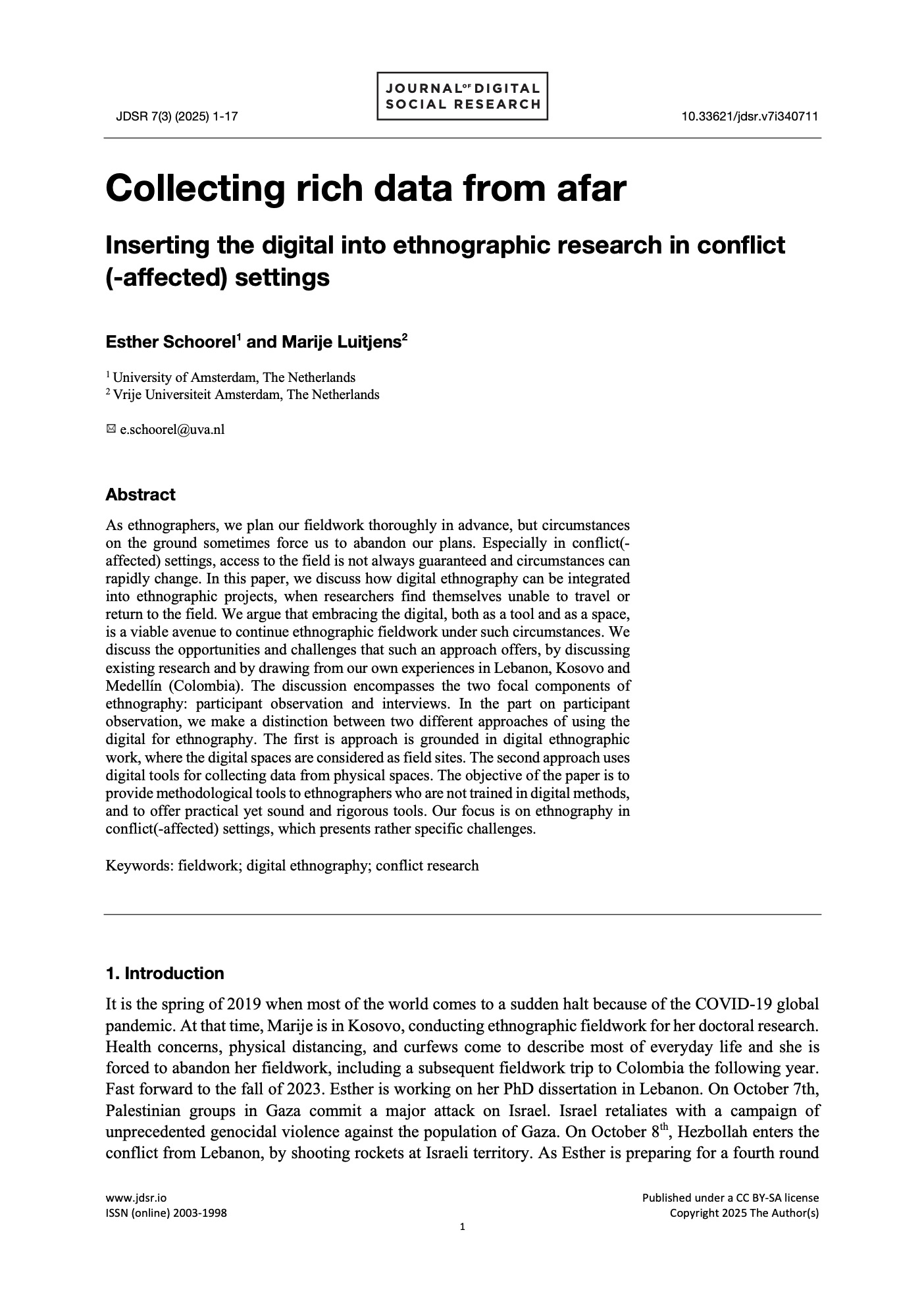
As ethnographers, we plan our fieldwork thoroughly in advance, but circumstances on the ground sometimes force us to abandon our plans. Especially in conflict(-affected) settings, access to the field is not always guaranteed and circumstances can rapidly change. In this paper, we discuss how digital ethnography can be integrated into ethnographic projects, when researchers find themselves unable to travel or return to the field. We argue that embracing the digital, both as a tool and as a space, is a viable avenue to continue ethnographic fieldwork under such circumstances. We discuss the opportunities and challenges that such an approach offers, by discussing existing research and by drawing from our own experiences in Lebanon, Kosovo and Medellín (Colombia). The discussion encompasses the two focal components of ethnography: participant observation and interviews. In the part on participant observation, we make a distinction between two different approaches of using the digital for ethnography. The first is approach is grounded in digital ethnographic work, where the digital spaces are considered as field sites. The second approach uses digital tools for collecting data from physical spaces. The objective of the paper is to provide methodological tools to ethnographers who are not trained in digital methods, and to offer practical yet sound and rigorous tools. Our focus is on ethnography in conflict(-affected) settings, which presents rather specific challenges.
References
Adler, P & P. Adler. (1987). Membership Roles in Field Research. Sage Publications.
Aspect Network. (2021). Research Method: Participatory Mapping. 17 March 2021. https://aspect.ac.uk/resources/research-method-participatory-mapping/ (accessed 9/10/2025).
Beninger, K. (2017). Social Media Users’ Views on the Ethics of Social Media Research. In The SAGE Handbook of Social Media Research Methods (pp. 57–73). https://doi.org/10.4135/9781473983847.n5
Bernard, H. R. (2011). Research Methods in Anthropology: Qualitative and Quantitative Approaches. New York: AltaMira Press.
Bernard, H. R. & Gravlee, C. C. (2015). Handbook of Methods in Cultural Anthropology. Rowman & Littlefield.
Boellstorff, T., Nardi, B., Pearce, C., & Taylor, T. L. (2012). Ethnography and Virtual Worlds: A Handbook of Method. Princeton University Press.
Burrell, J. (2017). The Field Site as a Network: A Strategy for Locating Ethnographic Research. In L. Hjorth, H. Horst, A. Galloway, & G. Bell (Eds.), The Routledge Companion to Digital Ethnography (Issue 2, pp. 51–60). Routledge.
Cochrane, L. & and J. Corbett. Participatory mapmaking. In Handbook of Communication for Development and Social Change (pp.705 - 714).
Copes, H., Tchoula, W., Brookman, F., & Ragland, J. (2018). Photo-Elicitation Interviews with Vulnerable Populations: Practical and Ethical Considerations. Deviant Behavior, 39(4), 475–494. https://doi.org/10.1080/01639625.2017.1407109
Cotter, K. (2021). “Shadowbanning is not a Thing”: Black Box Gaslighting and the Power to Independently Know and Credibly Critique Algorithms. Information Communication and Society. https://doi.org/10.1080/1369118X.2021.1994624
Deakin, H. & K. Wakefield. (2014). Skype interviewing: reflections of two PhD researchers. Qualitative Research, 14(5): https://doi.org/10.1177/1468794113488126
Dong, J. (2017). Chinese elite migrants and formation of new communities in a changing society: An online-offline ethnography. Ethnography, 18(2), 221–239. https://doi.org/10.1177/1466138116674225
Eggeling, K. A. (2023). Embracing the ‘Inverted Commas’, or How COVID-19 Can Show Us New Directions for Ethnographic ‘Fieldwork.’ Qualitative Research, 23(5), 1342–1358. https://doi.org/10.1177/14687941221096594
Emerson, R. M., Fretz, R. I., & Shaw, L. L. (2011). Writing Ethnographic Fieldnotes. The University of Chicago Press.
Evans, J. & P. Jones. (2011). The walking interview: Methodology, Mobility and Place. Applied Geography, 31 (2): 849-858. https://doi.org/10.1016/j.apgeog.2010.09.005
Forberg, P., & Schilt, K. (2023). What is Ethnographic About Digital Ethnography? A Sociological Perspective. In Frontiers in Sociology (Vol. 8). https://doi.org/10.3389/fsoc.2023.1156776
Geertz, C. (1973). Thick Description: Toward an Interpretive Theory of Culture. In The Interpretation of Cultures: Selected Essays (pp. 3–30). Basic Books.
Goffman, E. (1956). The Presentation of Self in Everyday Life. University of Edinburgh.
Gruber, T., Szmigin, I, Reppel, A. & R. Voss. (2008). Designing and Conducting Online Interviews to Investigate Interesting Consumer Phenomena. Qualitative Market Research: An International Journal. 11, 256-274. 10.1108/13522750810879002.
Günel, G., Varma, S., & Watanabe, C. (2020). A Manifesto for Patchwork Ethnography Society for Cultural Anthropology. Member Voices. https://culanth.org/fieldsights/a-manifesto-for-patchwork-ethnography
Guimaraes, M. (2005). Doing Anthropology in Cyberspace: Fieldwork Boundaries and Social Environments. In Virtual Methods: Issues in Social Research on the Internet (pp. 141-56). New York: Berg.
Hine, C. (2015). Ethnography for the Internet: Embedded, Embodied and Everyday. Bloomsbury.
(2000). Virtual ethnography. London: Sage.
Hjorth, L., Horst, H., Galloway, A., & Bell, G. (2017). The Routledge Companion to Digital Ethnography. Routledge.
Howlett, M. (2022). Looking at the ‘Field’ through a Zoom Lens: Methodological Reflections on Conducting Online Research during a Global Pandemic. Qualitative Research, 22(3), 387–402. https://doi.org/10.1177/1468794120985691
Jones, M. O. (2022). Digital Authoritarianism in the Middle East Deception, Disinformation and Social Media. Hurst.
Jorgensen, D. (1989). Participant Observation. Sage Publications.
Käihkö, I. (2021). Conflict Ethnography Goes Online: Chatnography of the Ukrainian Volunteer Battalions. In The Companion to Peace and Conflict Fieldwork, (pp. 207-221). Palgrave Macmillan.
Karen O, & Reilly. (2005). Ethnographic Methods. Routledge.
Kavanaugh, P. R., & Maratea, R. J. (2020). Digital Ethnography in an Age of Information Warfare: Notes from the Field. Journal of Contemporary Ethnography, 49(1), 3–26. https://doi.org/10.1177/0891241619854123
Kim, J., Williams, S., Eldridge, E., & Reinke, A. J. (2023). Digitally Shaped Ethnographic Relationships during a Global Pandemic and Beyond. Qualitative Research, 23(3), 809-824. https://doi.org/10.1177/14687941211052275
Kinney, P. (2017). Walking Interviews. Social Research Update (67).
Kingsolver, A., Boissière, M., Padmanaba, M., Sadjunin, E. & S. Balasundaram. (2017). Cultural and Participatory Mapping. In Mapping Across Academia (pp. 305-322). Springer: Dordrecht.
Kozinets, R. V., & Gambetti, R. (2021). Netnography Unlimited: Understanding Technoculture Using Qualitative Social Media Research. Routledge. https://doi.org/10.4324/9781003001430
Kozinets, R. (2015). Netnography Redefined. Sage Publications.
Kozinets, R. V. (2020). Netnography Today A Call to Evolve, Embrace, Energize, and Electrify. In Netnography Unlimited, p. 3-23. Routledge. https://doi.org/10.4324/9781003001430
Kozinets, R. (2021). “Deep Surfing”: And, Behold, at Last, the Mighty Immersion Journal—Part 4 of 4. Sage Research Methods Community, June 28 2021. https://researchmethodscommunity.sagepub.com/blog/deep-surfing-and-behold-at-last-the-mighty-immersion-journal-part-4-of-4 (accessed 9/10/2025).
Kuznar, L. & O. Werner. (2001). Ethnographic mapmaking: Part 2: Practical concerns and triangulation. Field Methods 13(3): 291-96.
Mann, C. & F. Stewart. (2000). Internet Communication and Qualitative Research: A Handbook for Researching Online. SAGE Publications.
Marcus, G. E. (1995). Ethnography in/of the World System: The Emergence of Multi-Sited Ethnography. Annual Review of Anthropology, 24, 95–117.
Markham, A. N. (2005). The Methods, Politics and Ethics of Representation in Online Ethnography. In Handbook of Qualitative Research (pp. 793–820).
Michaelsen, M., & Glasius, M. (2018). Authoritarian Practices in the Digital Age: Introduction. http://dare.uva.nl
Miller, D. (2018). Digital Anthropology. Cambridge Encyclopedia of Anthropology. https://doi.org/10.29164/18digital
Musante, K. (2015). Participant Observation. In Handbook of Methods in Cultural Anthropology (pp. 251 - 292).
O’Connor, H. & C. Madge. (2017). Online interviewing. In The SAGE Handbook of Online Research Methods (pp. 416–434). London: SAGE Publications.
Pink, S., Horst, H., Postill, J., Hjorth, L., Lewis, T., & Tacchi, J. (2016). Digital Ethnography: Principles and Practice. SAGE.
Poell, T. (2015). Social Media Activism and State Censorship. In D. Trottier & C. Fuchs (Eds.), Social Media, Politics and the State : Protests, Revolutions, Riots, Crime and Policing in the Age of Facebook, Twitter and YouTube (pp. 189–206). Routledge.
Proietti, L. (2024). From Online to Offline: Getting Ready for In-Person Fieldwork through Social Media Ethnography. Possibility Studies & Society. https://doi.org/10.1177/27538699241244418
Richard, V. & Lahman, M. (2014). Photo-Elicitation: Reflexivity on Method, Analysis, and Graphic Portraits. International Journal of Research & Method in Education, 38(1), 3–22. https://doi.org/10.1080/1743727X.2013.843073
Salmons, J. (2015). Qualitative Interviews Online: Strategies, Design, and Skills. Sage Publications.
Spradley, J. (1980). Participant Observation. Holt, Rinehart and Winston.
Sullivan, J. (2012). Skype: An Appropriate Method of Data Collection for Qualitative Interviews? Hilltop Review 6(1): 10
Townsend, L., Wallace, C., & Harte, D. (2016). Social Media Research: A Guide to Ethics.
Downloads
Published
Issue
Section
License
Copyright (c) 2025 Esther Schoorel, Marije Luitjens

This work is licensed under a Creative Commons Attribution-ShareAlike 4.0 International License.