
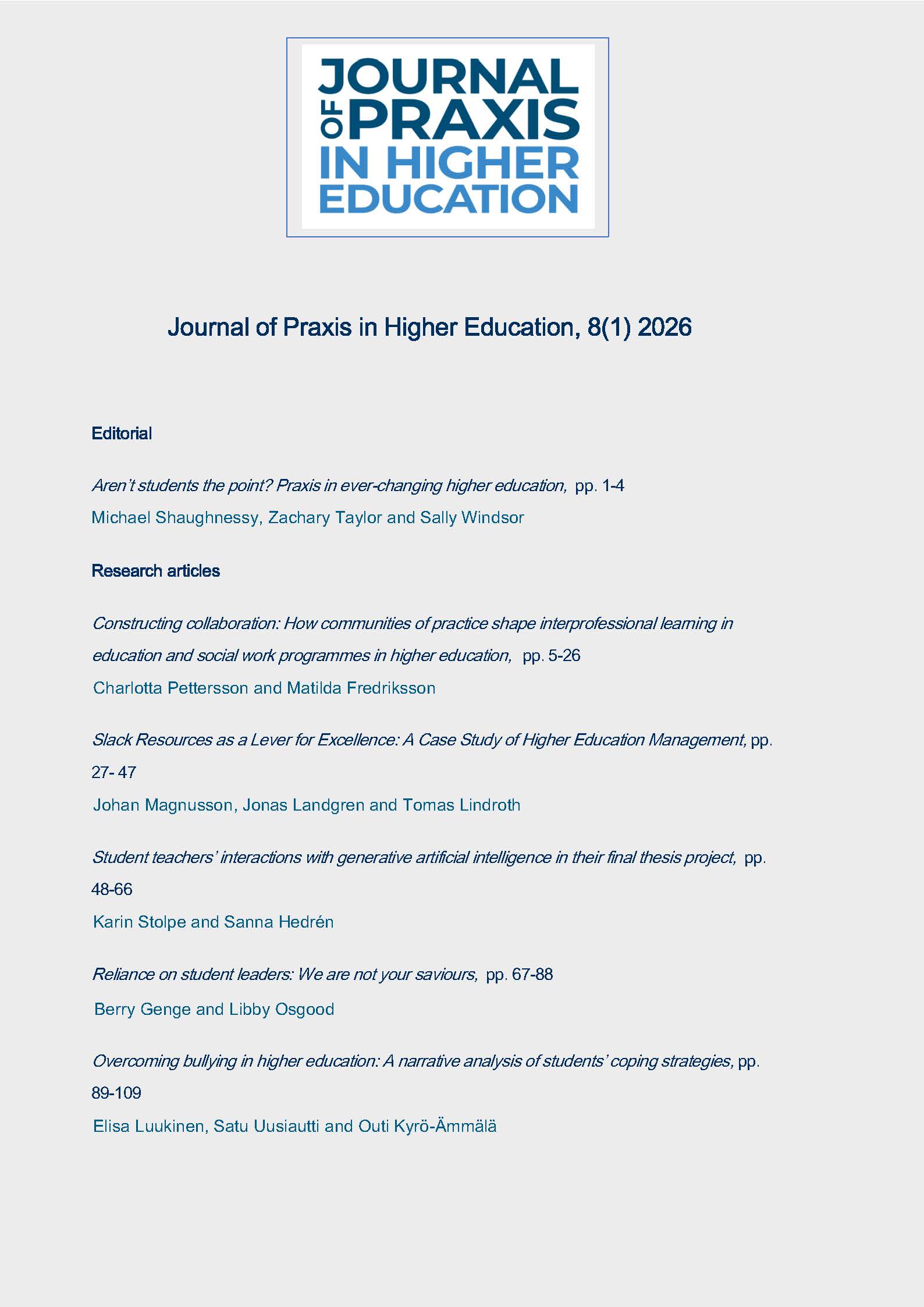
Reliance on student leaders: We are not your saviours
DOI:
https://doi.org/10.63223/jphe.2026.54849Keywords:
critical theory, higher education, saviourism, student leadership, sustainabilityAbstract
While student leadership is often celebrated as a developmental opportunity, there can be an emotional toll on the leaders and commodification of their efforts. Further, relying on student leaders to address gaps or barriers is unsustainable given the short duration students spend in higher education. Using thematic analysis of micro-case studies from award-winning student leaders across Canada and applying Smyth's critical reflection framework to a student leader’s lived experience, this paper critiques how institutions showcase student success while turning a blind eye to the structural problems that necessitate student intervention. Theoretical frameworks—including Sanford’s theory of challenge and support, institutional betrayal, and the student-customer model— paired with a critical theory lens reveal the misalignment between institutional recognition and meaningful support. While acknowledging the socio-historical contexts of higher educational systems, this paper suggests that without institutional accountability and sustainable collaboration, student leaders are unfairly burdened with responsibilities they are not equipped or positioned to carry long-term. The paper argues for a shift in responsibility from students to institutions to ensure systemic change, authentic recognition, and removing of saviourism.
Downloads
Published
How to Cite
Issue
Section
License
Copyright (c) 2026 Berry Genge, Libby Osgood

This work is licensed under a Creative Commons Attribution-NonCommercial-NoDerivatives 4.0 International License.

